Apple tree Gornist: characteristics of the variety and care
| Color | Reds |
|---|---|
| Ripening season | Summer |
| Size of apples | Average |
| Taste | Sweet and sour |
| Crown type | Tall tree |
| Shelf life | Low shelf life |
| Application | For recycling , Fresh |
| Winter hardiness | High winter hardiness |
| Fruiting age | From 5 years old |
 History of origin and regions of growth
Growing regions
- Ural.
Origin
Work on developing this variety began in the late 1980s. Leonid Andreevich Kotov, a renowned Russian-Soviet breeder, conducted two main stages of selection at the Sverdlovsk Experimental Horticultural Station. First, hybrid seedling No. 2-8-2 was obtained by pollinating the Cinnamon Striped variety with Ural varieties. This was then open-pollinated, resulting in the creation of an entirely new variety, named Gornist.
Around the end of the 1990s, the apple tree was sent to various farms for practical testing, which it passed with great success. In 2000, the variety was classified as elite, Vesen, in the State Register, and by 2002, it was zoned for the Ural region. However, thanks to its outstanding qualities, the trees have also spread to surrounding regions, and with proper care, they even show outstanding performance in Siberia and the Far East.
Content
Description of the apple tree variety Gornist
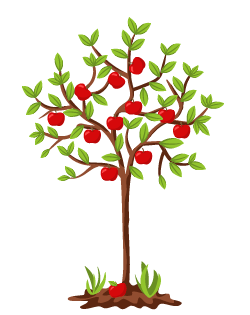 This rather large tree is distinguished not only by its appearance. Despite its slow fruiting, the variety's high yield and consistent fruiting patterns attract many gardeners. The trees exhibit high resistance to low temperatures, high humidity, and various fungal apple infections. It is recommended for cultivation in intensive commercial orchards, as well as in small garden plots.
Apples: What they look like
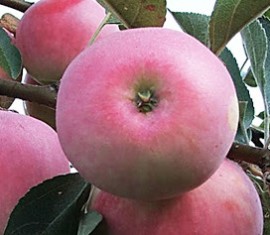
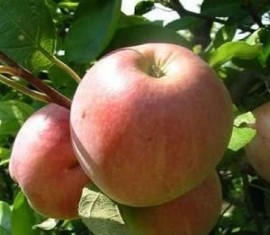
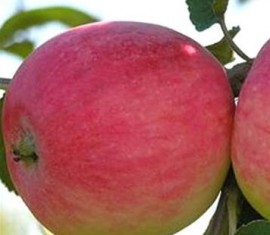
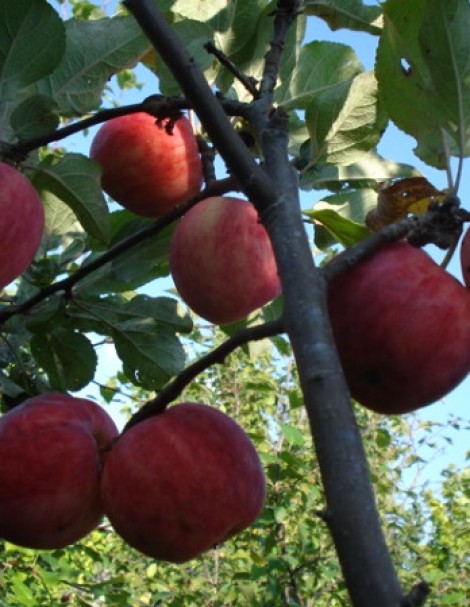
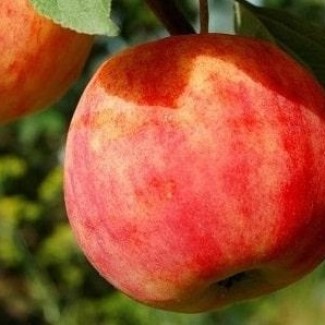
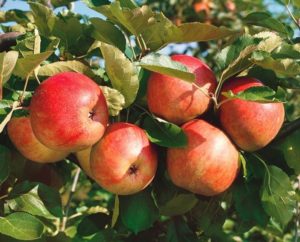 The fruits of this variety are generally small or slightly below average in size. They barely reach 80-120 grams in weight, but compared to Ranetki apples, they appear quite large. The apples are round, slightly oblong, egg-shaped, uniform in size, with subtle ribbing.
The skin is smooth, green or light green, turning a deep dark yellow as it ripens. The blush is a fuzzy, streaky, reddish-brown or reddish-orange color, covering approximately 85-95% of the entire surface. Subcutaneous spots are light, numerous, and clearly visible. The chemical composition is characterized by the following indicators:
- P-active substances (catechins) – 253.9 milligrams.
- Ascorbic acid (vitamin C) – 9 milligrams.
- Total sugars (fructose) – 9.3%.
- Pectins (fiber) – 11.5%.
- Titratable acids – 0.7%.
The flesh of the fruit is initially light green or green, becoming creamy as it ripens. When fully ripe, it may have pink or bright red veins. It is quite juicy, yet coarse-grained and slightly rough, crisp, prickly, sweet and sour, and has a powerful, distinctive aroma. The flavor is considered balanced, harmonious, and dessert-like. According to professional tasting, these apples score 4.4 and 4.5 points out of 5 possible for appearance and taste, respectively.
Apple tree 'Gornist': characteristics
Crown and root system
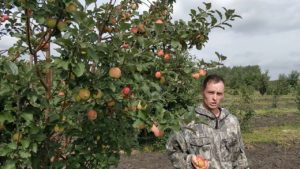 The bugle tree is considered a vigorous growing tree. It can easily grow to a height of 8-10 meters if not pruned in time.When young, the crown is pyramidal or oval, but with age it can become broadly pyramidal and even slightly spreading. The shoots typically branch off from the main trunk at an acute angle, which often leads to their splitting. They are covered with reddish-brown, smooth bark, which can crack and crumble with age. Fruiting occurs primarily on the ring shoots.
The variety's leaves are distinctive, oval or sometimes ovate, short-pointed, and may have a spirally curled tip. They tend to fold into a boat shape, have a heavily pubescent backside, and a finely serrated, wavy margin. The root system is medium-deep, highly branched, and quite robust, and may or may not have a central taproot, depending on the rootstock used.
Productivity and pollination
It can be said that among Ural apple trees, this variety is quite fruitful, but officially it is classified as medium-yielding.
A mature tree typically yields approximately 85-95 kilograms of aromatic fruit, and in good years, even 95-120 kilograms can be harvested with proper care and timely fertilization. The yield per hectare is at least 100 centners of apples.
The Gornist is self-sterile, or, as they say, self-sterile. This means that if there are no other varieties within 50-150 meters that flower at the same time, no harvest can be expected. Experienced gardeners plant the Gornist near other plantings, and to improve pollination, they place the garden near an apiary or use mobile apiaries.
Winter hardiness and disease resistance
This tree is very undemanding and adapts well to damp, cool weather throughout the summer. In winter, it can withstand extended periods when temperatures drop below -30 to -33°C, putting it almost on par with the Gorno-Altaisk or Uralsk trees. However, young seedlings must be protected from the cold, and most importantly, from drafts and strong winds.
Gornist is also quite resistant to infectious fungal diseases, which afflict most Ural apple trees. Even during years of severe epiphytotics, the variety remains relatively uninfected. scab The risk is extremely minimal. However, if the disease does catch on, both the leaves and the fruit will be affected. However, this happens extremely rarely, no more than once in a thousand cases.
Rootstocks and subspecies
| Subspecies | Description |
| Standard | This tree, which grows on a standard rootstock, is considered an ornamental tree. It grows no more than 2.5-3 meters in height, significantly different from the parent variety. It has an unusually domed crown, high yields (over 110 kilograms per mature tree), and early maturity (up to 5 years). |
| Dwarf | In this variant, the apple tree grows even smaller, no more than 2.5 meters in height, but more often around 1.5-2 meters. Interestingly, these trees are even more frost-resistant, and they begin bearing fruit around the second or third year of life. They are recommended for cultivation in almost any region of our country, with the exception of the Far North and the Far East. |
Features of growing the Gornist
 Landing
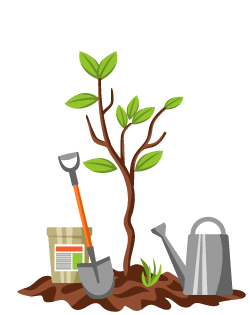 Landing
Basic conditions
- Like all apple trees, the Gornist prefers sunny, open sites with full sun exposure throughout the day. However, it can tolerate some shade as well. The key is avoiding strong winds, especially for young trees.
- Nearby groundwater is not the best environment for this variety's root system. Its deep roots can easily reach water tables higher than 2.5 meters. Planting trees directly near open water bodies, floodplain depressions, and lowlands is also not recommended.
- The distance between apple trees in the orchard should be at least 5-6 meters to prevent their crowns from clashing with each other in the future. 4.5-5 meters between rows is sufficient.
- The holes can be prepared in advance, or just 2-3 weeks before planting. To do this, dig holes 80 centimeters deep and the same diameter with vertical sides. Add soil and fertilizer to the bottom, followed by a thin (10-15 centimeter) layer of drainage material (gravel, broken brick, or nut shells). The entire hole is filled with 20 liters of water and left uncovered in the open air.
- The root collar of the Gornist must protrude above the soil surface by at least 8-12 centimeters to prevent the tree from rooting above it. Otherwise, all the original properties of the rootstock may be lost.
- Before planting, it would be a good idea to first inspect the roots, cut off any damaged, dry, or diseased ones, and soak the tree in warm water for 4-6 hours.
- Stakes are immediately driven into the holes for tying, which cannot be removed for the first 2-3 years.
- Place the seedling directly on the drainage layer, cover with soil, lightly compacting it in layers with your hands. All that's left to do is water the trees with 40-50 liters of water, and mulch the surface with chopped grass, compost, humus, or whatever else is on hand.
Landing dates
This variety can be planted in either spring or fall, with the latter option considered more suitable by gardeners. This should be done approximately 2-3 weeks before the first frost. This will typically be around the last ten days of September or early October. Closed-root material, in pots or bags that don't require disposal, can be planted outdoors at any time throughout the growing season; it should establish without any problems.
Protection from frost and rodents
Even though honeycomb is considered winter-hardy, it still requires protection during cold weather, especially in the early stages. Young seedlings can be wrapped in burlap, agrofibre, roofing felt, or even old tights. The root zone can be covered with mats and straw or dry grass, and 10-15 centimeters of soil can be piled up.
To prevent insects from settling at the tree's roots, the trunk should be whitewashed with lime in the spring and fall, covering a depth of approximately 1-1.2 meters. To protect against hungry rodents during the winter, greasing the trunk with grease or even regular lard is very effective.
Tree care
 Tree care
Loosening the soil, watering: proper agricultural technology
This plant is considered one of the least demanding in terms of care. It doesn't require constant soil loosening, watering, or fertilizing. However, all these measures are worth implementing if the goal is to achieve high yields. Annual digging around the trunk and removing weeds, root suckers, and shoots from other trees and shrubs will be sufficient.
Watering won't hurt if the weather is hot and dry. However, it's crucial not to overdo it. For example, if the summer temperature is 27-29°C and there has been no precipitation for 10 days, it's worth applying 30-40 liters of water to one mature tree twice, morning and evening. Along with watering, you can also lightly fertilize; apple trees respond particularly well to nitrogen fertilizers.
Pruning: simple crown shaping
The Gornist's crown is quite spreading, but not prone to excessive thickening. Therefore, regular formative pruning will be necessary, but it shouldn't be too difficult. A sparse, tiered style is optimal, with branches spaced widely apart in steps. It's also important to regularly remove old, diseased, or dead shoots. From 15 to 18 years of age, trees can be rejuvenated by removing 2-3 mature branches.
Pollinator varieties
Reproduction
- Clones (layering).
- Rooting cuttings.
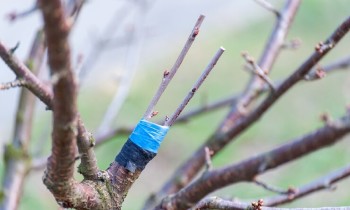
- Grafting by buds and cuttings.
- Growing from seeds.
Diseases and pests
- Fruit rot.
- Milky dew.
- Tinder fungus.
- Moniliosis.
- Hawthorn.
- Codling moth.
Ripening and fruiting of the Hornist
The beginning of fruiting
 The beginning of fruiting
Gornist can't be considered an early-bearing variety, as it begins to bear fruit for the first time around 6-8 years old. Dwarf and standard varieties may produce apples slightly earlier, but the trees will still not produce a full harvest. The variety's optimal reproductive period is considered to be over 50-55 years, after which yields rapidly decline.
Flowering time
Apple trees begin blooming around mid-May, like most other varieties. Therefore, pollinators are usually unaffected. The blooming period lasts on average 12-16 days, allowing for effective cross-pollination. The flowers are very large, have a powerful, distinctive fragrance, and are pure white, sometimes with a light green undertone.
Fruiting and growth
The apple tree begins to gain momentum quite quickly, despite the late start of fruiting. In just 5-7 years, it will reach full strength and produce the expected 120 kilograms of fruit with proper care. At the same time, it grows foliage very quickly, at least 30-50 centimeters per year.
This variety is considered a summer or early autumn variety, meaning the first ripe apples can be picked from the branches as early as late August or early September. The apples hold well on the branches, so don't rush to avoid missing the harvest deadline. However, they won't last long. They retain their nutritional value for a maximum of 3-4 weeks, after which they begin to become soft, wilted, tasteless, and sour. Therefore, it's best to process them completely by this time.
Top dressing
- Nitrogen fertilizers.
- Mineral complexes.
- Peat.
- Compost.
- Manure.
- Humus.
What to do if it doesn't bloom or bear fruit
- Check for pests and diseases.
- Transplant.
- Limit or activate watering.
Why do apples fall?
- Natural factors.
- Pests.
- Diseases.
- Excess moisture.
Leave your feedback on the winter-hardy variety Gornist to share your experience and knowledge with others.