Apple tree Mayak Zagorje: characteristics of the variety and care
| Color | Reds |
|---|---|
| Ripening season | Autumn |
| Size of apples | Average |
| Taste | Sweet and sour |
| Crown type | Average tree height |
| Shelf life | High shelf life |
| Application | Universal variety |
| Winter hardiness | High winter hardiness |
| Fruiting age | Up to 5 years |
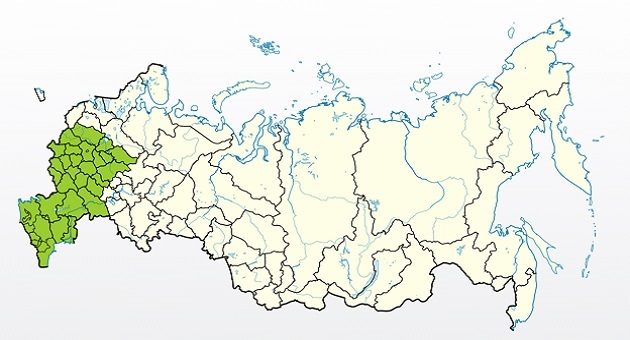 History of origin and regions of growth
Growing regions
- North Caucasus.
- Crimea.
- Middle zone.
- Some northern regions.
Origin
Mayak Zagor'ya is considered one of the new varieties. Work on it began in the early 1990s, when the renowned breeder Viktor Valer'yanovich Kichina began working on it at the experimental station of the All-Russian Institute of Selection and Technology of Horticulture and Nursery. It was obtained by crossing and subsequently open-pollinating the Mayak, Delicious Golden, and Stark Spur varieties.
At the beginning of the new century, the variety was classified as elite and sent for field trials to various farms across the country. Gardeners immediately appreciated the merits of this autumn apple tree, but it became most widespread in the mild climates of Crimea and the North Caucasus. It is successfully grown in the central part of the country and in some more northern regions, such as the Leningrad region. In 2008, it was included in the State Register and zoned for the Central Region.
Content
Description of the apple tree variety Mayak Zagorye
 You can expect significant resistance to low temperatures, hardiness, undemanding nature, and consistently high fruit production. The trees require little care, yet still delight with abundant, delicious fruit. They are recommended for growing in both small garden plots and intensive commercial orchards.
Apples: What they look like
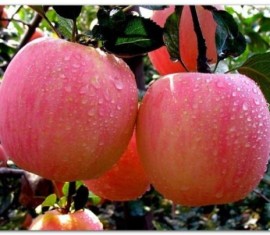
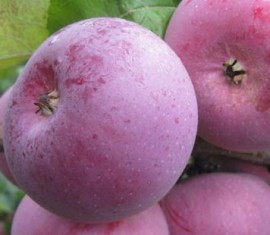
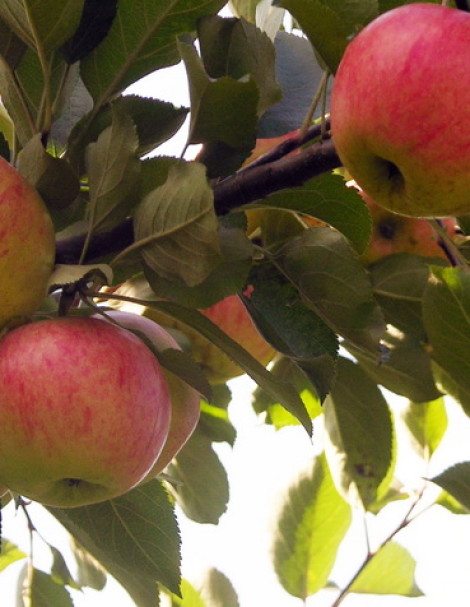
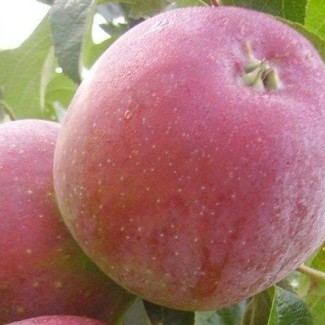
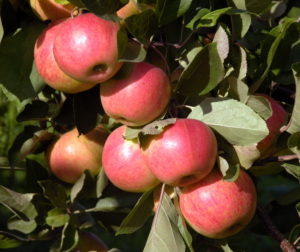 The fruit is generally medium to above average in size, reaching approximately 170-200 grams. Not uniform in size, the tree can produce small, medium, and large apples. The fruits are round, sometimes slightly tapered, with noticeable ribbing, especially on the sepals; they are flattened, sometimes compressed.
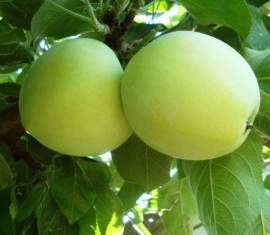
The skin is dense, smooth, and glossy, sometimes covered with a loose oily coating. When unripe, it is green or dark green, turning yellow as it ripens, acquiring a honey-colored or slightly orange hue. The blush covers approximately 70-85% of the surface; it is brick-red or bright red, blurred and streaky, and quite dense. Subcutaneous punctures are few, light gray, small, and not very noticeable. The chemical composition is best characterized by the following indicators per 100 grams:
- P-active substances (catechins) – 113 milligrams.
- Ascorbic acid (vitamin C) – 9.2 milligrams.
- Total sugars (fructose) – 13.1%.
- Pectins (fiber) – 9.6%.
- Titratable acids – 0.49%.
The apple flesh is initially greenish, but as it ripens, it acquires a slight yellowish or creamy hue. It is prickly, crisp, fine-grained, and truly juicy, with a moderate aroma and a pleasant sweet-and-sour, dessert-like, balanced, and harmonious flavor. Professional tasters rate the apples 4.3 out of 5 for appearance and flavor.
Apple tree Mayak: characteristics
Crown and root system
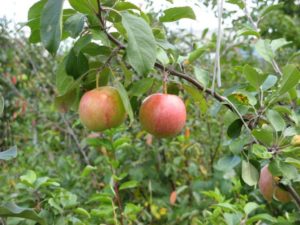 It is officially accepted that Mayak belongs to medium-sized trees, however, the definition of a natural semi-dwarf is most suitable for it. The maximum height of the tree without pruning is approximately 3.5-4 meters. However, most gardeners prefer to limit standard trees to a height of 3 meters, not allowing them to grow any taller. The crown is compact, oval or pyramidal when young, becoming broadly oval and even slightly spreading with age. The shoots are long, straight, brown or reddish-brown, without pubescence, and in most cases branch off from the main trunk at a right angle or close to it.
The leaves are rounded, slightly elongated, and short-pointed, with finely serrated margins, sometimes folded into a boat-like shape. They are leathery, matte, and wrinkled, with active nervation, and may have a sparse pubescence on the back. The root system is highly branched and superficial, and may or may not have a central taproot, depending on the rootstock used.
Productivity and pollination
One of the apple tree's advantages is its abundant and regular fruiting, as well as its early maturity. Today, no one wants to wait 8-10 years to harvest, so they choose varieties that yield up to 20-30 kilograms of fruit by the fourth or fifth year.
With minimal care and favorable weather conditions, one mature tree can produce an average of at least 85-100 kilograms of fruit weighing between 160 and 200 grams. The maximum yield is considered to be 160 kilograms, which was harvested in Moscow region in 2010.
The Mayak variety is considered self-pollinating (relatively speaking), meaning even if there are no other apple trees within 50-150 meters, a harvest will still occur. However, the yield will likely barely reach 25-35% of the potential maximum. To achieve a 100% yield, apple trees with suitable flowering times must be nearby. Moving an apiary to the garden during flowering also helps.
Winter hardiness and disease resistance
Mayak is considered to be very cold-tolerant, with temperatures down to -37-40°C (-37--40°F) being completely unaffected. However, there are some caveats. Firstly, the tree trunks cannot withstand severe frosts lasting more than 2-3 weeks in a row, and secondly, they cannot withstand periods of sudden thaws followed by a return. The trees also dislike drafts, so care must be taken to prevent the seedlings from dying.
Mayak has relatively good resistance to arthropod blight, moniliosis, powdery mildew, and other fungal apple diseases. Even in years of severe epidemics, trees often remain unaffected by the disease, especially if all precautions are taken. If they do become infected, it primarily affects the leaves, and the fruit is edible. However, this will need to be determined on a case-by-case basis.
Rootstocks and subspecies
This apple variety is most often grown on vegetative standard rootstock. This variety boasts the highest winter hardiness and yield. However, to create an even more compact crown, it can be grown on dwarf and semi-dwarf rootstocks. These trees barely reach 2.5-3 meters in height, but their tolerance to low temperatures drops by about half. There are no columnar Mayaks, so be careful when purchasing.
Growing Mayak Zagorje
 Landing
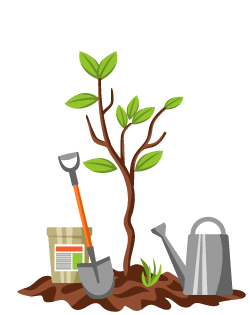 Landing
Basic conditions
- Apple trees prefer locations with full sun throughout the day. Therefore, planting them in the shade is unproductive. It's also a good idea to protect the trunks from winds and drafts on the north side. They are planted under the shelter of fences and hedges, taller plants, the walls of buildings, and on hillsides (not on the north side).
- Trees thrive on moisture, but if the groundwater level is above 2.5 meters, it's best to use a deeper drainage layer. It's not recommended to plant Mayak near rivers, ponds, lakes, wells, floodplains, or marshy areas.
- The variety thrives in chernozem, sod-podzolic soil, loam, and light loam. Sandy loam and sand aren't ideal, but with proper regular fertilizing, the tree can thrive there as well. The key is to keep the soil pH within the standard range for apple trees.
- Dig holes 80 centimeters deep and 90 centimeters in diameter, with steep sides. It's a good idea to add some fertile topsoil mixed with compost or humus to the bottom. Next, add a 15-20 centimeter layer of gravel or broken brick for drainage, and fill the entire hole with 30 liters of water.
- Leave 3-4 meters between trees in a row, and 2.5-3 meters between rows. This will prevent their crowns and rhizomes from clashing in the future.
- Before planting, inspect the root system, cut off all dry, rotten or damaged shoots, and soak them in warm water for 4-8 hours.
- Root collar leave it approximately 5-8 centimeters above the soil surface to prevent the tree from taking root higher.
- Place the seedling on a drainage mound, spreading its roots, and cover it with soil, compacting it lightly with your hands. Create a small mound around the perimeter of the dug circle, pour 20-30 liters of water into it, and mulch the surface with manure or compost.
Experienced gardeners recommend purchasing one-year-old seedlings from nurseries for outdoor planting. They show the best survival rate, develop quickly, and produce good results.
Landing dates
It's believed that Mayak can be planted in either fall or spring, with virtually no impact on the final result. In the former case, it should be done before the sap begins to flow, but the risk of recurrent frosts is already low, around late April or early May. In the latter case, the optimal time is late September or early October, when the first frosts are at least 2-4 weeks away.
Protection from frost and rodents
Despite apple trees' frost resistance, protection is essential, especially in the relatively harsh climate of the temperate zone. If a windy and cold winter is expected, it's a good idea to wrap the trunks with burlap, roofing felt, agrofibre, or old women's tights. The root zone can be covered with a mat of dry grass or straw, leaves, and even a 10-15 centimeter layer of soil.
To prevent insects from hibernating near the rhizomes and then damaging the young foliage, whitewash the trunks with lime at least once a year, but preferably twice – in spring and fall. To repel rodent pests that chew the tender bark of trunks in winter, it is recommended to coat the trunks with grease, lard, or special commercially available solutions.
Tree care
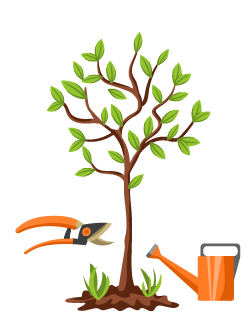 Tree care
Loosening the soil, watering: proper agricultural technology
All apple trees thrive in oxygen-rich soil, so the surface soil should be loosened regularly. Dig it twice a year, but hoe it once a month, although this is not necessary. As the trees mature, the area around the trunk can be covered with sod to prevent weeds from growing, which will be sufficient for the trees to thrive.
Mayak requires significant watering only in extremely dry and hot years. Under normal conditions, approximately 5-6 waterings during the growing season are sufficient. However, if there is no rain for a long time, water the trees once every ten days, especially during flowering, fruit set, and ripening. Around September (the first or second ten-day period), all watering should be stopped completely; otherwise, the apple tree will not have time to prepare for winter and may die.
Pruning: simple crown shaping
The variety's annual growth is modest, so pruning is not necessary. The first formation occurs the year it is planted in open ground. It is sufficient to leave 2-3 skeletal branches, which should be 5-7 centimeters shorter than the main trunk. The central trunk can be trimmed by a third to create a compact crown and prevent the tree from growing too tall.
The main concern going forward will be sanitary pruning, which is performed in spring and fall. At this time, all dry, damaged, or diseased shoots are removed. At 10-15 years of age, rejuvenation can be performed by removing 2-3 mature branches. This type of pruning should be done approximately every 2-4 years.
Reproduction
- Clones (layering).
- Rooting by cuttings.
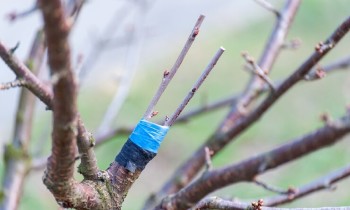
- Grafting by cuttings or buds.
Diseases and pests
- Powdery mildew.
- Scab.
- Cytosporosis.
- Moniliosis.
- Spotting.
- Green aphid.
- Copperhead.
- Weevil.
- Flower beetle.
- Codling moth.
Ripening and fruiting of Mayak Zagorje
The beginning of fruiting
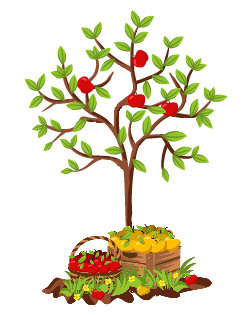 The beginning of fruiting
Flowers appear already in the nursery in the first year of life, but they should be plucked immediately and the same procedure should be followed until the 4th-5th year, when it will be possible to harvest a significant crop (5-10 kilograms).
Flowering time
Mayak's buds begin to open in the first or second ten days of May. However, due to weather or climate conditions, this may shift slightly. Blooming lasts up to three weeks. The flowers are medium-sized, saucer-shaped, with large petals and prominent stamens, snow-white or slightly pinkish. The fragrance during blooming is slight.
Fruiting and growth
The variety can grow no more than 10-15 centimeters per year, so it gains height slowly. The process accelerates until the first fruiting, but then slows down. Therefore, you'll have to wait about 12-15 years for the tree to reach full growth. However, during this time, it can surprise you with its vigorous fruiting. By the 7th-9th year, the branches will be ready to harvest a full, maximum crop, and by the 10th-12th year, the full harvest will be ready.
Harvesting begins around mid-October, when the apples reach technical maturity. However, there's no need to rush; they cling firmly to the branches and don't fall off when overripe. Consumer maturity occurs later, after about 1-1.5 months, when all the sugars have caramelized, and the apples become sweeter and more pleasant. Under suitable conditions, the fruit can be stored until spring without losing its properties or quality.
Top dressing
- Superphosphate.
- Mineral complexes.
- Ammonium sulfate.
- Peat.
- Compost.
- Humus.
What to do if it doesn't bloom or bear fruit
- Check for pests and diseases.
- Transplant.
- Feed.
Why do apples fall?
- Natural factors.
- Pests.
- Diseases.
Leave your own reviews of the Mayak Zagor'ya variety to share your experience and knowledge with other gardeners.