Pobeda apple tree: characteristics of the variety and care
| Color | Greens |
|---|---|
| Ripening season | Winter |
| Size of apples | Average |
| Taste | Sweet and sour |
| Crown type | Tall tree |
| Shelf life | High shelf life |
| Application | Universal variety |
| Winter hardiness | Low winter hardiness |
| Fruiting age | From 5 years old |
 History of origin and regions of growth
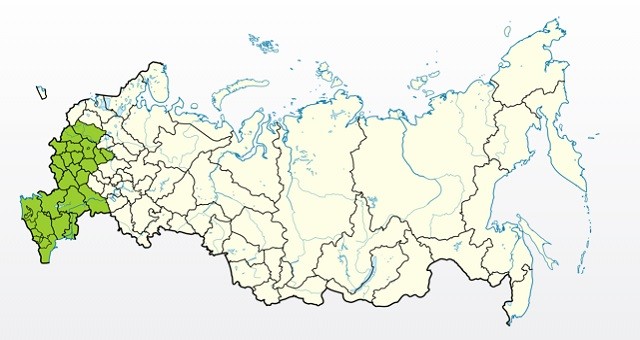
Growing regions
- Middle zone.
- North Caucasus.
- Crimea.
Origin
In the first half of the twentieth century, Russian-Soviet apple breeder Semyon Fedorovich Chernenko, a researcher, breeder, and author of the famous "apple" planting calendar, experimented with the London Pepin and Antonovka varieties. Around 1927, a new hybrid was developed, given the striking and beautiful name "Pobeda."
The new variety was immediately sent for testing in the Oryol, Tula, Voronezh, Kursk, Vladimir, and other regions. It was discovered that the apple trees thrive in chernozem soils, provided the weather conditions are fairly mild. In any other conditions, growing Pobeda becomes problematic and requires extensive maintenance. The variety is considered old, is not listed in the State Register, and has no official zoning.
Content
Description of the Pobeda apple variety
 Since the apple tree is not listed in the State Register, every gardener plants it at their own risk. Therefore, it's a good idea to research all the characteristics and descriptions of the variety in advance. This vigorous tree is primarily attractive for its abundant and regular fruiting without dormancy, producing large, beautiful, and delicious fruits with a distinct sweetness. However, Pobeda cannot boast of early fruiting, long shelf life, or frost resistance. Due to its extreme unpredictability, it is recommended exclusively for small home gardens.
Apples: What they look like
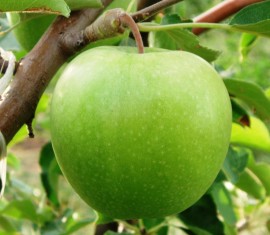
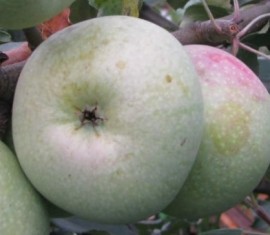
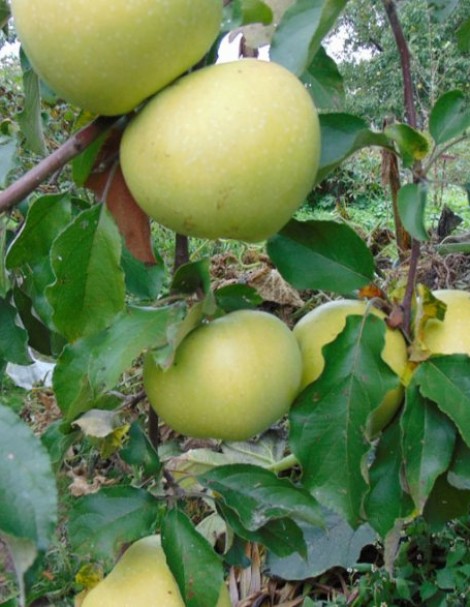
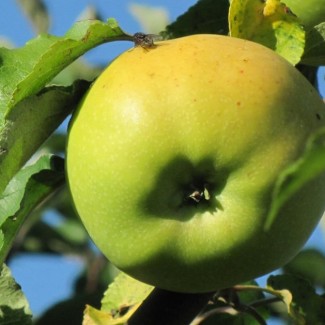
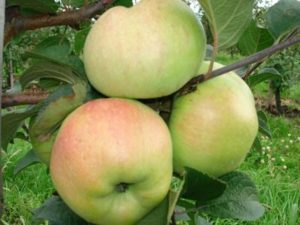 This variety produces fairly large fruits, easily reaching 180-230 grams. Some can even reach 250 and 300 grams, but these are rare. They are round, slightly flattened, with ribbing barely visible to the naked eye. The skin is thin, yet strong and elastic, making them suitable for transportation. It is smooth, glossy, covered with a dense waxy coating, dark green when unripe, but lightens as they ripen, becoming light green, then greenish-yellow or even light yellow.
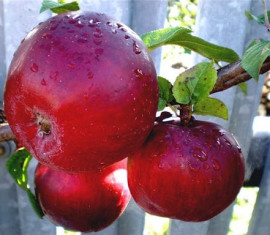
The blush may appear as blurred, pale pink spots on the sun-exposed side, but it's barely noticeable. Subcutaneous spots are numerous, light, and difficult to see. The chemical composition can be characterized by the following indicators, calculated per 100 grams of product:
- P-active substances (catechins) – 1238 milligrams.
- Ascorbic acid (vitamin C) – 12.3 milligrams.
- Total sugars (fructose) – 9.8%.
- Pectins (fiber) – 11.4%.
- Titratable acids – 0.57%.
The Pobeda fruit's flesh is juicy, medium-grained, crisp, prickly, and quite firm. It's quite tender, with a slightly creamy or yellowish hue when ripe, and has a pleasant sweet and sour flavor. It's considered harmonious, balanced, and a dessert fruit. Professional tasters have rated it 4.2 points for appearance and flavor on a 5-point scale.
Apple tree Pobeda: characteristics
Crown and root system
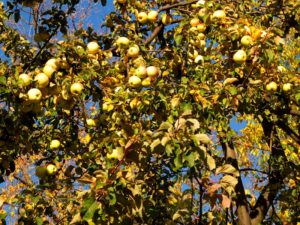 It is a tall tree that can easily reach 6-7 meters or more in height without pruning. Moreover, it grows tall quite quickly, and within five years can easily become the tallest tree in your garden. The crown of young seedlings is oval or even pyramidal, but over the years it increasingly resembles a dome or a sphere. The tree is not prone to excessive density, and its branches are spaced widely apart. Although they usually extend from the trunk at an acute angle, they rarely break off, as they are very firmly anchored.
The bark of the shoots is reddish-brown or brownish-brown, which can turn brown with age, cracking, and falling off. The leaves on the branches are large, oval, slightly elongated, rich green, leathery, glossy, and shiny. They are often folded like a boat, have a finely serrated edge, and a short, pointed tip. Light down may be visible on the underside. The root system is robust, highly branched, and deep enough to support such a tall tree in an upright position.
Productivity and pollination
Although flowers may appear on the branches as early as the second or third year, their number is quite small. They are usually picked immediately. This variety cannot be called early-bearing; it will not produce its first harvest until the sixth or eighth year after planting in open ground.
A mature Pobeda tree can produce approximately 100-120 kilograms of fruit by the age of 10. Over the next 3-5 years, fruit production will increase slightly, reaching 120-130 kilograms, which can be considered its absolute maximum.
The variety is considered conditionally self-fertile. This means you'll regularly harvest some apples even when there are no other varieties within 50-150 meters that are suitable for pollination due to their flowering time. However, for a good harvest, Pobeda will definitely need to be interplanted with other varieties. It's also a good idea to bring a mobile apiary to the orchard during flowering, or even plant the trees close to one.
Winter hardiness and disease resistance
Some gardeners claim that this variety has average or even above-average resistance to low temperatures. However, this isn't entirely true. In the mild Crimean or South Caucasian climates, in the south of our country, they still require protection from frost, while in the changeable temperate climate, every effort will be required to protect your trees from frost.
The variety is moderately resistant to apple tree infectious diseases. With proper and timely care, it will likely avoid infection. However, in particularly dangerous, wet years, it can be attacked very quickly and heavily. Often, after an attack, trees are simply unable to recover.
Rootstocks and subspecies
Pobeda is traditionally grown on vegetative and standard rootstocks, as well as on dwarf and semi-dwarf varieties. Because it is considered unpromising, no subspecies have been developed, and there is no columnar subvariety.
Features of growing Pobeda
 Landing
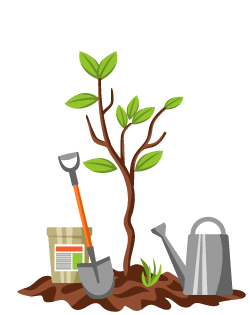 Landing
Basic conditions
- The variety thrives in flat, rock-free areas, well-lit by the sun, but sheltered from strong winds and especially drafts.
- Soil The apple tree must be fertile, otherwise it will not bear fruit and may even refuse to bloom.
- Groundwater should be no closer than 1.5-2 meters below the soil surface, otherwise Pobeda will inevitably reach it with its powerful roots and begin to rot. Near a lake, river, pond, well, in a lowland where meltwater accumulates, or in a floodplain depression are also far from ideal locations.
- You can prepare planting holes in advance, about six months in advance, or just one to three weeks in advance. Dig holes 1 meter in diameter and 80 centimeters deep, fill the bottom with soil mixed with fertilizer (humus, compost, manure), then add 12-15 centimeters of drainage material (gravel, broken brick, stones, vermiculite), add 30-40 liters of water, and leave uncovered.
- Stakes are driven into the holes immediately, facing north relative to the seedling. They can be removed 3-4 years after planting.
- The root collar can be left above the surface no lower than 10-15 centimeters, so as not to lose the original properties of the rootstock.
- The distance between trees should be at least 6-7 meters, and between rows 5-6 meters is enough, then the mature trees will not interfere with each other with either crowns or roots.
- Place the seedling directly on the drainage mound, spreading out the roots (it's a good idea to inspect them beforehand, trim off any damaged ones, and soak them in warm water for 3-6 hours). Cover with soil, compacting it by hand. Water the trees with 20-40 liters of water, and mulch the surface with available materials (manure, compost, chopped grass, or humus).
Landing dates
Pobeda is a very delicate apple tree, so planting timing must be carefully considered. Autumn, when the leaves have completely fallen, is acceptable in warm southern regions, but careful timing is required to ensure there are at least 30-40 days before frost. In spring, it's best to plant around the end of April, when the threat of frost has passed.
Protection from frost and rodents
To ensure young seedlings don't perish, maximum effort will be required. Pobeda is typically planted only in mild climates, but the risk of frost is difficult to eliminate. Therefore, it's always important to cover apple trees for the winter. Place mats of hay or dried grass on the root zone, and wrap the trunks with roofing felt, tar paper, burlap, or agrofibre. Young trees can be covered with a tent-like covering.
To repel hungry rodents that love to feast on the juicy bark, it's best to coat the trunks with grease or lard. Commercially available products are also available. To protect trees from insects, whitewash the lower 1-1.5 meters with regular lime.
Tree care
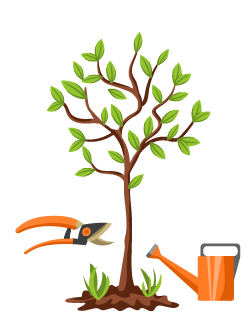 Tree care
Loosening the soil, watering: proper agricultural technology
All apple trees appreciate oxygen-rich soil, and Pobeda is no exception. Therefore, it's a good idea to dig and hoe the soil around the trunk at least twice a year. At the same time, remove weeds, root suckers, and other plant shoots. However, you can hoe and mulch the soil every time you water.
This variety needs adequate watering if you want it to not only grow but also produce a good harvest. Young first- and second-year-old trees require at least six waterings per season. Mature trees will only need three to five waterings. The recommended watering rate is 20 to 40 liters, depending on the tree's size and weather conditions. It's a good idea to fertilize and supplement with watering.
Pruning: simple crown shaping
Formative pruning is most often done in the spring, when it's easy to see which branches are superfluous. The easiest way to achieve this is with a sparse, tiered pruning, where branches are spaced widely apart. Leaving 2-3 skeletal branches in the first year is sufficient. The central stem is shortened by a third, and the shoots should be 5-7 centimeters lower.
Every fall and spring, sanitary pruning should be performed after a thorough inspection. All damaged, diseased, and dead branches should be cut off. Regular removal from the trunk is also a good idea. mushrooms And lichensDon't allow moss to grow. Starting around 10-12 years, you can perform rejuvenating pruning, removing 1-3 mature branches to allow new ones to develop.
Pollinator varieties
- White filling.
- Lobo.
- Grushovka Moscow.
- Welsey.
- Lungwort.
- Quinti.
- Spartan.
- Jonathan.
Reproduction
- Clones (offshoots).
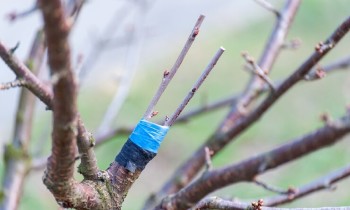
- Grafting by cuttings or buds.
- Rooting cuttings.
Diseases and pests
- Scab.
- Powdery mildew.
- Cytosporosis.
- Moniliosis.
- Scale insect.
- Green aphid.
- Codling moth.
- Hawk moth.
- Scoop.
Ripening and fruiting of Victory
The beginning of fruiting
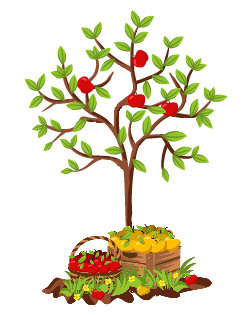 The beginning of fruiting
This variety isn't considered an early-bearing variety, as its first flowers appear approximately 5-6 years after planting in open ground. However, even then, there will be isolated inflorescences, which are best pinched off to allow the tree to establish itself. The first full harvest can be obtained in the 7-9 year. By then, 5-15 kilograms of fragrant green fruit are typically harvested.
Flowering time
Like most apple trees, Pobeda produces buds in mid-May and blooms shortly after. The blooming period lasts no more than 10-14 days, giving pollinating insects time to work on the trees. Pobeda's flowers are large, clustered in small inflorescences. The flowers themselves have large, fleshy petals, saucer-shaped, a snow-white hue, sometimes with a hint of pink or light green, and possess a strong fragrance.
Fruiting and growth
The tree grows green mass quite quickly, at a rate of half a meter per year. Therefore, by the fifth to eighth year, it can easily exceed five meters in height. The key is to prune it correctly, then harvesting and maintenance will be hassle-free. Maximum fruiting can be expected only by the 15th to 20th year. Moreover, the active lifespan of an apple tree reaches at least 75 years or more. These are resilient apple trees, capable of producing fruit for at least a century.
The best time to harvest is late September or even early October. However, care must be taken; it's best to pick the apples immediately as soon as they begin to turn yellow. Otherwise, they may fall to the ground and will need to be processed immediately. Consumer maturity occurs approximately 1-1.5 months after cellaring, when the sugars have fully caramelized. Pobeda apples can be stored without losing their flavor or marketability until approximately March or April.
Top dressing
- Peat.
- Compost.
- Mineral complexes.
- Ammonium sulfate.
- Urea.
- Humus.
- Manure
What to do if it doesn't bloom or bear fruit
- Check for pests and diseases.
- Feed.
- Transplant to a sunnier area.
Why do apples fall?
- Natural factors.
- Overripe.
- Excessive humidity.
- Pests.
- Diseases.
Please leave your own reviews of the Pobeda variety so that other gardeners can learn from your experience.