Moscow Necklace apple tree: characteristics of the variety and care
| Color | Reds |
|---|---|
| Ripening season | Autumn |
| Size of apples | Large |
| Taste | Sweet and sour |
| Crown type | Columnar tree |
| Shelf life | High shelf life |
| Application | Fresh |
| Winter hardiness | High winter hardiness |
| Fruiting age | Up to 5 years |
 History of origin and regions of growth
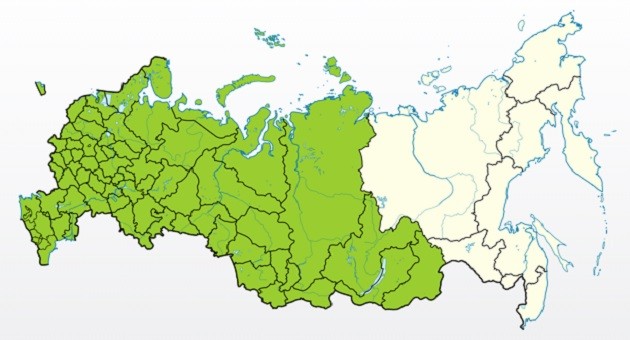
Growing regions
The variety has such high frost resistance that it is successfully cultivated throughout our country, with the exception of the Far North and several Northeastern regions.
Origin
Moskovskoe Ozhelie (Moscow Necklace) is a newly bred variety that is currently in the experimental testing stage and has not yet been included in the State Register or zoned for distribution in the regions.
It was developed from a seedling of another columnar apple tree, an older selection, called "Vozhak." The variety's creator is generally considered to be Mikhail Vitalyevich Katalkin, a pomologist from the Moscow region who works at the "Dvoryanskoye Ozero" nursery.
Content
Description of the Moscow Necklace apple variety
 Columnar apple trees, a relatively recent development, are highly valued by gardeners in our country. These low-growing but highly productive trees are easy to care for and grow, and are also undemanding of weather and climate conditions. The Moscow Necklace, for example, boasts high-quality fruit, resistance to fungal infections, and an enviable tolerance to low temperatures, making it suitable for planting even in Siberia in the Far East.
Apples: What they look like
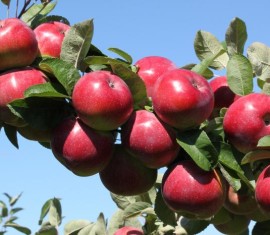
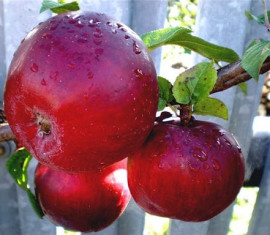
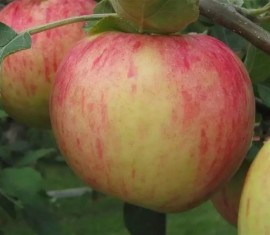
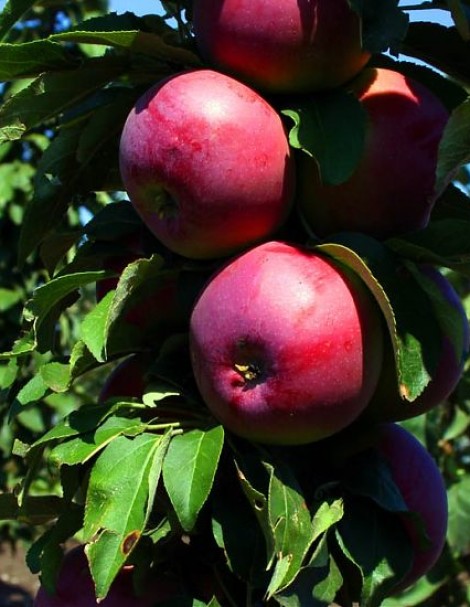
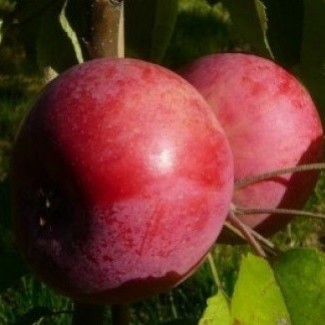
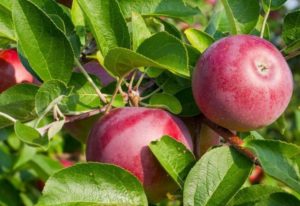 The fruits are usually medium to large in size, irregular in size, rounded, and even spherical, with a single apple weighing between 130 and 240 grams. Ribbing is subtle, and they may be slightly flattened and have a protrusion at the tip.
The skin is dense yet quite thin, smooth, and glossy. Initially, it is dark green, but becomes more yellowish as it ripens. 90-98% of Moskovskoe Olechye apples are covered with a dense, beautiful red blush. The surface has a matte, waxy coating, giving the fruit a bluish tint. The chemical composition can be characterized by several indicators:
- P-active substances (catechins) – 216 milligrams.
- Ascorbic acid (vitamin C) – 11.2 milligrams.
- Total sugars (fructose) – 13%.
- Titratable acids – 0.6%.
The flesh is juicy, prickly, tender, dense, and white or slightly yellowish. It's so fragile that the apples split open on their own when dropped. The flavor is considered harmonious and balanced, reminiscent of a dessert. It's sweeter, but with a bright, tart aftertaste and a mild aroma. The tasting score is only 4.4 out of 5.
Moscow Necklace apple tree: characteristics
Crown and root system
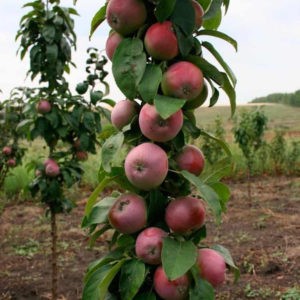 Trees of this variety are considered naturally semi-dwarf. They can reach a maximum height of 2.5-3 meters, which significantly simplifies not only their care but also allows for mechanized harvesting. Crown They are columnar, distinguished by strong, dense foliage, and can reach 0.4-0.7 meters in diameter. The bark on the long, straight shoots is greenish-brown, smooth, and glossy, and may be slightly pubescent, turning slightly brown with age.
The leaves of this variety are large, rounded, elongated, and quite long. They are dense, dark green or just green, smooth, glossy, and leathery. They have slightly serrated edges, and the tips are long and sharp. The tree's root system is also compact, but it is sufficiently branched to search for water in the soil.
Productivity and pollination
No gardener who has grown apple trees for even a few years in a row expects large fruit yields from columnar trees. These trees are quite small and simply cannot produce large quantities of fruit, as only one or, at most, two branches actually bear fruit. However, all these shortcomings are more than compensated for by the overall fruit yield per hectare, which can easily exceed 150-200 tons.
On average, a mature tree can produce no more than 9-12 kilograms of sweet, beautiful apples per year, but this only occurs with careful, regular care. In most cases, the yield does not exceed 7-10 kilograms annually without a rest period.
The Necklace is conditionally (partially) self-fertile, but the percentage of ovaries that can develop through self-pollination is extremely low (2-6%). Therefore, it is essential to plant this variety alternately with other varieties to ensure cross-pollination. It is recommended to bring hives (a portable apiary) into the garden during flowering to make it easier for insects to find trees that don't have a very strong aroma.
Winter hardiness and disease resistance
Bred for harsh conditions Apple trees in the Moscow region They have proven to be remarkably resilient to low temperatures, as well as temperature fluctuations, piercing winds, and unexpected thaws. The trees can easily withstand temperatures as low as -40-42°C without losing their fruit. Moreover, their small crown and compact height allow them to withstand the cold effectively. Therefore, apple trees are recommended for cultivation in virtually any region of our country, including Siberia and the Far East.
The variety also exhibits enviable resistance to various fungal infections and other apple diseases. Therefore, it can be grown with virtually no chemical spraying, simply by regularly performing preventative maintenance such as cleaning the trunk area, whitewashing the trunks, and other gardening routines. This allows for the cultivation of environmentally friendly, healthy fruits.
Rootstocks and subspecies
| Subspecies | Description |
| Crumb (bush) | There's a non-columnar subspecies of the Moscow Necklace that grows as a bush of many shoots, no more than 50-65 centimeters tall. This apple tree is very prolific, producing at least 15-17 kilograms of fruit per year. The apples on these bushes are smaller, but no less tasty and juicy. The hybrid is scab-resistant and winter-hardy, and can be grown even in the Far North. |
| X-2 | This hybrid grows as a columnar tree and can reach a height of 3 meters if unpruned. It begins bearing fruit the second year, producing abundant harvests of 18-20 kilograms of very large apples (up to 250 grams). During fruiting, branches can become heavily laden with fruit, causing them to break, shortening the tree's already short lifespan. Therefore, it is recommended to control the number of ovaries in the spring by removing excess fruit, and then use staking and support. The tree's active lifespan is only 10-15 years. |
Growing Features of Moscow Necklace
 Landing
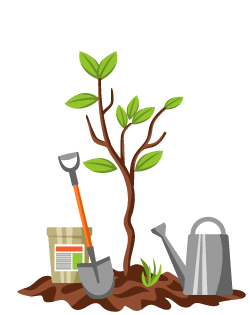 Landing
Basic conditions
- The best soil for this variety is slightly acidic loam or sandy loam mixtures. However, the tree can even be grown in black soil if you add some river sand.
- The location should be well-lit and draft-free. A building wall, a fence, a tall fence, or other mature trees can provide shelter from the wind.
- There's no need to prepare the holes for the Ozherelye plant in advance. You can simply dig the holes a day or two in advance (60 centimeters deep and the same in diameter). Simply mix the soil with compost, and the planting mixture is ready.
- Immediately on the north side, stakes are driven into the holes to tie up the young trees.
- It is enough to leave 0.5 meters of distance between trees, and 1 meter between rows, so they will not conflict with each other.
- A 10-15 centimeter thick drainage layer is placed at the bottom of the hole. Broken brick, vermiculite, gravel, or nut shells can be used for this.
- A seedling is placed on top so that its root collar protrudes a few centimeters above the ground.
- The root system is sprinkled with soil, lightly compacting it, a border of soil is formed around the trunk circle, 30-40 liters of water are poured into it, mulched with compost, chopped grass, and humus.
Landing dates
These apple trees are distinguished by the fact that they begin to bloom within the first year after being planted outdoors. These buds should be removed, but the tree has already initiated all the necessary processes. Therefore, it is recommended to plant the Moscow Necklace in the fall, around late September or early October, after the leaves have completely fallen and the sap flow in the trunk has ceased. This will give the tree much more time to adapt and establish roots.
Protection from frost and rodents
Apple trees are generally resistant to minor temperature fluctuations. Therefore, in mild climates, no measures are necessary to protect them. However, in challenging conditions, where the weather changes dramatically over the course of a few days and temperatures can drop to -45°C, experienced gardeners recommend covering the area around the tree trunks with spruce branches, straw, or hay. The trunks can be wrapped in agrofibre or burlap, or even used as a kind of tent for the apple trees.
To repel hungry rodents during the winter, tree trunks are coated in the fall with a thick layer of melted lard or grease. Whitewashing the trunks with lime will also help repel insects that like to nest in the roots and hibernate there for the winter. This is also recommended to be done in the fall.
Tree care
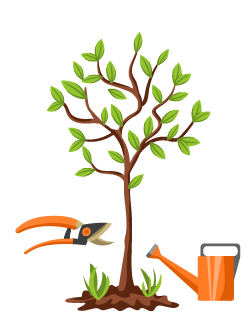 Tree care
Loosening the soil, watering: proper agricultural technology
Weeding and loosening the soil around the Moscow Necklace's trunk are essential to ensure abundant fruiting each year. Weeds, shoots from shrubs and other trees, and root suckers must be regularly removed. Deep digging should be performed once or twice a year, but care must be taken to avoid damaging the roots.
This variety also requires watering and fertilizing, and these should be done regularly. If the summer is dry, water the trees up to twice a week, and apply fertilizer the following day. The key is to do everything in moderation; don't overdo it.
Pruning: simple crown shaping
The first pruning of an apple tree, the formative one, is performed the same year as planting. The main shoot is pruned back to the first fruiting branch, which is then left to bear fruit. This process will subsequently become much more protracted as the fruiting branches grow and age. Sanitary pruning of dry, thin twigs and unnecessary, diseased, or damaged branches is performed annually in the spring or fall.
Pollinator varieties
- President.
- Scarlet Sails.
- Vasyugan.
- Leader.
- Currency.
- President.
Reproduction
- Clones (layering).
- Rooting by cuttings.
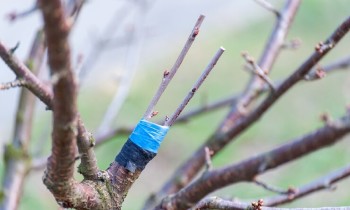
- Grafting by cuttings or buds.
- Growing from seeds.
Diseases and pests
- Powdery mildew And scab (very rarely).
- Cytosporosis.
- Green aphid.
- Leaf roller.
- Flower beetle.
Ripening and fruiting of the Moscow Necklace apple tree
The beginning of fruiting
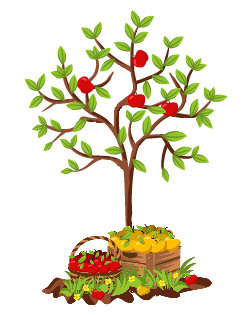 The beginning of fruiting
This is a very early-bearing variety, so in the first year after planting a one-year-old seedling in open ground, you can grow several red, sweet apples. However, gardeners advise preventing this and instead plucking almost all the blossoms during the first two years. Therefore, the official start of fruiting is considered to be 3-4 years after planting, when you can harvest no more than 5-15 apples.
Flowering time
Depending on the growing region and prevailing weather and climate conditions, the Moscow Necklace's blooming period can range from early to mid-May, or even late May. Moreover, it is quite short, lasting only a few days. The flowers are densely packed on the branches, white or slightly pinkish, and have a moderate fragrance.
Growth and fruiting
The apple tree's natural growth is slow, no more than 5-10 centimeters per year, so it sometimes seems as if it's not growing at all. However, this is a semi-crowned apple tree, so don't expect much more. It prefers to gradually increase fruiting. By the sixth to eighth year, a single tree can produce its maximum yield per season. The variety's active life and fruiting lifespan, like most columnar apples, is unlikely to reach 20-25 years, but its apples begin to "run out" after 15 years.
Apples ripen late, around early October, but can be stored as early as late September. They have a fairly good shelf life, as they can easily be stored until spring under the right conditions. However, in a typical cellar, they are best consumed within 2-3 months. Apples are primarily intended for fresh consumption, but if the juices are low and there are still plenty of fruit, they can be processed into juice, jam, or preserves.
Top dressing
- Peat.
- Dolomite powder
- Compost.
- Manure.
- Humus.
- Ammonium nitrate.
- Urea.
- Potash fertilizers.
- Ammonium sulfate.
- Mineral complexes.
What to do if it doesn't bloom or bear fruit
- Transplant.
- Feed.
- Check for diseases or pests.
Why do apples fall?
- Pests.
- Diseases
- Natural weather phenomena.
- Lack of fertilizers.
Please leave your feedback on the Moskovskoe Ozheleziye apple tree in the comments so that any gardener can learn from your experience.