Scarlet Sails apple tree: characteristics of the variety and care
| Color | Reds |
|---|---|
| Ripening season | Autumn |
| Size of apples | Average |
| Taste | Sweet |
| Crown type | Columnar tree , Dwarf |
| Shelf life | Average shelf life |
| Application | Fresh , For recycling |
| Winter hardiness | Average winter hardiness |
| Fruiting age | Up to 5 years |
 History of origin and regions of growth
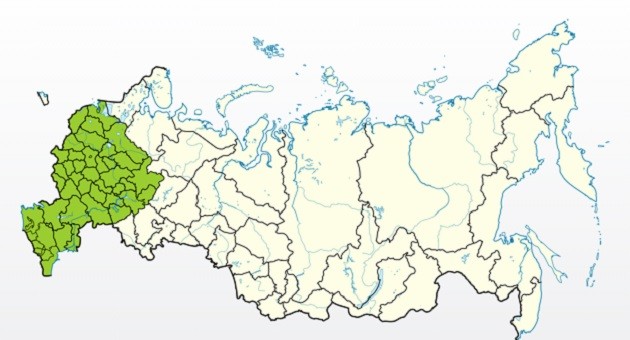
Growing regions
- Middle zone.
- Central Black Earth Region.
- Volga region.
- North Caucasus.
- Some northern regions.
Origin
Work on developing this variety began in the late 1980s. A group of breeders from the Crimean Horticultural Station, through cross-pollination and crossing several frost-resistant varieties, developed a naturally dwarf apple tree.
It was decided to name it Scarlet Sails, because the columnar trees, when fruiting, truly resemble masts with beautiful red panels. The variety was added to the State Register of Ukraine in 1994. Since then, it has successfully spread throughout the former Soviet Union.
Content
Description of the Scarlet Sails apple tree variety
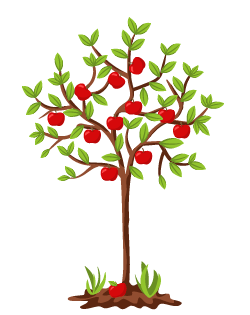 This variety has only recently appeared in our country, and is therefore considered a new variety. It is a columnar apple tree, considered a natural dwarf. This late-summer-ripening, early-fruiting, regular-bearing apple tree is easy to care for and requires no special care, making it a favorite among experienced gardeners. Despite its summer fruiting season, Scarlet Sails apples have an enviable shelf life and produce good yields. Therefore, they are recommended not only for small home gardens but also for commercial intensive orchards.
Apples: What they look like
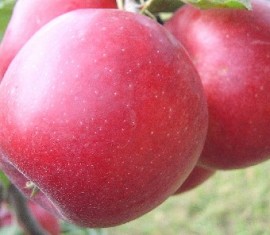
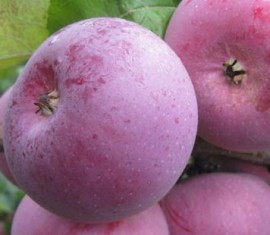
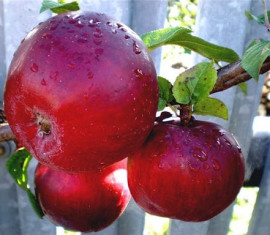
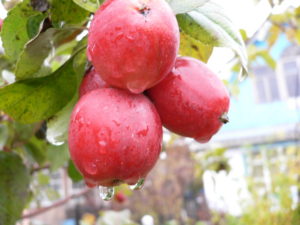 The fruits of this variety are generally medium-sized or even smaller than average, with an average weight of just under 100 grams. The apples are round, but often lopsided, irregularly shaped, often with protrusions and growths, and can be slightly elongated or flattened.
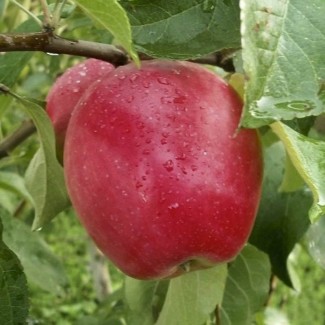
The skin is dense but thin, glossy, green or yellowish-green, and has a waxy coating that gives the apples a bluish tint. As it ripens, it becomes covered with a carmine-red or bright red, streaky, diffuse blush, covering 70-95% of the surface. Subcutaneous light-yellow dots, small but numerous, are clearly visible. The chemical composition is characterized by the following indicators per 100 grams of product:
- P-active substances (catechins) – 264 milligrams.
- Ascorbic acid (vitamin C) – 19.4 milligrams.
- Total sugars (fructose) – 10.8%.
- Pectins (fiber) – 11.6%.
- Titratable acids – 0.47%.
The apple flesh is dense, fine-grained, and has a sweet, honey-like flavor with a slight tart finish. It's crisp but not hard, and breaks easily when bitten. Experts rate the flavor as harmonious, dessert-like, and balanced. The taste score for the appearance of the fruit is 4.6, and for the flavor, 4.7-4.8 out of 5.
Apple tree Scarlet Sails: characteristics
Crown and root system
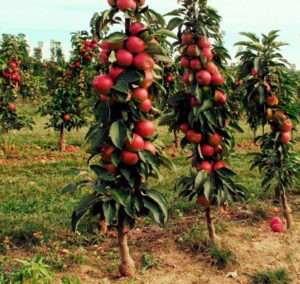 The tree is a columnar tree, so it usually does not grow very tall. It is considered to be of medium height, although it is unlikely that you will find specimens taller than 2.5 meters even in the most favorable conditions. This characteristic makes it a favorite among gardeners, as it allows for very dense plantings. Scarlet sails form a columnar structure consisting of a central stem with no side branches, so they can reach a maximum height of 1-1.5 meters. The bark is usually smooth, reddish-brown or brownish-brown, and may darken and crack slightly over the years.
The leaves of this variety are quite dense and can be light or dark green depending on growing conditions. They are leathery, glossy, or matte, with a light pubescence along the underside. They often have a reddish tint. The leaves are oval, elongated, but not too long. Their edges are slightly serrated and crenate, and the tips are slightly pointed and curve downward. The root system is extensive but rather superficial, which reduces its resistance to low temperatures.
Productivity and pollination
These apple trees produce very abundant fruit; in good years, the entire trunk is literally covered with beautiful red fruits. Compared to Antonovka, they produce only a small amount, weighing only 35-45 kilograms at most.
However, given the compact size of the trees, the overall yield per hectare is only slightly lower. With good care and favorable weather conditions, thrifty growers harvest 50-60 kilograms of apples from Scarlet Sails per season.
The tree was bred to be self-fertile, and indeed, it doesn't need to be near other varieties to produce consistently good harvests. Moreover, it doesn't even need bees; it can pollinate itself with the wind. However, experts still recommend rotating seedlings and maintaining a nearby apiary, as this significantly (by 25-50%) increases the variety's yield.
Winter hardiness and disease resistance
Despite being bred for warmer climates, the tree boasts impressive performance, especially compared to other early-ripening apple trees. The tree can withstand even strong winds and frosts down to -18-20°C without causing significant damage to the fruit. However, if winter lasts long, with frosts lasting more than a month, it's a good idea to cover the trees. Some gardeners claim to grow Scarlet Sails even at -30°C, but they cover them with a tent in the fall.
The variety isn't immune to scab or powdery mildew, but it's quite resistant to fungal infections. With timely preventative measures, such as digging around the trunk, preventing standing water, and preventing rotting of fallen leaves or fruit, there's virtually nothing to worry about. Pests readily damage delicate wood, bark, and apples, but they're easily controlled by treating apple trees with insecticides in a timely manner.
Rootstocks and subspecies
Regardless of the rootstock a variety is grown on, it will retain all the qualities of the parent plant. However, there are several main subspecies that are worth examining in more detail.
| Subspecies | Description |
| Standard | In this type of apple tree, the entire fruiting zone is concentrated at the top of the stem. It looks quite unusual, and from a distance, these apple trees can easily be mistaken for exotic shrubs, their tops covered in large red fruits, or even boats with scarlet sails. A standard apple tree greatly simplifies the already simple harvesting process. |
| Decorative | This subvariety grows to approximately 1.5-2 meters, no more. You won't get a large harvest from these dwarf varieties, and their fruits are somewhat smaller, weighing only 60-80 grams. However, it is indispensable in landscape design for modern gardens. It can be used to create beautiful hedges or to decorate plots in any way you like. These apple trees bloom profusely and look stunning throughout the growing season. |
Features of growing Scarlet Sails
Columnar apple trees are planted according to the same rules as other varieties. They don't require any special care, but it's a good idea to follow a few guidelines. Then, Scarlet Sails will regularly delight you with bountiful harvests.
 Landing
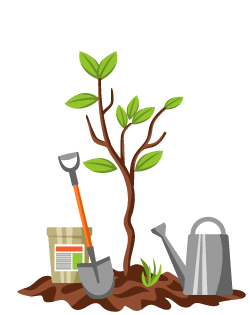 Landing
Basic conditions
- This variety requires sunny, well-ventilated locations. Care must be taken to avoid drafts, otherwise the apple trees may become diseased.
- Proximity to groundwater or open water bodies is not the best environment for Scarlet Sails. The tree's roots begin to rot when exposed to stagnant moisture.
- It's best to prepare planting holes in advance. They should be 60-80 centimeters deep and approximately 1 meter in diameter. Mix some of the fertile soil (the top layer) with fertilizer and return it to the planting area. Add 20 liters of water and leave it there until spring, or at least for a few weeks.
- You don't need to leave much space between trees of this variety; 1 meter is enough for them to feel comfortable.
- The root collar should protrude above the ground by 2-4 centimeters.
- Apple trees are planted on drainage (10-15 centimeters) made of gravel, vermiculite or broken brick, after straightening the roots and removing any damaged or dry ones.
- Cover the roots with soil, gently shaking the stems to remove air pockets. Then water with 30-40 liters of water, adding more soil as needed.
Landing dates
Scarlet sails are susceptible to stress, just like other plants, so it's best to plant them when active growth ceases, that is, in spring or fall. Experienced gardeners recommend choosing the latter option, as this will give the apple trees more time to adapt to the new conditions. Seedlings purchased from closed root system (in special pots), you can plant them without any doubt at any time, even in the middle of summer, nothing will happen to them.
Protection from frost and rodents
The tree is considered a moderately hardy variety. Therefore, in regions where temperatures drop below 18-20°C for extended periods, it will need to be protected from frost. The root zone is covered with soil up to a depth of 10-15 centimeters, and covered with spruce branches, hay, or straw bales. The trunks are wrapped with roofing felt, tar paper, and even nylon tights. If frosts last for more than a month, a shelter made of burlap or agrofibre can be constructed.
To protect the plant from insects that settle in the root zone and then eat the foliage and damage the bark and wood in the spring, it is whitewashed in the fall. Frost protection and the delicate bark of apple trees attract hungry rodents. Coating it with grease, lard, or specialized commercial products will help protect it from damage.
Tree care
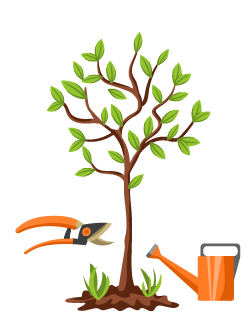 Tree care
Loosening the soil, watering: proper agricultural technology
Caring for Scarlet Sails is no different from regular gardening and is even much easier given the tree's size. Infrequent (twice a year) tilling of the soil around the trunk is required. This must be done very carefully to avoid damaging the roots. It's also a good idea to remove weeds, grass, and shoots from shrubs or other trees.
Apple trees require watering only during periods of extreme heat and drought, when there has been no natural precipitation for more than two weeks. It's better to water deeply (40-60 liters over two periods), but less frequently than too often. Essential fertilizers can be added along with the water. Apple trees especially need them during flowering, fruit set, and ripening. However, overdoing it is also important.
Pruning: simple crown shaping
Columnar apple trees don't require crown shaping, as they don't have skeletal branches. Side shoots and thin twigs can simply be pruned and removed promptly. In the second year, the trunk is shortened by one-third. Subsequently, these steps will likely be unnecessary, or only rarely.
Pollinator varieties
- Grushovka.
- Chinese golden.
- It will be early to the ground.
- Melba.
- Folder.
- Quinti.
Reproduction
- Clones (layering).
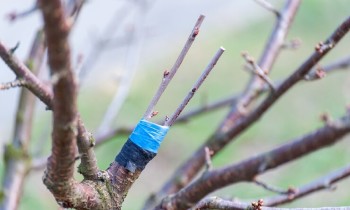
- Grafting by cuttings or buds.
- Growing from seeds.
Diseases and pests
- Powdery mildew.
- Scab.
- Cytosporosis.
- Scale insect.
- Leaf roller.
- Flower beetle.
Ripening and fruiting of the Scarlet Sails apple tree
The beginning of fruiting
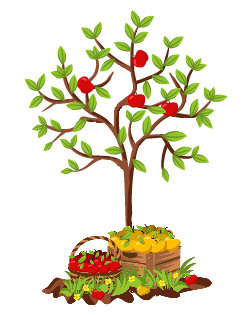 The beginning of fruiting
The variety begins to bloom in the first year after planting, but it is recommended to remove the buds to allow the tree to develop foliage. The first harvests of several fruits can be collected in the third or fourth year, but this is hardly considered full fruiting. By the fifth year, a single tree can yield up to 10-15 kilograms of juicy fruit.
Flowering time
This indicator is directly influenced by the weather and climate conditions of the growing region. Flowering begins in May, as with most early apple trees, but can linger until early June. Its duration is short, only 6-10 days. Scarlet Sails flowers are large, fragrant, and usually white, but can be slightly pinkish or even red in ornamental varieties.
Fruiting and growth
With proper care, an apple tree can yield at least 35 kilograms of apples per year, but record yields of 60-70 have been recorded. However, this requires some effort, including properly wrapping the trees for the winter, eliminating the risk of disease or insect infestation, and protecting them from stress.
The fruits begin to ripen as early as mid-August, but harvesting maturity usually doesn't occur until early September. It's crucial not to miss this moment, as ripe apples can simply fall to the ground. Scarlet Sails have an enviable shelf life for a summer apple tree. In a cool, humid, well-ventilated cellar where the temperature doesn't rise above 5-10°C, they can easily be stored until mid-January without losing their appeal.
Top dressing
- Bird droppings.
- Manure.
- Compost.
- Peat.
- Potassium and nitrogen fertilizers.
- Mineral complexes for apple trees.
- Superphosphate.
What to do if it doesn't bloom or bear fruit
- Transplant.
- Provide or stop watering.
- It is better to cover it for the winter.
- Check for pests or diseases.
- Feed.
Why do apples fall?
- Overripe.
- Lack or excess of moisture.
- Natural phenomena (hail, wind, rain).
- Pests.
- Diseases.
Leave a review of the Scarlet Sails apple tree in the comments below to share your experience with other gardeners.