Vasyugan apple tree: characteristics of the variety and care
| Color | Reds |
|---|---|
| Ripening season | Summer |
| Size of apples | Large |
| Taste | Sweet and sour |
| Crown type | Columnar tree |
| Shelf life | Low shelf life |
| Application | For recycling , Fresh |
| Winter hardiness | High winter hardiness |
| Fruiting age | Up to 5 years |
 History of origin and regions of growth
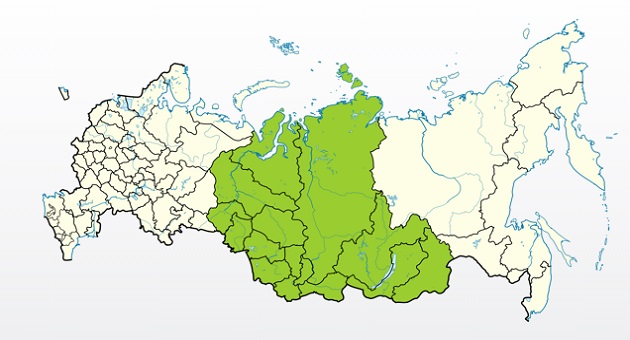
Growing regions
- Ural.
- Western Siberia.
- Far East.
Origin
In the late 1970s, active work was underway to develop dwarf and columnar apple trees suitable for cultivation in the harsh conditions of Russian Siberia, the Urals, and even colder regions further north. In 1987, at the Sverdlovsk Experimental Station of the Institute of Horticulture (now VSTISP), the renowned scientist V.V. Kichina and his colleague N.G. Morozova obtained a hybrid seedling, which was named after a river in the southern part of the Tomsk region.
Field trials of the variety have not yet been completed, and it is not included in the State Register of Breeding Achievements. The apple tree also lacks official zoning, although it is widely grown in the aforementioned regions.
Content
Description of the Vasyugan apple variety
 Every Siberian gardener dreams of a small, compact apple tree that produces a bountiful harvest of delicious and distinctive apples every year. The Vasyugan variety fits this description perfectly, boasting high winter hardiness, undemanding nature, and easy and low-maintenance care. Furthermore, it withstands strong winds when well supported, thanks to its strong wood that resists splitting, even during heavy harvests or winter storms. It is recommended for growing in small plots near the home and in commercial intensive orchards.
Apples: What they look like
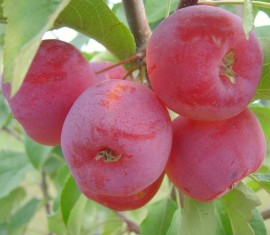
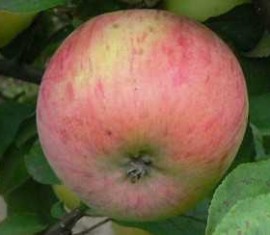
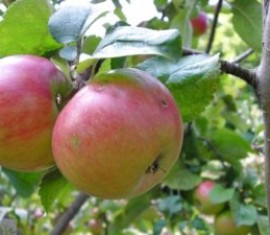
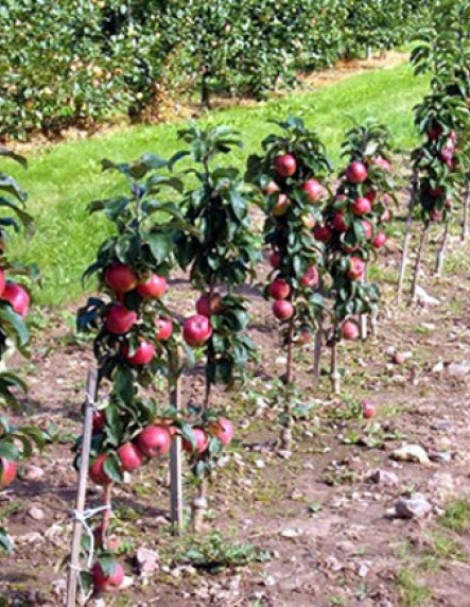
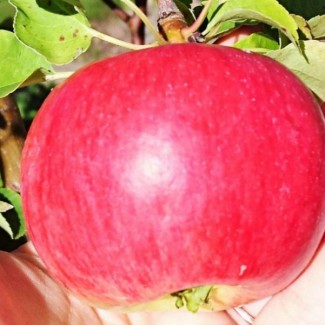
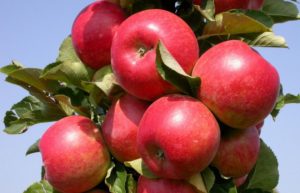 The fruits grow to be medium to large, which is quite rare for northern apple trees. They can easily reach 200-250 grams, are round, slightly elongated, somewhat conical, and predominantly uniform in size, with light and subtle ribbing.
The skin is very dense, even hard, smooth, thin, and has a greenish-yellow base color. The blush is blurred, streaked, and spotted, covering approximately 70-85% of the surface. It's pinkish red or carmine, and may appear slightly crimson. Sometimes, by the time the apples ripen, they become covered with a slightly grayish-blue waxy coating. Subcutaneous spots are light, gray-green, numerous, and quite large, and difficult to see against the spotted surface. The chemical composition is usually characterized by the following indicators per 100 grams of product:
- P-active substances (catechins) – 321 milligrams.
- Ascorbic acid (vitamin C) – 1 milligram.
- Total sugars (fructose) – 11.3%.
- Pectins (fiber) – 9.9%.
- Titratable acids – 0.85%.
The fruit's flesh is prickly, crisp, fine-grained, juicy, and aromatic, with a distinct creamy-greenish, sometimes even lemony, hue. The flavor is sweet and sour, with a distinct acidity, considered a table grape, harmonious, and balanced. According to professional tasting reviews, Vasyugan receives a 4.4 on a 5-point scale.
Apple tree Vasyugan: characteristics
Crown and root system
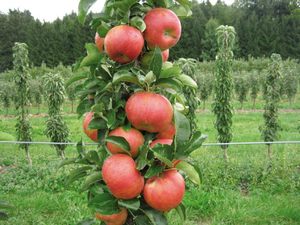 The tree is classified as a semi-dwarf, but the term columnar dwarf would be more appropriate for it. The maximum height can be no more than 2.5-3 meters, which significantly simplifies any maintenance work, including harvesting. The tree grows as a single trunk, like a classic columnar tree, with a pyramidal crown, bearing fruit on fruiting rings that cover the trunk. These are straight, medium-thick trunks with thin twigs instead of skeletal branches, covered with smooth, glossy, brown-green bark.
The leaves are medium to large, bright green or green in color, elongated, and have long, pointed tips. They are leathery, dense, moderately nerved, and have a serrate-crenate margin, glossy, and smooth. The root system is superficial and branched, but usually lacks a central taproot, which can cause the tree to become unstable in the soil and require support in the form of stakes, fences, and other supports.
Productivity and pollination
For columnar apple trees, the yield of the Vasyugan variety is very impressive.
A single mature tree can yield 10-12 kilograms of aromatic apples in the seventh to nineth year after planting. This may seem like a small amount, but the yield per hectare is actually higher than that of the Antonovka apple, thanks to its compact trunk, which is unable to grow in such harsh conditions.
The variety is considered self-fertile, meaning it doesn't require other apple trees for cross-pollination. Insects and wind are sufficient to produce a normal harvest. However, many gardeners still try to interplant the trees to maximize yields. Mobile apiaries are brought to the orchards during the flowering period, and the trees themselves are sprayed with sugar syrup to attract bees.
Winter hardiness and disease resistance
Vasyugan easily tolerates periods when ambient temperatures drop to -40-45°C. The variety is also resistant to sudden changes and fluctuations, from thaws to severe frosts. There have been cases where Antonovka suffered serious damage, losing up to 30% of its green mass, while this variety suffered no damage at all and bore fruit the following year without any significant changes. However, it's still important to remember to protect it for the winter and prepare for it properly.
The variety has a high resistance to fungal infections. However, this is not genetically determined, because powdery mildew or scab However, they can still affect trees during years of severe epiphytotics. To avoid these risks, it's best to treat trees promptly and regularly with fungicides, as well as insecticides to control insect pests, which can also become a serious problem.
Rootstocks and subspecies
There are currently no subspecies of Vasyugan, and it's unlikely that they will appear anytime soon. However, it is known that when grown on dwarf rootstocks, such as MM-26 or M-106, the trees become even more compact and their yield increases, but their frost resistance decreases. In more southern regions, the fruits begin to ripen much earlier, which many assume indicates early subspecies of the variety, but this is a common misconception.
Features of growing Vasyugan
 Landing
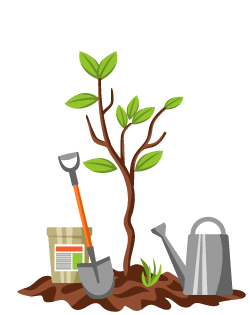 Landing
Basic conditions
- First, you need to choose a quality seedling, opting for tall, sturdy, one-year-old trees from a nursery with thick trunks. Trees with a closed root system, such as those grown in bags or pots, thrive best, as they don't require any additional disposal after planting.
- Places under trees should be protected from strong winds and drafts, not even because this will damage them, but because strong gusts can uproot your plantings.
- Proximity to groundwater and soil They don't play a major role. Although it's recommended not to plant Vasyugan near open water bodies and shallow wells, it's unlikely to reach depths greater than 2 meters. It thrives in black soil, loam, and sandy loam, and even grows well on rocky soils.
- The holes for the variety can be prepared the previous season, or they can be dug 3-4 weeks before planting. For this, dig steep holes 60-70 centimeters deep and 70-80 centimeters in diameter. Add a small amount of fertilizer mixed with soil to the bottom, then add stones or broken brick for drainage, and then fill with 15-25 liters of water.
- A distance of 1-1.5 meters between trees in a row and no more than 1.5-2 meters between rows is sufficient, and even less is possible. A columnar crown and a less extensive root system will not interfere.
- You can drive stakes into the holes immediately for staking—one at a time, but two is better. They can be made of wood or metal. They shouldn't be removed for at least 4-5 years, but by then it's best to provide the apple trees with other, permanent supports.
- The root collar should be left at least 5-7 centimeters above the soil surface to prevent the tree from rooting higher. Otherwise, all the properties and qualities of the rootstock will simply be lost.
- Place the tree on a drainage mound, spread the roots, cover with soil, and compact it well by hand. Water the tree with 35-40 liters of water, and mulch the soil surface with chopped grass, compost, straw, or whatever is available.
Landing dates
When purchasing seedlings with closed root system, there's no need to worry about the best time to plant them outdoors. This can be done anytime during the growing season. However, otherwise, it's best to plant the variety in spring or fall, when there's no risk of frost damage. The optimal time is late March or early April, and late September or early October.
Protection from frost and rodents
This variety is resistant to even fairly severe frosts, so you won't have to worry too much about covering it. Simply cover the root zone with a mat of dry grass and wrap the trunks with roofing felt, tar paper, or agrofibre. This is essential if temperatures drop below -35-37°C; taller apple trees tolerate it without issue. In the harshest conditions, you can cover the trees with a tent-like covering, fortunately, their low height allows for this.
Tree care
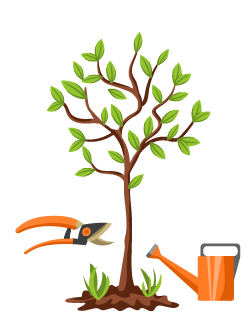 Tree care
Loosening the soil, watering: proper agricultural technology
All apple trees require root tilling at least once a year, and Vasyugan is no exception. At the same time, you'll need to remove root suckers, shoots from other plants, and nutrient-robbing weeds. The rest of the year, you can lightly hoe the soil to allow the roots to breathe.
Young first-year seedlings will need to be watered several times a week in small amounts until they are fully established. Drip irrigation is ideal, if possible. Subsequently, this can be limited to about 6-10 times per season, and only in dry and hot weather. Fertilizer should be applied more frequently to poor soils, while black soil can be fertilized only 2-3 times per year.
Pruning: simple crown shaping
Pruning columnar apple trees is a special art. You want to prevent the crown from branching, but cutting everything off indiscriminately isn't the best solution. Therefore, special care must be taken to preserve the top bud, and strong lateral shoots should be removed immediately, leaving 2-3 buds, which will then produce fruiting branches. After the third year, these lateral shoots should be pruned back, allowing new shoots to grow. This process is repeated annually, maintaining the columnar shape of the crown.
Trees are regularly inspected in spring and fall for dead branches or damaged shoots. These should be pruned, and the cut areas sealed with garden varnish or water-based paint. Rejuvenation of columns is not performed, as their lifespan is limited to approximately 35-50 years, and even then, in private gardens. In intensive orchards, trees are removed after 20-25 years and new ones are planted.
Pollinator varieties
- Bellefleur the Chinese.
- In Memory of Ulyanishchev.
- Uralsk resident.
- Antonovka.
- Gorno-Altaisk.
Reproduction
- Rooting cuttings.
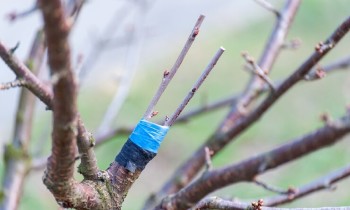
- Grafting by buds and cuttings.
- Clones (layering).
Diseases and pests
- Moniliosis.
- Scab.
- Powdery mildew.
- Fruit rot.
- Cytosporosis.
- Tinder fungus.
- Green aphid.
- Codling moth.
Ripening and fruiting of Vasyugan
The beginning of fruiting
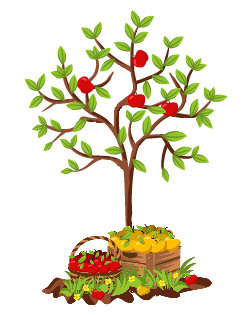 The beginning of fruiting
Apple trees of this variety are very early fruiters; some arrive from the nursery with ready-made fruit. Flowers and apples appear as early as the first or second year, but it's best to pluck them at this time to allow the tree to establish better roots. Fruiting begins in the third or fourth year, when a single tree can yield 6-8 kilograms of fruit.
Flowering time
The onset of the process depends directly on the climate and weather conditions in the region where the apple trees are grown. This can occur in early, mid, or even late May. The trees produce large, beautiful, and fragrant pink flowers, very beautiful. Blooming lasts approximately 8-14 days, also depending on the weather.
Fruiting and growth
The tree can't be called fast-growing, as it can only grow approximately 5-14 centimeters per year. However, due to its small height, it reaches its full height quite quickly. Fruiting also increases rapidly, and you'll be harvesting a full crop by about 6-9 years.
Apples ripen at the end of August, but not uniformly; you need to check their color. If a slight bluish bloom appears, it's time to pick the fruit. Throughout September, you can pick them gradually, without fear of them falling to the ground. However, preserving them for long is unlikely, as even in the most ideal conditions, they only last for 45-60 days.
Top dressing
- Superphosphate.
- Compost.
- Nitrogen fertilizers.
- Humus.
- Potassium complexes.
- Ammonium nitrate.
- Manure.
What to do if it doesn't bloom or bear fruit
- Check for pests and diseases.
- Transplant.
- Limit or increase watering.
Why do apples fall?
- Natural factors.
- Pests.
- Diseases.
Leave your feedback on the winter-hardy Vasyugan variety to share your experience with others.