Moscow Winter Apple Tree: Variety Features and Care
| Color | Greens , Striped , Reds |
|---|---|
| Ripening season | Autumn |
| Size of apples | Large |
| Taste | Sweet and sour |
| Crown type | Tall tree |
| Shelf life | Average shelf life |
| Application | Fresh , For recycling |
| Winter hardiness | High winter hardiness |
| Fruiting age | From 5 years old |
 History of origin and regions of growth
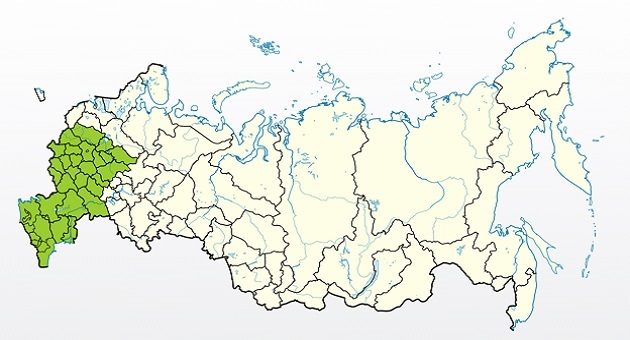
Growing regions
- Middle zone.
- North Caucasus.
- Crimea.
- Some northern regions.
Origin
The history of this variety began relatively recently, only in the mid-twentieth century, at the experimental station of Lomonosov Moscow State University. In 1963, breeder Sergei Ivanovich Isaev first obtained seeds from pollination of the domestic Antonovka Obyknovennaya and the "American" Welsey. Everything went very well; the apple trees inherited the best qualities of their parent varieties, so it was decided to continue working with them.
The hybrids proved to be interesting and were accepted for state testing in 1977. In 2001, the variety was classified as elite, and a year later, it was added to the State Register and zoned for the Middle Volga and Central regions.
Content
Description of the Moscow Winter apple tree variety
 As the name suggests, these fruits ripen in late autumn, just before the winter cold sets in. The trees are resilient to low temperatures and sudden fluctuations, undemanding in terms of growing conditions and care, unfussy in terms of soil and moisture, require little fertilizer, and have good resistance to fungal infections.
The fruits have high nutritional value, are rich in vitamins and minerals, are tasty, beautiful, and can easily be stored for more than six months, provided basic conditions are met. These apple trees are recommended for growing in industrial and intensive orchards, as well as in private gardens.
Apples: What they look like
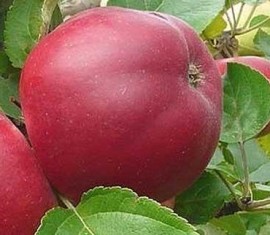
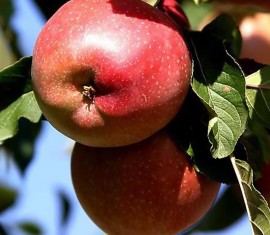
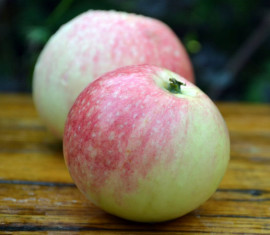
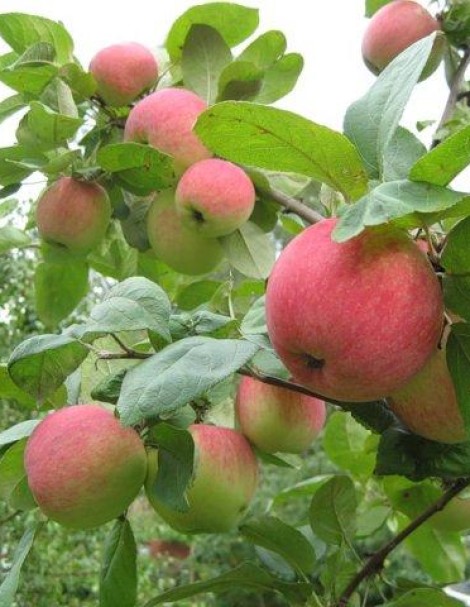
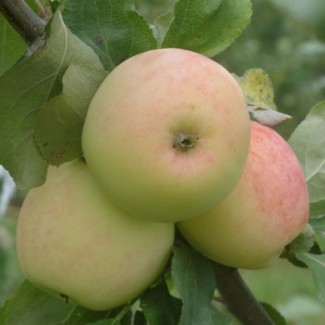
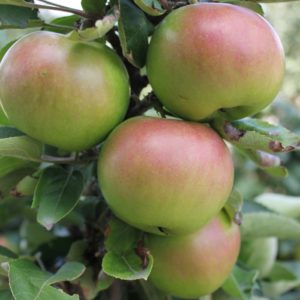 In most cases, the fruits on the tree are large or very large. They easily reach 180-200 grams, and even 230-250. In particularly fruitful years, the apples approach 300 grams and can grow even larger. They are round, symmetrical, and can be slightly flattened along the central axis, with equal sides. The ribbing is subtle, sometimes only slightly visible at the top of the fruit.
The skin is smooth, shiny, and glossy, developing a slightly oily coating during ripening. It is green or light green, and at maturity, it becomes greenish-yellow or even lemon-colored. The blush is mottled and streaky; it can be pale, diffuse, and translucent, or bright and distinct, occupying approximately 45-75% of the surface. Its color is predominantly bright or carmine red, rich and juicy.
Subcutaneous dots are large, light green or gray, evenly distributed, close together, and clearly visible. To assess the chemical composition, it's easiest to consider the following parameters per 100 grams:
- P-active substances (catechins) – 348 milligrams.
- Ascorbic acid (vitamin C) – 21.1 milligrams.
- Total sugars (fructose) – 12.3%.
- Pectins (fiber) – 8.9%.
- Titratable acids – 0.94%.
The flesh is dense, sometimes even firm when picked, becoming medium-dense with age. It is fine-grained, very juicy, has a pleasant texture, and is crisp. It is white or slightly greenish, but can also be slightly creamy. The flavor is dessert-like, balanced, somewhat spicy, and slightly sweet. The aroma is strong and unique, with notes of honey and wild herbs. A professional tasting score is 4.3-4.5 out of 5.
Moscow Winter Apple Tree: Characteristics
 Crown and root system
 Crown and root system
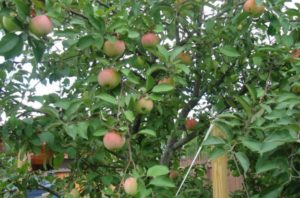
This is an extremely tall tree, which makes it not suitable for every gardener. Without formative pruning it can reach 8-10 meters in height., making maintenance and harvesting seriously difficult. Because the branches are arranged horizontally, that is, perpendicular to the trunk, the crown becomes spreading, and over time, it becomes weeping, sometimes drooping. The branches are long, thick, straight, covered in steel-gray or greenish-gray bark, which tends to crack and crumble over the years.
The leaves are large, wrinkled, leathery, dense, glossy, deep green or just green, with sparse pubescence on the underside. Their edges are finely serrated, serrated, and can be slightly wavy, with a short, pointed tip. The root system is deeply buried, branched, and vigorous, occupying a significant amount of space beneath the surface.
Productivity and pollination
Moscow Winter is a high-yielding variety that also ripens fairly early.
With proper care, regular feeding, watering and fertilization, one tree can produce approximately 140-170 kilograms of fragrant and tasty apples per season..
One of the advantages of this apple tree is its complete self-fertility. For pollination, Moskovskoe requires only wind and bees, after which the fruit will surely set and ripen. However, to maximize yield, experts recommend planting this variety close to other varieties to ensure cross-pollination. Furthermore, Moskovskoe itself can serve as a good pollinator for self-sterile apple trees.
Winter hardiness and disease resistance
The trees have good tolerance to low temperatures. They tolerate temperatures down to -32-35°C fairly easily, without freezing of shoots or buds. However, sudden changes in temperature, such as thaws and severe frosts, can damage them. Therefore, it is important to carry out all measures to protect apple trees in a timely and proper manner during the cold season.
To various fungal infections, including powdery mildew and five races scabiesThe trees are highly resistant. This means they rarely become infected, and even if they do, the damage is not severe. With proper care, they can recover from an illness in as little as a year and continue to produce fruit at their usual rate.
Rootstocks and subspecies
There are no subspecies of the Moskovsky apple yet, but it is already being grown on various rootstocks. A seed rootstock produces a standard-sized tree, while dwarf and semi-dwarf varieties produce much more compact trunks. This will significantly simplify care and harvesting, but will also reduce the trees' frost resistance. The advantages of this variety include the apples' high marketability, while the disadvantages include their smaller size and short shelf life of only 90-110 days.
Features of growing Moscow Winter
Landing
 Landing
Basic conditions
- The site should be well-drained, otherwise the apples will shrink year after year. It should be large enough to accommodate a large tree with a crown diameter of 5-6 meters. Otherwise, all the plants growing underneath will be heavily shaded.
- Moskovskoe prefers airy, well-aerated soils, as well as groundwater at least 3-3.5 meters deep. It grows well in chernozem, sandy loam, and clay loam, but it's best not to plant it near a river or lake, as this will cause root rot.
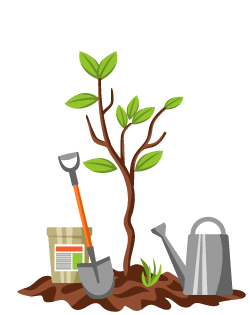
- The holes should be prepared in the fall or spring, but can be done as early as 1-3 weeks before planting. To do this, dig a hole with steep sides, 80-90 centimeters deep and about one meter in diameter. Add soil and fertilizer to the bottom, followed by stones or broken brick, and then fill with water (45-60 liters). The holes are then left outdoors.
- It's a good idea to dig or drive support bars or stakes into the holes right away. They can be made of plastic, metal, or wood—it makes no difference. The seedlings should be tied to them, and they will serve as a secure anchor. support for the next 5-6 years.
- Before planting, carefully inspect the rhizome, trimming off any dry or rotted shoots with pruning shears. If the root system is weakened and unhealthy, soak the plants in water for 5-8 hours to allow them to absorb moisture before planting.
- Leave at least 5-6 meters between the holes so that in the future the trees do not conflict with either roots or branches.
- The root collar should remain 5-8 centimeters above the soil surface if the rootstock's properties are to be preserved. Otherwise, if rooted higher, they will be completely lost.
- Place the seedling directly on the drainage, support it with your hand, shake it gently, and cover it with soil, compacting it but not too hard. The density of asphalt is definitely not necessary here. Create a soil embankment around the perimeter, pour 45-60 liters of water inside, and mulch the surface.
Landing dates
Moskovskoe Zimnee can be planted in both spring and fall; it shows roughly the same survival rates in both cases. The key is to ensure that the sap has not yet started flowing in the trunks at the time of planting.
Protection from frost and rodents
This variety is very winter-hardy, so no special sheltering techniques are required. Standard measures are sufficient, such as wrapping the trunks or covering the root zone with mats of straw or dried grass. Young trees require shelter, while older ones will "fight" frost on their own.
To haresTo prevent mice and hamsters from grazing the tender bark of young trees, they are coated in the fall with melted animal fat, grease, and other strongly aromatic substances that repel animals. To get rid of insects, the trunks are whitewashed with lime in the spring and fall.
Tree care
 Tree care
Loosening the soil, watering: proper agricultural technology
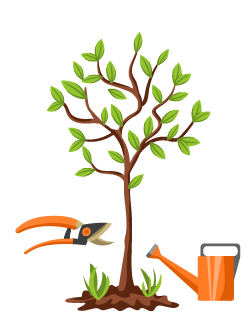
Plants love loose, oxygen-rich soil, and this crop is no exception. Therefore, digging around the trunk should be done twice a year and hoeing 1-3 times a month. This will also remove any weeds and root suckers that rob the apple trees of nutrients and minerals.
Moskovskoe loves moisture, but it won't tolerate overwatering. Therefore, when young, it can be watered up to 3-4 times a month, and as it matures, 2-3 times. If it rains, stop watering and wait for the soil to dry out (about ten days). It's recommended to add various fertilizers and fertilizers along with the water; this will ensure they're absorbed much more effectively by the roots.
Pruning: simple crown shaping
The crown of this variety is naturally structured in such a way that it facilitates proper pruning. In the first year, the central trunk is cut back by a third, and all branches are pruned, leaving two or three main branches spaced far apart at different heights. Subsequently, the same standard should be strictly adhered to, removing all shoots growing inward and upward-thrusting suckers.
Sanitary pruning is carried out in the fall, when the sap in the trunks has already frozen. All diseased, dry, or damaged (broken) shoots must be removed. This is especially important after abundant fruiting, when branches often fail to withstand the weight and break off.
Reproduction
- Rooting.
- Grafting.
- Growing from seeds.
- Clones.
Diseases and pests
- Cytosporosis.
- Scab.
- Powdery mildew.
- Black crayfish.
- Green aphid.
- Codling moth.
Ripening and fruiting of Moscow Winter
The beginning of fruiting
 The beginning of fruiting
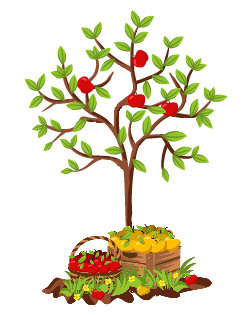
This apple tree can't be called early-bearing, as you'll have to wait quite a while for the first fruits to appear. The very first blossoms must be picked off completely, then the apples are allowed to set over the next two or three years, and then the entire tree is picked again, without missing any fruit. The first harvest can be collected as early as the seventh to tenth year, and should yield approximately 8-12 kilograms of fragrant, delicious fruit.
Flowering time
Like most winter apple trees, the Moskovskoe apple tree opens its buds only in the second half of the last month of spring. However, the results will largely depend on the growing region and the prevailing weather and climate conditions. The process lasts approximately 10-16 days and is completed by the end of May. The tree produces beautiful, large flowers, densely covering the branches, gathered in clusters of white or slightly pinkish hues, and fragrant.
Fruiting and growth
The tree is slow-growing and can produce no more than 12-15 centimeters in a single season, so fruiting progresses very slowly and gradually. It may grow somewhat faster before bearing fruit, but then slows down. You'll have to wait approximately 15-20 years for a full, large harvest, but the abundance and regularity of the harvest more than offset this inconvenience. The apple tree never takes a break, bearing fruit every season.
The fruits begin to ripen around the end of September, but it's best to wait until the following month to harvest. Up until mid-October, you can safely harvest the apples gradually and store them as they ripen. In a cellar with suitable temperature and humidity conditions, they will keep well until spring. However, they are unlikely to last long enough to reach the next harvest; they may become wilted, crumbly, and lose their flavor and aroma.
Top dressing
- Mineral complexes.
- Humus.
- Superphosphate.
- Compost.
What to do if it doesn't bloom or bear fruit
- Provide proper and abundant watering.
- Check for pests or diseases.
- Transplant to a more spacious or sunny place.
- Fertilize or feed.
Why do apples fall?
- Natural factors (strong wind, hail, rain).
- Pest damage.
- Diseases.
Please leave your feedback on the Moskovskoe Zimnee variety so that other gardeners can learn about your experiences growing these trees.