Apple tree 'Michurin's Memory': characteristics of the variety and care
| Color | Reds |
|---|---|
| Ripening season | Autumn |
| Size of apples | Average |
| Taste | Sweet and sour |
| Crown type | Average tree height |
| Shelf life | High shelf life |
| Application | For recycling , Fresh |
| Winter hardiness | Average winter hardiness |
| Fruiting age | Up to 5 years |
 History of origin and regions of growth
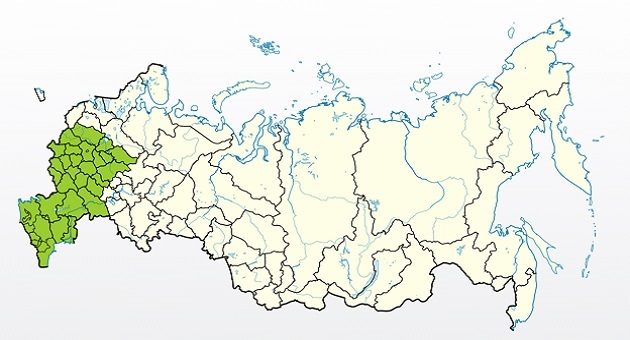
Growing regions
- Middle zone.
- Leningrad region.
- Middle Volga region.
- North Caucasus.
- Crimea.
- Some northern regions.
- Moscow region.
Origin
This variety was developed at the experimental station of the All-Russian Research Institute of Horticulture (now the I.V. Michurin Federal Scientific Center) around 1927-1930. The Shamparen-Kitayka variety was used in the breeding; the parent apple tree is unknown. The project was led by Sergei Ivanovich Isaev, who supervised the following:
- Maksimova M.P.
- Ivanova Z. I.
- Zayets V.K.
The first registration date for variety testing is considered to be December 1949, during the difficult post-war period. At that time, the new hybrid was classified as an elite variety. It was not until 1959 that it was included in the State Register of Breeding Achievements, after which the variety was officially zoned for the Lower Volga and Central Black Earth regions. In reality, it is easily cultivated across much larger swaths of our country.
Content
Description of the Michurin Memory variety
 A medium-sized tree with a loose, compact crown, it is widely popular for individual plantings. It is being replaced in commercial plantings by newer, more advanced varieties. Pamyat Michurina is a medium-sized, early-fruiting variety that is easy to care for and requires no regular feeding or fertilizing. It tolerates harsh environmental conditions well, is moderately frost-hardy, and is resistant to summer heat.
The fruits are distinguished by their attractive appearance, pleasant aroma and texture, good taste, excellent commercial quality, and excellent shelf life. They are easily transported, even over long distances, and are suitable for fresh consumption and processing. A disadvantage is the large, drooping crown. Recommended for individual cultivation, but also suitable for commercial planting.
Apples: What do they look like?
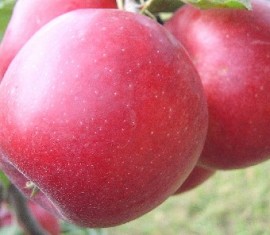
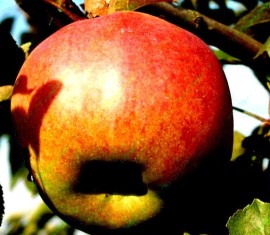
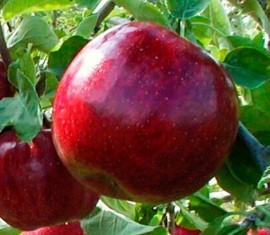
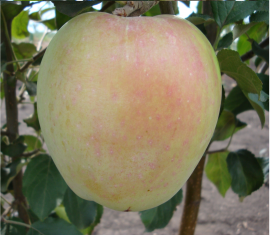
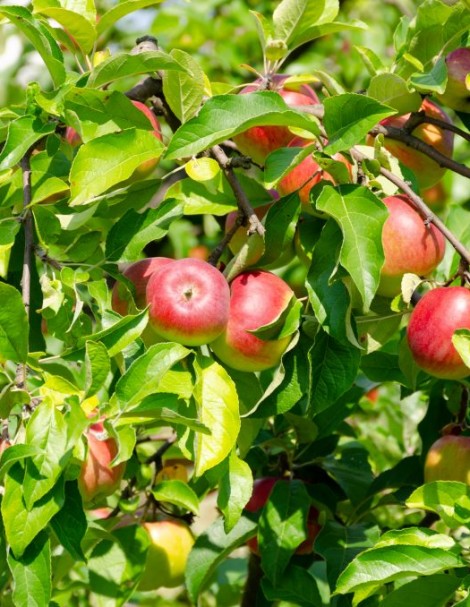
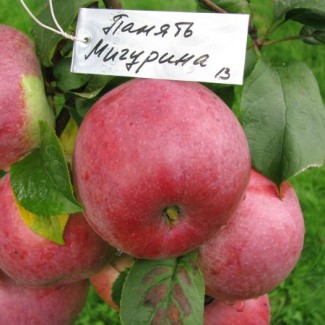
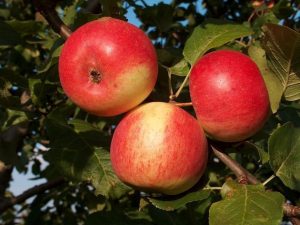 The fruits are usually medium or slightly smaller than average in size. Their maximum weight can reach 120-140 grams. They are onion-shaped, slightly flattened, conical, and can be asymmetrical, but are generally uniform in size. They are smooth, with slightly visible but smooth ribbing and wide ribs.
The skin is dense but thin, elastic, strong, and firm, protecting the flesh well from damage. Its primary hue is green, but as it ripens, it becomes yellow-green, lemon, or even honey-gold, a rich, full-bodied color. The blush is streaky, mottled, red, bright red, carmine, or red-orange, covering 65-90% of the apple. The surface has a waxy, bluish bloom, with numerous small, grayish-green, rusty subcutaneous dots faintly visible. To assess the chemical composition, it is advisable, as advised by professionals, to evaluate the following data:
- P-active substances (catechins) – 184 milligrams.
- Ascorbic acid (vitamin C) – 5.9 milligrams.
- Fructose (total sugars) – 10.2%.
- Pectins – 14.3%.
- Titratable acids – 0.53%.
The "Memory of Michurin" apple has a pleasant, fine-grained, and very juicy flesh, crisp and prickly, yet tender, making it easy to bite into. Its firmness is medium, and the flavor is sweet and sour, juicy, slightly spicy, pleasant, and refreshing. It is considered balanced, harmonious, and dessert-like. The fruit's tasting score on a professional 5-point scale is 4.7.
Apple tree 'Michurin's Memory': characteristics
Crown and root system
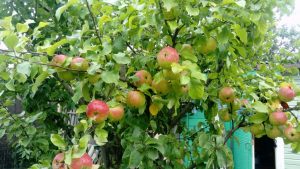 The tree is classified as a standard tree of moderate growth strength. At maximum, it can reach 3.9-4.5 meters in height. Its crown is expansive and broadly oval, easily covering a diameter of up to 4.5-5 meters, or even more. The branches are straight and long, with tips reaching to the ground. They extend from the central core at an angle close to 90° and are covered with dark brown or fulvous-brown bark with light pubescence. Fruiting occurs on rings, fruiting twigs, and spears (mixed).
The leaves are fairly densely distributed on the branches. They are oval, elongated, medium-sized, and obovate. They have a finely serrated, serrated, and sometimes slightly wavy margin, with a short, pointed tip. The blade can be straight or slightly convex. They are green, dark green, or rich green. The root system is medium to deeply rooted, branched, and fibrous, with numerous small branches adapted for seeking moisture.
Productivity and pollination
Pamyat Michurin cannot be called a high-yielding variety, but with good care its fertility can be increased above average.
A single tree can yield at least 75-90 kilograms of aromatic apples per year. At standard planting density, a hectare yields approximately 55-70 centners, which is quite impressive.
The variety is conditionally self-fertile, meaning that approximately 25-30% of the apples will ripen even if there isn't a single other apple tree within 250-300 meters for cross-pollination. However, everyone wants to maximize the yield, so it's common to interplant different varieties. Any apple tree that blooms at the same time as the Pamyat will do.
Winter hardiness and disease resistance
The tree is quite frost-tolerant. It can survive temperatures as low as -27-29°C even without special protection, as long as these temperatures don't last long. However, it's best to protect the trees from frost to prevent them from freezing, otherwise they'll have to spend several years recovering. Apple trees don't tolerate sudden temperature fluctuations or excessive humidity, but they tolerate drought quite well.
To scab, moniliosis, cytosporosis Apple trees are moderately resistant to powdery mildew. They are rarely affected, but when they do become infected, the attacks are severe and severe. Not only the leaves but also the fruit are affected, so prevention is essential. Timely treatments and spraying will minimize all risks.
Rootstocks and subspecies
There are no known subspecies of apple trees, but they can be grown on a wide variety of rootstocks. This allows for slight adjustments to their size. For example, dwarf and semi-dwarf varieties allow for a much more compact crown, as these trees don't grow taller than 2-2.3 meters. However, winter hardiness will suffer significantly, and the fruit may be larger and more beautiful, though less numerous.
Features of growing Memory of Michurin
 Landing
 Landing
Basic conditions
- Before planting, choose a sunny, open area, well protected from drafts, but not in a low-lying area where air can stagnate. Trees will grow in the shade, but they may be weak, stunted, grow poorly, or even refuse to bloom or bear fruit.
- Almost any soil is suitable, especially if regular care, feeding, and fertilization are included. It grows well in sand, clay, black soil, loam, and sandy loam, in forest podzolic soils, and on rocky slopes.
- Preparing the holes in advance isn't necessary, but it's best to dig them no later than 2-3 weeks before planting. Mark out a spot up to 1 meter in diameter and dig a hole 60-70 centimeters deep. Mix the top layer of topsoil with fertilizer (minerals and organic matter) and fill the bottom. Place drainage on top, and fill with water (30-40 liters). No covering is required.
- It is better to buy seedlings immediately before planting, but if this is not possible, it is acceptable to bury them at a 45° angle until spring.
- Leave at least 3-4 meters between trees to prevent them from getting in each other's way as they age, and 4.5-5.5 meters between rows is ideal. This will significantly simplify maintenance and harvesting.
- Inspect the seedling; if the top has wilted or any branches have broken, it's best to prune them immediately. The rhizome is inspected as well, removing any dry, broken, or damaged shoots. You can soak the apple tree in water for 4-5 hours before planting.
- The root collar should protrude above the surface by at least 5-6 centimeters.
- It is advisable to immediately dig or hammer in support planks into the holes to tie up the apple trees.
- Place the seedling on a drainage platform, carefully spreading the roots so they point downwards, or at least sideways. They shouldn't be crushed or bent. Cover the tree with soil, lightly compact it by hand, and water it. The surface should be mulched. This will slow down the moisture loss and prevent watering for longer.
Landing dates
Although the tree is quite resistant to low temperatures, it's still best to plant it in spring. A young sapling will likely struggle to survive frost if it hits prematurely. However, if planted in March or April, it will have the entire summer to adapt to the environment. In warmer southern regions, you can plant Pamyat in September or October, when there are still at least 3-5 weeks left before frost.
Tree care
 Tree care
Protection from frost and pests
Preparing apple trees for winter is not difficult. Simply clear the tree trunks and stop watering in late August or early September. Just before winter, after pruning, wrap the trunks with available materials, from roofing felt to old women's nylon tights. Smaller apple trees can be wrapped in a tent-like structure, which provides special benefits: windproofing and protection from rodents.
To get rid of insects, brush the trunks and whitewash them with lime every spring and fall. Spraying with industrial insecticides also works well. Fungicides eliminate fungal threats. To repel rodents, use lard, which is the safest, but fuel oil, grease, and other strong-smelling substances can also be used.
Loosening the soil, watering: proper agricultural technology
Dig around the trunk in the spring, and repeat the same procedure in the fall. Avoid going too deep with the spade blade to avoid damaging the surface roots. During the growing season, you can also lightly loosen the soil with a hoe to prevent it from compacting. Regularly remove weeds and shoots from other plants, as well as root suckers from the apple tree itself.
Pamyatya rarely needs watering, only when young and during the driest periods. It will survive these on its own, but it's not difficult to help the tree, and this will have a positive impact on its yield. Young trees can be watered 5-8 times per season, while mature trees only need 4-5.
Pruning: simple crown shaping
Many gardeners believe that trees don't need any formative pruning. They don't tend to become overgrown, so once pruned, you can simply maintain their natural, less vigorous branching. Others believe that trees can literally be "twisted into ropes," meaning they can be shaped into any form, and this is true.
Sanitary pruning is almost impossible to avoid. Branches overloaded with fruit can break and should be cut off immediately, as the tree is already under significant stress and should not be further aggravated. All cut areas should be immediately treated with garden pitch. Don't forget to prune away any diseased, dead, or insect- or rodent-damaged shoots.
Pollinator varieties
Diseases and pests
- Cytosporosis.
- Scab.
- Moniliosis.
- Powdery mildew.
- Hawthorn.
- Green aphid.
- Leaf roller.
Ripening and fruiting in memory of Michurin
The beginning of fruiting
 The beginning of fruiting
The early fruiting of a variety depends on the rootstock and growing region, so it's a variable value. For example, a tree on a dwarf rootstock can produce its first harvest as early as 2-3 years, while a vegetative rootstock may only produce its first harvest in 4-5 years. However, the process usually doesn't take longer, unless grown in shade or exposed to strong winds. If the tree doesn't bear fruit later, it should be replanted in a sunnier or more fertile area.
Flowering time
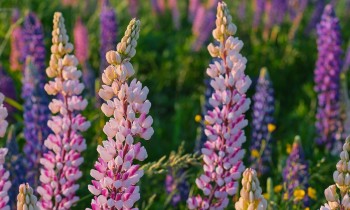
Michurin's Memory blooms mid-season, in May. Bright pink buds open into fragrant, very large, pale pink flowers, gathered in clusters of 5-8. Depending on climate and weather, the blooming time may vary slightly, but the process will take approximately 14-18 days. Therefore, a variety of pollinators can be found.
Fruiting and growth
The tree grows quite quickly, especially before fruiting, when all its energy is devoted to building up green mass. Over time, the rate of growth slows somewhat, but not significantly. Considering the small maximum height of the trunks, they very quickly acquire their final shape. Fruitfulness increases gradually, reaching full fruiting in just 5-6 years.
Fruit ripening begins in late September, but sometimes, in colder regions or during rainy summers, it can extend until early or even mid-October. You can tell when the apples are ready to pick by the bluish, waxy, oily coating that appears on the surface. The apples are firmly attached to the branches, so there's no need to worry about them falling. The fruit can be transported over any distance, but should be stored in a dedicated refrigerator or cellar until mid- to late spring.
Top dressing
- Dolomite flour.
- Eggshells (calcium-containing complexes).
- Humus.
- Manure.
- Compost.
- Superphosphate.
- Mineral and nitrogenous complexes.
- Chicken or pigeon droppings.
- Ammonium nitrate.
What to do if it doesn't bloom or bear fruit
- Wrap up.
- Limit or increase watering.
- Remove insects.
- Cure diseases.
Why do apples fall?
- Weather troubles.
- Early frosts.
- Pests or diseases.
- Overripening.
Please leave your feedback on the Pamyat Michurin apple variety to help novice gardeners assess their potential and potential for growing apple trees in their own plots.