Red Free apple tree: characteristics of the variety and care
| Color | Reds |
|---|---|
| Ripening season | Summer |
| Size of apples | Average |
| Taste | Sweet |
| Crown type | Average tree height |
| Shelf life | Low shelf life |
| Application | Fresh , For recycling |
| Winter hardiness | Average winter hardiness |
| Fruiting age | Up to 5 years |
 History of origin and regions of growth
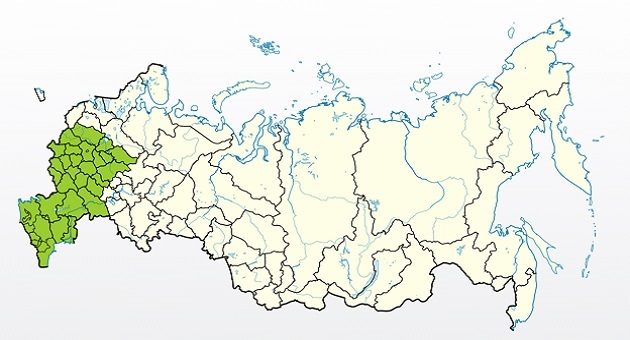
Growing regions
- Crimea.
- Adygea.
- North Caucasus.
- Chechnya.
- Ingushetia.
- Dagestan.
- Central Black Earth Region.
- Middle zone.
- Moscow region.
Origin
This apple tree is of American origin. It was developed in the mid-1970s by crossing a domestic apple tree with the hybrid M. floribunda Sieb. 821. The trees proved sufficiently winter-hardy that gardeners in our country were also able to grow them. In the early 1980s, the new variety successfully entered the European market and later reached the Soviet Union.
In 1986, the first application for variety registration was submitted. The originators were the Federal State Budgetary Scientific Institution "North Caucasus Center for Horticulture and Winemaking" and the Novozavedenskoye Agricultural Artel Fruit Farm. Trials and field testing continued until 2000, when Red Free was included in the State Register of Breeding Achievements and officially zoned for the Central Black Earth and North Caucasus regions.
Content
Description of the Red Free variety
 This medium-sized, very compact summer-ripening apple tree has proven to be quite suitable for cultivation in our country's rather challenging climate. Its main advantage is considered to be its immunity to all five races. scabies At the genetic level (the Vf gene), they are not particularly resistant to powdery mildew. However, Red Free is a high-yielding and early-bearing variety, producing fruit annually without a rest period. The trees are undemanding in terms of growing conditions, are environmentally sustainable, hardy, and can withstand fairly long cold periods.
The fruits of this variety are quite large, fragrant, attractive, and delicious, possessing high marketability and consumer qualities. They are suitable for fresh eating and for making juices, dried fruits, preserves, and jams. They are easy to transport, but do not keep well for long periods. The main drawback is the apples becoming smaller when the branches are overloaded, and flowering must be regulated. This variety is recommended for both industrial intensive orchards and individual cultivation.
Apples: What do they look like?
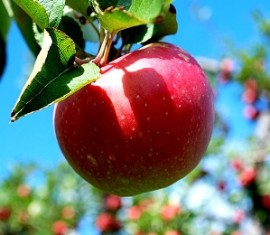
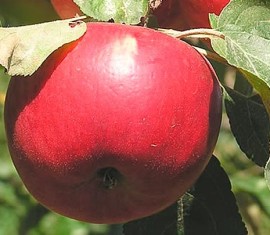
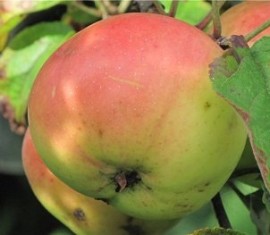
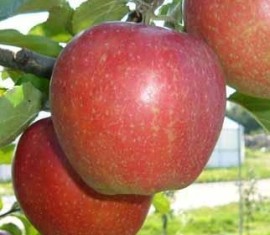
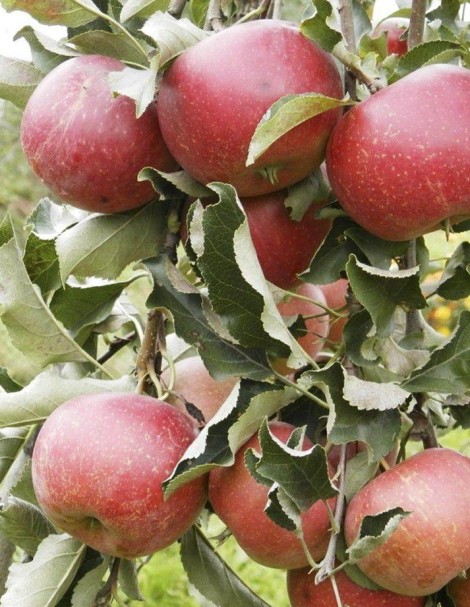
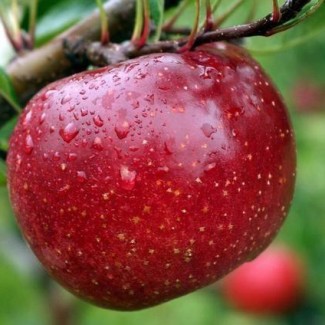
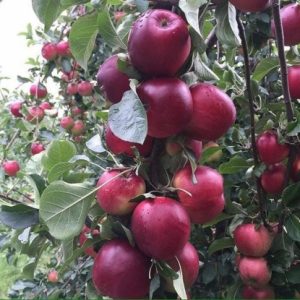 The fruits are generally medium or slightly larger than average in size. They grow to approximately 140-160 grams per paddle, but in some years, with proper care, they can be larger. Their shape is round, uniform, regular, spherical, and can occasionally be flattened near the petiole or elongated along the central axis, but only slightly. Ribbing is almost imperceptible, and there is no lateral suture.
The fruit has a delicate, thin to medium-thick skin that cracks easily and is brittle. It is smooth, highly glossy, and shiny, and when ripe, may develop a waxy, silvery-gray coating. The skin's base color is green or yellowish-green, but it is almost completely hidden by a rich, blushing blush, which can be mottled, striped, blurred, dark red, or even burgundy-purple. Subcutaneous punctures are numerous, gray-green, and clearly visible. It is recommended to evaluate the chemical composition of apples using a simple sample of data:
- P-active substances (catechins) – 158 milligrams.
- Ascorbic acid (vitamin C) – 14.1 milligrams.
- Total sugars (fructose) – 14.7%.
- Pectins (fiber) – 11.4%.
- Titratable acids – 0.42%.
Red Free has a pleasantly textured, medium- to fine-grained flesh that's crisp, very juicy, and possesses a powerful caramel aroma. It has a whitish-cream or slightly yellowish hue. The flavor is generally considered balanced, dessert-like, harmonious, and sweeter, with a subtle tartness. According to official ratings from professional tasters, the fruit scores 4.4 out of 5 possible points for taste and appearance.
Red Free apple tree: characteristics
Crown and root system
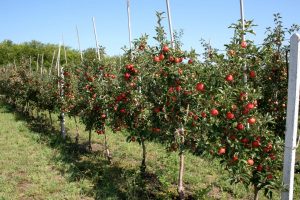 The tree is usually considered to be of medium height, although it is more likely to be of low growth.Without additional shaping, it can grow to a height of no more than 2.5-3.5 meters., so it can safely be called a natural semi-dwarf. The crown is round, irregular, asymmetrical, spreading with age, broadly oval or spherical when young, with medium to low density. Shoots extend from the main stem at a right angle, are straight, medium in length, covered with reddish-brown or reddish-brown bark, smooth, and pubescent. Fruiting is mixed.
The leaves are medium or slightly smaller than average, oval-elongated, short-pointed, leathery, and dense. They are mostly smooth but can be wrinkled, with coarse nervation. The edges are finely serrated, crenate-serrate, and rich green, light green, or just green in color; the underside may be slightly pubescent. The root system is superficial, shallow, and branched; fibrous on most rootstocks, with many small branches around the perimeter. It is moderately adapted to water-seeking.
Productivity and pollination
The variety is considered high-yielding, although it cannot be compared with many similar apple trees.
From one fully ripe Red Free tree trunk, successful growers can harvest at least 55-70 kilograms of apples per season. Considering the tree's low stature, these figures are considered above average for standard planting density..
A drawback of the apple tree is its extremely weak pollen production, although the variety is considered self-fertile. Without external pollinators, it will yield no more than 35-40% of its potential harvest. Therefore, trees are always planted interspersed with those that are at the appropriate time to bloom.
Winter hardiness and disease resistance
Apple trees are moderately tolerant of low temperatures. They can tolerate temperatures down to -22-25°C fairly well, but only if they don't last long. Therefore, trees should be carefully covered and wrapped, especially in areas with fairly cold winters.
Red Free is completely protected from all five races of scab by genetic immunity, however powdery mildew poses a serious threat to it, which is the variety's main drawback. Parasites can also damage apple trees. However, all these problems are easily solvable with timely, regular preventative measures using commercial products readily available at agricultural supply stores.
Rootstocks and subspecies
The variety doesn't currently have subvarieties, but they may appear in the future. There are no columnar or creeping Red Free varieties, so be careful when purchasing seedlings. The apple tree is grown on various rootstocks, with dwarf ones being the most preferred.
Features of growing Red Free
 Landing
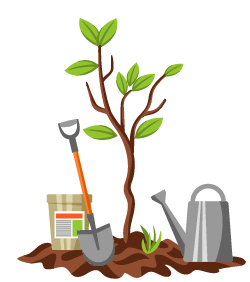 Landing
Basic conditions
- The soil for this variety should be rich, fertile, and permeable to air and water. If the soil is loamy or sandy, it should be fertilized, while heavy, rich black soil should be amended with clay and sand.
- The locations should be sunny and open, so that the sun's rays reach the apple trees for most of the day; in the shade, the trees will die.
- Apple trees should not be exposed to drafts, but stagnant air in the crowns is also not recommended, as this will encourage fungi to grow.
- It is customary to leave approximately 2-2.2 meters between trees, and up to 3 meters between rows. This will prevent them from clashing with their crowns and roots in the future.
- Dig holes in advance, making them 60-70 centimeters deep and the same in diameter. Fertilize the bottom (except for manure and nitrogenous complexes, which reduce survival), cover with soil and drainage, fill with water, and leave outdoors.
- Trellis or stakes are dug into the holes immediately to support them, otherwise wind and bad weather can uproot them and cause them to fall. If the trunks are positioned on the south side, these supports will provide additional protection from northerly winds in winter.
- When planting, the root collar must be left above the ground level to prevent roots from emerging higher. Otherwise, all the rootstock's properties will be negated.
- Drainage or soil is raked into the center of the hole. The tree is placed there, carefully spreading out the roots. The soil is sprinkled on top, and compacted by hand. The entire area is watered with 15-25 liters of water and mulched so that the mulch does not touch the bark.
Landing dates
The variety is quite delicate, especially when young, so it's best to plant it in the spring, when the soil has warmed up completely. A warm, dry day in April or May, before bud break, is ideal. It's a good idea to make sure there's no risk of frost before planting.
Tree care
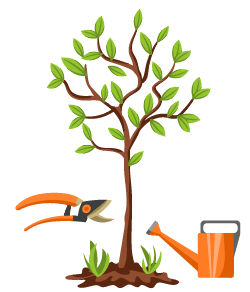 Tree care
Protection from frost and pests
After harvesting Red Free, it's not recommended to apply moisture until winter, otherwise the tree won't have time to prepare for winter. Young trees or those grown on dwarf rootstocks can be easily covered with a tent-like covering, using agrofibre, burlap, spongebond, or even tarpaulin. If the tree's size no longer allows this, simply wrap the trunks with suitable materials, and cover the area around the trunk with spruce branches, dry grass, or straw.
Whitewashing the lower part of the trunk with regular lime is effective against insects. This will prevent them from settling in the cracks in the bark. Rodents can be repelled with industrial products or regular animal lard, the smell of which will also discourage them from gnawing at the bark and young branches.
Loosening the soil, watering: proper agricultural technology
Regular digging around the trunks will be necessary to ensure adequate airflow and moisture for the rhizomes. Twice a year (winter-fall), using half a spade's depth, is sufficient, but extreme care must be taken to avoid damaging the shallow root system. During the rest of the growing season, you can simply lightly hoe the soil, for example, after each watering the following day. At the same time, weeds and debris should be removed from under the trunk, which is also very important for preventing fungal and parasitic diseases.
Red Free needs to be watered fairly frequently, especially in hot and dry years. The easiest way is to ensure the tree's root ball never dries out completely. When young, the apple tree requires more moisture, while as it matures, it needs slightly less. It's also a good idea to apply fertilizer along the perimeter of the tree's crown with water.
If you water the trees during the ripening period of the fruits, they may well crack, after which they will only be good for urgent processingThis also happens if it rains frequently. This will require careful monitoring, otherwise the entire harvest may be lost..
Pruning: simple crown shaping
The tree's crown shape is irregular due to branches growing at uneven rates. After initially forming sparse tiers, it's sufficient to simply maintain the natural branching and prune excess branches; the tree grows slowly. Red Free responds well to rejuvenation; starting at 10-11 years old, simply remove one or two mature branches, allowing the young ones to develop.
It's also important to regularly remove any dry, broken, or diseased branches. They will interfere with the trees' normal development and draw sap, which will be of no use, as the fruit on such shoots will no longer bear fruit. This is best done in the fall, but you can prune a broken branch at any time. The cut areas should be sealed. garden pitch, water-based or oil paint, or, in extreme cases, just soil.
Diseases and pests
- Cytosporosis.
- Powdery mildew.
- Black crayfish.
- Scale insect.
- Hawthorn.
- Green aphid.
Ripening and fruiting of Red Free
The beginning of fruiting
 The beginning of fruiting
Flowers on the tree can bloom in the first year after planting, but it's best not to let them set; it's best to pluck them immediately. Half of them will likely be barren, if not more, and the tree will waste energy on them that could otherwise be used to build up its rhizomes and foliage. The first fruiting usually occurs within 2-3 years, meaning you won't have to wait long.
Flowering time
These trees are known for their early fruiting season, so they bloom much earlier than most apple trees. Therefore, selecting pollinators carefully and meticulously ensures their timing is precisely matched. Red Free blooms profusely, simultaneously covering itself with large, fragrant flowers that emerge from large pink buds. As fruiting increases, flowering should be controlled by removing at least 35-50% of the blossoms, otherwise the apples will become smaller.
Fruiting and growth
The trees grow quite rapidly, growing 40-60 centimeters per year. Considering their short stature, apple trees reach their full height very quickly. They rapidly increase their fruitfulness, producing a full harvest by the 8th or 9th year. By then, flowering must be regulated each spring to prevent the fruit from becoming too numerous, which affects their size.
Red Free apples ripen in early August, sometimes delaying until mid-August. They are prone to shedding, so it's crucial to catch the moment. They ripen evenly, all at once, just as they bloom, so harvesting can be timed to coincide with the same day. The fruit is ready to eat immediately, delicious, juicy, and aromatic. They transport well and can even be stored in a cellar for 45-60 days without losing their flavor or texture.
Top dressing
- Potassium.
- Superphosphate.
- Humus.
- Peat.
- Calcium.
- Manure.
- Compost.
What to do if it doesn't bloom or bear fruit
- Increase watering.
- Remove insects.
- Cure diseases.
- Fertilize.
- Move to a sunny place.
Why do apples fall?
- Overripe.
- Wind, rain, hail, snow.
- Pests or diseases.
Leave a review of the Red Free apple tree variety so that even a novice gardener can receive useful information firsthand.