Apple tree VEM yellow: characteristics of the variety and care
| Color | Yellow |
|---|---|
| Ripening season | Autumn |
| Size of apples | Average |
| Taste | Sweet and sour |
| Crown type | Tall tree |
| Shelf life | Average shelf life |
| Application | Fresh , For recycling |
| Winter hardiness | High winter hardiness |
| Fruiting age | Up to 5 years |
 History of origin and regions of growth
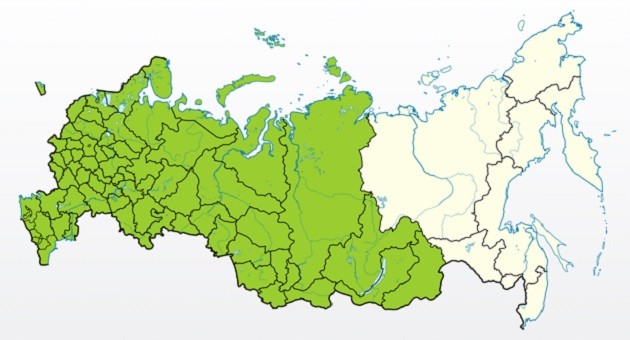
Growing regions
- Crimea.
- Volga-Vyatka region.
- Middle zone.
- Siberia.
- Leningrad region.
- Ural.
- North Caucasus.
- Moscow region.
Origin
Not long ago, a completely new apple variety was developed at the Sverdlovsk Horticultural Breeding Station of the Russian Academy of Agricultural Sciences. It was created by renowned Russian pomologist and breeder Leonid Andrianovich Kotov by crossing a special hybrid, 8K-523, with the Uralsky Souvenir variety. The goal was to develop a winter-hardy, scab-resistant variety, and this was a complete success.
There is no information about the VEM Yellow apple tree, also known as Danila, in the State Register. The variety also lacks official zoning. However, seedlings are already quite widespread throughout Russia.
Content
Description of the VEM yellow variety
 This tall, spreading, early-bearing tree immediately attracted the attention of gardeners across the country. It is easy to care for and requires little soil, doesn't require frequent fertilizing, and exhibits environmental resilience and adaptability. VEM easily tolerates even severe frosts and bears fruit regularly and abundantly. Its genetic code contains the Vf gene, which protects against all five types of frost. scabies.
The variety produces large, very attractive fruits with beautifully toasted rinds. They possess an excellent classic flavor and a powerful apple aroma, are easy to transport, and can be stored for quite a long time in the cellar. This variety is recommended not only for intensive commercial plantings, as its large, space-consuming crown is more suitable for individual garden plots.
Apples: What do they look like?
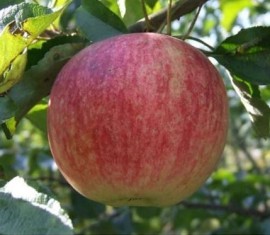
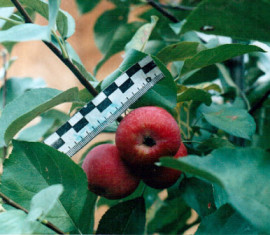
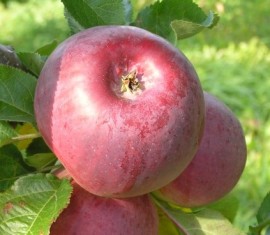
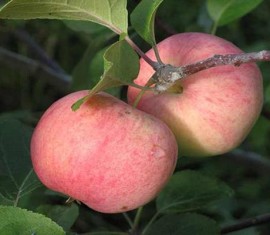
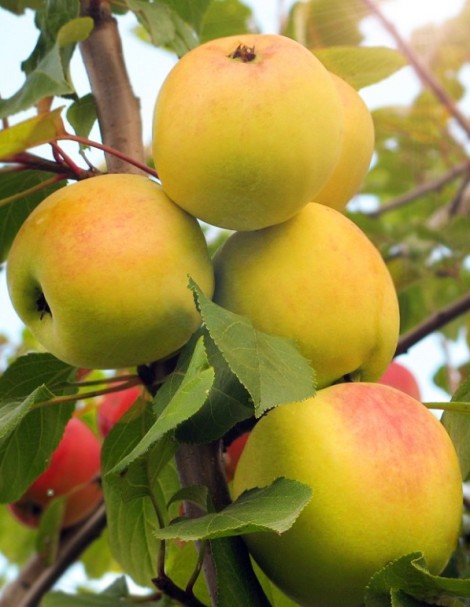
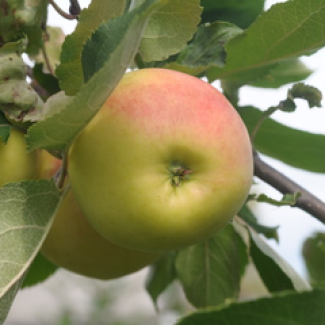
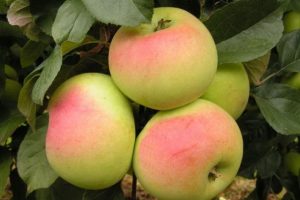 The VEM yellow variety produces medium to larger-than-average fruits, reaching 130-170 grams in weight. They are spherical in shape, sometimes slightly elongated, as if serrated, but not excessively so; they are round, smooth, and uniform. The apples are predominantly symmetrical and uniform, with clearly visible ribbing at the calyx, smoothed throughout the rest of the fruit, and lacking a lateral seam.
This variety has a dense, strong, and elastic skin, which many describe as firm and thick. It protects the fruit well from mechanical damage and is smooth and matte, but has a distinctive sheen. The skin's base color is yellow, straw-yellow, or whitish-yellow, often rich. On the sunny side, a translucent, blurred, spotted, speckled, or streaked blush of carmine-pink, crimson-red, or orange-red may appear. Subcutaneous dots are small but numerous, light gray or greenish in color, and not very visible. To assess the chemical composition, it's helpful to know the following:
- P-active substances (catechins) – 223 milligrams.
- Ascorbic acid (vitamin C) – 14.8 milligrams.
- Total sugars (fructose) – 11.3%.
- Pectins (fiber) – 8.7%.
- Titratable acids – 0.48%.
The VEM apple has a very pleasant flesh texture with a characteristic yellowish or yellowish-cream hue. It is fine-grained, easily broken, crisp, and very juicy. The apples have a sweet and sour flavor, considered harmonious, balanced, and dessert-like, with a delicate spicy undertone or a slightly winey note. Professionals give the fruit 4.5 out of 5 stars for taste and 4.6 for appearance.
Apple tree VEM yellow: characteristics
Crown and root system
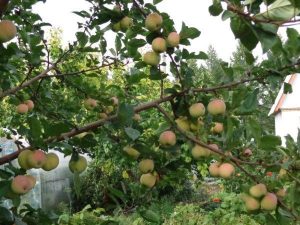 The tree of the VEM yellow variety is very tall, it can easily grow up to 10-12 meters in heightThe crown is spreading, oval or even pyramidal when young, but with age it widens, becoming increasingly weeping, drooping, and disheveled. The branches generally extend from the central core at a nearly right angle. They are long, sometimes slightly curved, but generally straight, and covered with greenish-yellow or yellow-brown bark. Fruiting is classified as mixed.
The tree's leaves are medium-sized to large, dense, smooth, and leathery. They are oval, elongated, and can be smooth or with wavy edges. The tip is long-pointed, and the edges are serrated, doubly serrated, and can be gathered upward into a boat-shaped form. The base color of the leaves is emerald-yellowish, but can also be rich green. They are matte, with a felt-like pubescence clearly visible on the underside. The tree's root system is very robust, strong, deep, and branched. On most rootstocks, the root system is fibrous, but on some, it may have a central taproot.
Productivity and pollination
It is generally accepted that this variety is high-yielding, although compared to such "dinosaurs" as Antonovka, it does not look very impressive.
One mature, fully formed tree can produce approximately 90-120 kilograms of aromatic fruit per season. According to official data, the average yield is 275-280 centners per hectare..
To produce fruit, the tree requires pollinators, as it is completely self-sterile. It's common to plant standard trees of different varieties, but with overlapping flowering times, interspersed, no more than 45-90 meters apart. At the same time, you can spray the crowns with sugar syrup and set up apiaries nearby.
Winter hardiness and disease resistance
This variety of VEM has high tolerance to low temperatures. Even young trees, 2-3 years old, can easily withstand temperatures as low as -32-35°C if properly prepared for winter and protected. The tree is resistant to sudden changes in temperature, from thaws to severe frosts, prolonged cold spells, and recurrent frosts, making it beloved and respected by gardeners in regions with challenging conditions, such as the Urals and Siberia.
The tree has a strong, genetically determined immunity to all five known scab strains. Apple trees are also resistant to other fungi and rarely become infected, especially with proper care. Parasites can damage tree trunks, but with timely prevention, there's no cause for concern.
Rootstocks and subspecies
The Danila variety in question has no subspecies or subcultivars. However, it can be grown on various rootstocks, imparting unique qualities and properties to the apple trees. This has virtually no effect on the taste or appearance of the fruit.
Features of growing yellow VEM
 Landing
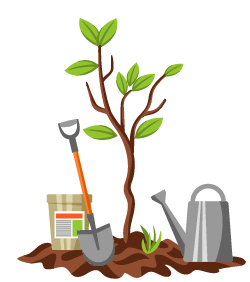 Landing
Basic conditions
- For planting, choose sunny places where the crown of the young tree will be illuminated for most of the day.
- Ventilation is important, but drafts can be dangerous. It's crucial to choose an open, but draft-free location.
- Groundwater levels in the area should not rise above 2-2.2 meters, otherwise the deep-seated rhizome may begin to rot, which will lead to the death of the apple tree.
- Leave a generous distance between trees, up to 5-6 meters, and between rows, up to 4-5 meters. This will prevent them from clashing with their crowns and roots in the future, interfering with each other's growth.
- Preparing holes for seedlings in advance is an important part of agricultural practice. They need to be well-established outdoors. To do this, dig holes 70-80 centimeters deep and 1 meter in diameter. Fertilizer is placed at the bottom of the holes, covered with soil from the top layer, and filled with water.
- The root collar (the grafting site) should always remain above the soil surface. For the VEM, 7-9 centimeters is sufficient to prevent it from rooting higher and compromising the rootstock's properties.
- It would be a good idea to insert supports or trellises into the holes for young trees; they will provide additional support and also protect them from cold winds in winter.
- Inspect the seedlings before planting, and remove any dry or broken shoots. To improve survival, soak the rhizomes in water for several hours, for example, the evening before planting in the morning.
- Place the tree on a drainage mound, spread out all the roots, cover with soil, and compact it well with your hands or feet. Water the surface with 30-45 liters of water, and then mulch to retain moisture in the soil for longer.
Landing dates
Yellow VEM can be planted not only in early spring, when the soil has warmed up completely, but also in autumn, after the leaves have fallen. Light frosts aren't harmful to apple trees, but sap flow in the trunks should be prevented. If the tree starts growing or doesn't have time to prepare for winter, the buds and even the wood can be seriously damaged. Therefore, in warmer regions, this isn't a big concern, but in harsher climates, spring planting is better.
Tree care
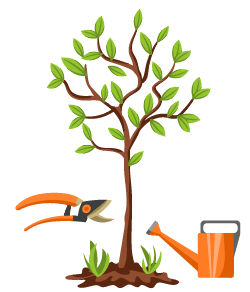 Tree care
Protection from frost and pests
Despite the trees' enviable frost resistance, preparing them for winter is both possible and necessary. While the trees are still young, they can be covered with tent-like coverings, swaddled in burlap or agrofibre from root to tip. This isn't possible with large, mature apple trees, and they don't need it anyway. It's sufficient to wrap the trunks with roofing felt or tar paper, and layer the root zone with spruce branches, straw bales, hay mats, or dried leaves.
To repel hungry mice and hares that feast on the delicate bark and twigs during the winter, coat apple trees with old lard, rendered animal fat, grease, or fuel oil. Insects can easily be eliminated by whitewashing the trunks with a thick lime solution. This is done twice a year, in the fall and spring.
Loosening the soil, watering: proper agricultural technology
Gardeners typically dig around the trunk once or twice a year, during the period when the sap is not flowing, that is, in spring and fall. However, for a mature yellow cedar, once is sufficient. During growth, the soil can also be lightly loosened, for example, the day after applying moisture. At the same time, remove all debris from the soil surface, trimming weeds, root suckers, and shoots of other plants. After 10-12 years of growth, the circle can be seeded with grass (lawn or herbaceous), which will provide natural aeration.
Watering is only necessary during the hottest and driest periods and when the plant is young. You can simply monitor the soil, preventing it from drying out completely. Wait 12-14 days after each rainfall before watering, as excessive moisture promotes disease. Fertilizers and fertilizers can be diluted with water, but not earlier than 4-5 years after planting.
Pruning: simple crown shaping
The variety isn't particularly prone to excessive density. Therefore, crown shaping is done in a nursery or in the garden from the first year, and then the natural branching is simply maintained. All non-fruit-bearing shoots, such as those growing inward, crossing, parallel, or vertically upward, should be pruned. The optimal shape is tiered, oval, pyramidal, or sparsely tiered.
In the fall, only sanitary cleaning is usually carried out, waiting until the sap has completely died down in the trunks. All cut areas should be carefully sealed. garden pitch or paint over it, if that is not possible, you can simply rub it over with soil.
Pollinator varieties
- Teremok.
- Cinnamon striped.
- Ural souvenir.
- Raika.
- Saffron pepin.
- Teremok.
- Professor Sprenger.
- Antonovka.
- Gala.
- Ranetki.
Diseases and pests
- Cytosporosis.
- Black crayfish.
- Powdery mildew.
- Leaf roller.
- Scale insect.
- Green aphid.
- Leafhopper.
- Hawthorn.
Ripening and fruiting of yellow VEM
The beginning of fruiting
 The beginning of fruiting
This variety produces fruit quickly; buds and beautiful flowers can be seen as early as the second or third year. However, it's best to pluck them completely to allow the tree to develop foliage and rhizomes. The first harvest is typically in the fourth or fifth year, when the crop has already reached several kilograms of fragrant fruit.
Flowering time
This variety is considered to bloom mid-season, in mid-May or towards the end of May. Therefore, pollinators are usually uncomplicated—there are plenty of varieties that bloom around the same time. Its flowers are small, but they cover the branches abundantly, turning the tree into a beautiful garden design element. The petals are delicate, airy, light, slightly pinkish or milky pink, and intensely fragrant.
Fruiting and growth
It will take the tree approximately 10-14 years to reach its maximum size, and the same amount of time will be required to wait for a full, full harvest. It grows approximately 60-70 centimeters per year, which is quite a lot. At full maturity, a full harvest of fruit can be harvested, but there is a risk that yield may fluctuate in unfavorable years or with improper care.
It's best to pick them from the branches in the first half of September or mid-September. However, it's important to keep a close eye on the fruit; if they've become plump, it's best to harvest them immediately. recycleThey store well, almost until the end of February or early March. They can be easily transported over long distances in boxes with two or three layers.
What to do if it doesn't bloom or bear fruit
- Limit or increase watering.
- Eliminate insects.
- Cure diseases.
- Feed.
- Transplant to a sunny place.
Top dressing
- Superphosphate.
- Humus.
- Peat.
- Calcium.
- Manure.
- Compost.
Why do apples fall?
- Wind, frost, rain, hail.
- Overripe.
- Pests or diseases.
Leave a review of the VEM Yellow apple tree variety so that even a novice gardener can receive useful information firsthand.