Vospitannitsa apple tree: characteristics of the variety and care
| Color | Reds |
|---|---|
| Ripening season | Autumn |
| Size of apples | Small ones |
| Taste | Sweet and sour |
| Crown type | Tall tree |
| Shelf life | Average shelf life |
| Application | Fresh , For recycling |
| Winter hardiness | High winter hardiness |
| Fruiting age | Up to 5 years |
 History of origin and regions of growth
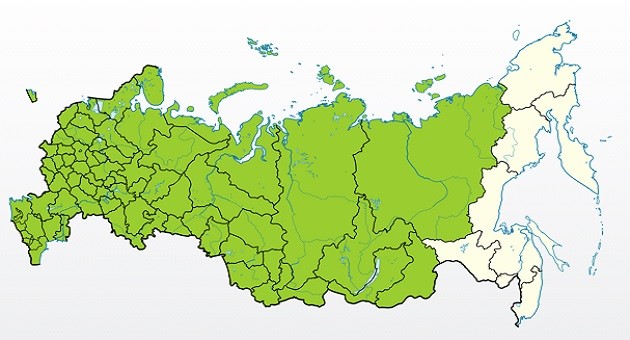
Growing regions
- Crimea.
- Middle zone.
- Tatarstan.
- North Caucasus.
- Moscow region.
- Leningrad region.
- Ural.
- Siberia.
- Bashkortostan.
- Novosibirsk region.
Origin
This apple tree was bred in the mid-twentieth century at the Krasnoyarsk Experimental Breeding Station. Russian pomologists N. N. Tikhonov, A. S. Tolmacheva, and A. N. Lyubochko participated in the breeding process. Around 1950, a cross between the Pudovshchina variety and the Alma-Ata Aport resulted in a semi-cultivated variety, which was later named Vospitannitsa.
There is no information about the apple tree in the State Register of Breeding Achievements. It also has no official regionalization, but it can be grown practically anywhere in our country. It is most popular in the Novosibirsk, Irkutsk, Kemerovo, Omsk, and Tyumen regions.
Content
Description of the Vospitannitsa variety
 This semi-cultivated variety, boasting high winter hardiness, is sure to attract the attention of gardeners in harsh regions of the country. It easily withstands not only winter frosts but also sudden fluctuations in temperature, and tolerates dry and hot summer periods with ease. The tree is environmentally sustainable, undemanding of care and soil, and requires little frequent feeding, fertilizing, or watering. It is tall and takes up quite a bit of garden space, but this is compensated for by its early maturity, bearing fruit regularly, producing good annual harvests of aromatic and highly nutritious apples.
The fruits themselves are small on the tree, but very rich in a variety of nutrients, as with most semi-cultivated varieties. They are beautiful, aromatic, easy to transport, and keep quite well, which is unusual for northern varieties. Vospitannitsa is recommended for cultivation in private gardens, due to its tall stature, which would hinder mass harvesting.
Apples: What do they look like?
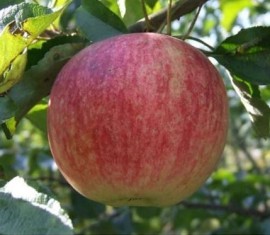
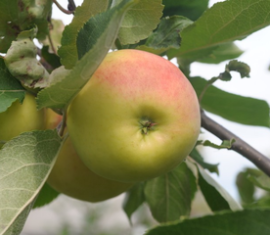
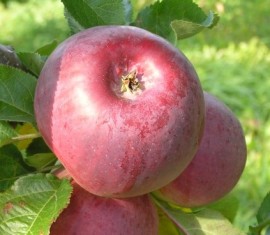
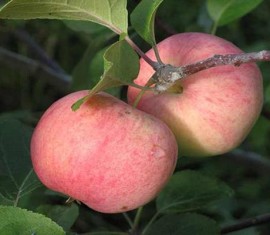
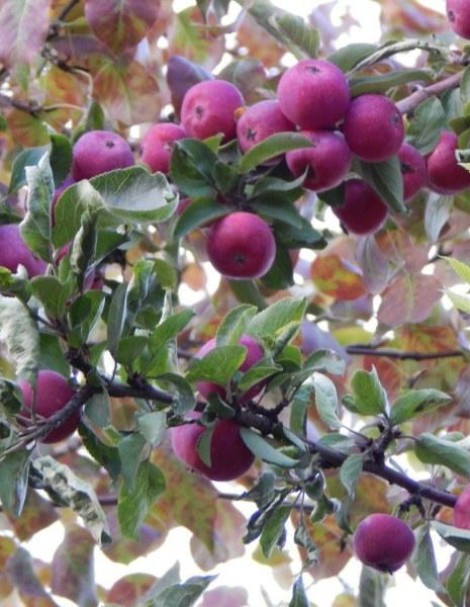
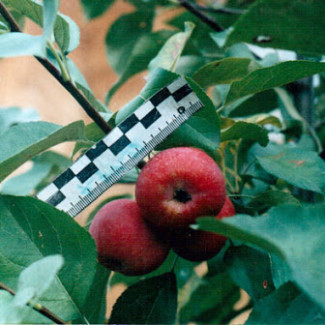
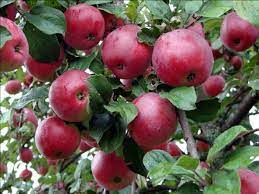 The fruits are small or close to medium, but rarely so. Most apples weigh barely 25-35 grams, but in some years, individual specimens can reach 70-80 grams. They are symmetrical, mostly uniform. Their shape is round, sometimes slightly conical, flattened, and can be bulbous or slightly elongated, with subtle ribbing and no lateral seam.
The skin is above average in density, medium in thickness, elastic, even somewhat firm, just right to protect the flesh from mechanical damage. It is smooth and, during ripening, becomes covered with a dense, waxy, silvery-gray coating. The base color is green or greenish-yellow. The blush is dark red, rich red, or burgundy, occupying at least 65-80% of the surface. Subcutaneous punctures are numerous, elongated, greenish-gray, and large. Assessing the chemical composition is easy, once you understand a few indicators:
- P-active substances (catechins) – 442 milligrams.
- Ascorbic acid (vitamin C) – 18.9 milligrams.
- Total sugars (fructose) – 14.6%.
- Pectins (fiber) – 13.9%.
- Titratable acids – 1.26%.
Vospitannitsa has firm to medium-firm flesh, fine-grained, and very juicy. It's typically milky-green, sometimes slightly lemony, and the skin has reddish-pink veins, giving it a distinctive hue. The flavor is considered pleasant, harmonious, sweet and sour, with a distinct spicy-wine acidity, and dessert-like. Professional tasters give the fruit 4.6-4.8 points out of 5.
Apple tree Vospitannitsa: characteristics
 Crown and root system
 Crown and root system
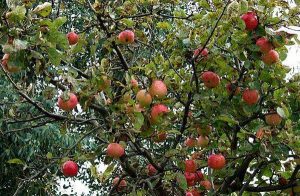
This tree is very fast growing and also tall. It can easily reach a height of 10-11 meters., if not trained properly and in a timely manner. Pruning can keep the trunks within 6-7 meters, which will significantly facilitate maintenance and harvesting. The crown shape is round, oval-elongated, or high-oval, moderately dense, and fairly compact. In old age, it can become slightly spreading. The shoots are medium in length and thickness, rounded in cross-section, covered with smooth, greenish bark, and bear mixed fruit.
The leaves are small to medium-sized, elongated, with short, pointed tips. The margins are finely serrated, jagged, often wavy, or folded into a boat shape. They are usually a rich, bright, or light green, with rough ribbing and sometimes a felty down on the underside. The root system is very robust, well-dug, and branched; fibrous on most rootstocks, but can also be taproot. It is well adapted to the search for water and nutrients.
Productivity and pollination
The variety cannot be called high-yielding, although for northern apple trees it produces a very decent amount of fruit.
One mature Vospitannitsa tree can yield up to 75-85 kilograms of aromatic and extremely nutritious apples in just one season. In some unfavorable years and/or with poor care, yields can drop by approximately 45-50%.
Semi-cultivated apple trees are self-fertile by default, requiring no external pollinators to produce fruit. They are also considered excellent pollinators for other varieties. However, experienced gardeners say that if other apple trees with suitable flowering times are nearby, the variety's yield increases significantly (by 45-70%). Therefore, it is advisable to interplant the trees.
Winter hardiness and disease resistance
Vospitannitsa's frost resistance is very high. It can survive winters with temperatures down to -39-42°C without any damage. It survived the harsh winters of 1976-1978 with only 1-2 frost damage. However, it's important to remember to properly prepare for cold weather and provide shelter, as trees dislike prolonged frosts, high humidity, and sudden temperature fluctuations.
The variety's field resistance to various diseases is excellent, but scab regularly attacks the foliage. Most often, the fruit is unaffected, but during years of severe epiphytotics, anything can happen. Therefore, prevention is just as important for Vospitannitsa as for other apple trees. Pests readily attack the apple tree, and it's important to ensure they are eliminated.
Rootstocks and subspecies
The most popular type of apple tree is the standard vegetative rootstock, but it can be grown on almost any type. There are no subspecies of semi-cultivated rootstocks yet, and there are no columnar or creeping varieties, so be careful when purchasing.
Features of growing a Pupil
Landing
 Landing
Basic conditions
- The soil for planting apple trees is not at all important, the main thing is that it is permeable to air and moisture, but this task is easily accomplished by diluting the soil with river sand and loosening it regularly.
- A sunny location will allow the tree to reach full strength faster, produce a full harvest, and produce sweeter and healthier apples. In the shade, trees may simply stretch upward without developing lateral shoots, leading to low fruit yields. In some cases, severe shade can even kill the apple tree.
- It's advisable to consider the depth of the groundwater table. The powerful root system penetrates deep and will rot if it reaches water. Therefore, it's best to choose drier sites and avoid planting apple trees near rivers and lakes, in swamps, or floodplains.
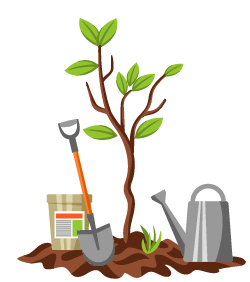
- Preparing the planting site in advance isn't necessary; apple trees tolerate almost any conditions. When pre-digging, make holes a meter deep and the same in diameter, add fertilizer to the bottom, water, and add drainage if needed. If you're planting right away, you can simply dig a hole, fill it with stones, and add water. In the latter case, fertilizer can be applied the same year as planting.
- It's a good idea to leave 5-6 meters between trees and the same amount between rows. The tree is large and can interfere with the proper development of surrounding plants, so this is also worth considering.
- If there is a need to preserve the properties of the rootstock, the root collar is left above the soil surface by 4-6 centimeters.
- Initially, the tree needs support, so it's best to dig in or drive in planks or stakes right away. The seedlings will be tied to these stakes using regular garden or utility twine in a figure-eight pattern.
- The tree is placed in the hole, the roots are dipped in a mixture of soil and water, and a special rooting compound is used if necessary. The roots are covered with soil, compacted, the surface is watered, and mulched.
Landing dates
The variety doesn't care whether it's transplanted outdoors in the fall or spring. The key is for the soil to be warm, but for the sap to remain immobile in the trunks. The further north the growing region, the better the March-April period, to prevent the imminent cold weather from damaging the young and fragile apple trees.
Tree care
 Tree care
Protection from frost and pests
The plant is very resistant to low temperatures, so no special tricks are required. Simply wrap the trunks with burlap or old tights. In the coldest regions, cover the root zone with mats of hay or straw or spruce branches, which are removed in early spring before the trees begin to grow.
Whitewashing the tree trunks with regular lime to a height of 1-1.3 meters, or treating them with industrial chemicals, is effective against insects that readily settle in bark crevices. Rodents can be repelled by coating all tree trunks with rendered animal fat, grease, fuel oil, or old drying oil. Covering trunks with metal or strong plastic mesh also effectively protects the bark from being eaten by hares and hamsters.
Loosening the soil, watering: proper agricultural technology
Only the youngest trees should be dug. This can be done in spring and fall, or even just once a year. Hoeing the soil more frequently is possible, but not necessary. It should be thoroughly loosened only the day after watering, during dry and hot weather. In the fourth to sixth year, you can sow herbs or lawn grasses around the tree trunk to provide natural aeration. Remember to remove debris, weeds, and other plant shoots from under the tree.
Only very young seedlings or those growing in particularly arid regions may require frequent watering. In these cases, water should be applied 5-7 times per season, at a rate of 456-60 liters per trunk. In normal climates, trees require water much less frequently; it can be applied 2-3 times per season, mixed with fertilizers and fertilizers.
Pruning: simple crown shaping
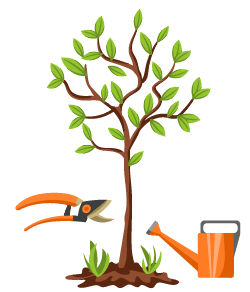
The Vospitannitsa (Pupil) tree doesn't grow very densely, but it still requires maintaining its crown. It's best to create a sparse, layered style from the first year, then simply maintain it, preventing the tree from becoming overgrown. To achieve this, remove all shoots growing inward, upward-protruding, parallel, or intersecting.
Sanitary cleaning is usually carried out in the fall, when trees can best withstand stress. All broken, dry, or diseased shoots should be cut off. They will no longer be useful, and they still draw sap from the tree. It's customary to cover the cut areas with paint or garden pitch, but if there is nothing like that, then an ordinary swamp will do just fine.
Pollinator varieties
Diseases and pests
- Scab.
- Cytosporosis.
- Fruit rot.
- Powdery mildew.
- Black crayfish.
- Scale insect.
- Leafhopper.
- Hawthorn.
- Green aphid.
- Leaf roller.
Ripening and fruiting of the Pupil
The beginning of fruiting
 The beginning of fruiting
The variety begins bearing fruit quite early, which is unusual for Siberian winter-hardy apple trees. Already in its fourth or fifth year, it can produce up to 5-10 kilograms of aromatic fruit. Of course, you'll have to wait a bit longer for full fruiting, but not too long.
Flowering time
The tree's buds are a rich pink, even slightly purple, and appear quite late on the tree, so recurrent frosts usually don't affect fruiting or harvest. The flowers are pale pink or white with a slight pink tint, the petals light, delicate, airy, and very beautiful. The tree blooms profusely, looking elegant during this period, and its fragrance carries for dozens of meters.
Fruiting and growth
Few apple trees can match the vigor of the Vostutannitsa, as it can grow 90-100 centimeters per year, reaching its maximum height in just ten years. This growth rate allows for a very rapid increase in fertility. By the eighth or ninth year, the apple tree produces a full harvest, and its long lifespan allows for colossal yields.
The fruit begins to ripen as early as early September, but can sometimes take until mid-September. You can tell when it's ripe by the color; it turns dark burgundy or purple, and the under-skin spots lighten. Apples ripen evenly, transport well in boxes and in bulk, and can be stored in a standard cellar for up to 60-80 days. They are suitable for drying, jams, preserves, marmalades, and juices.
Top dressing
- Superphosphate.
- Humus.
- Peat.
- Calcium.
- Manure.
- Compost.
- Nitrogen complexes (not in the first 3-4 years).
What to do if it doesn't bloom or bear fruit
- Increase watering.
- Remove insects.
- Cure diseases.
- Fertilize.
- Move to a sunny place.
Why do apples fall?
- They are very overripe.
- Wind, rain, hail, snow.
- Pests or diseases.
Leave a review of the Vospitannitsa apple tree variety so that even a novice gardener can receive useful information firsthand.