
Apple tree Amber Necklace: characteristics of the variety and care
| Color | Yellow |
|---|---|
| Ripening season | Autumn |
| Size of apples | Large |
| Taste | Sweet and sour |
| Crown type | Columnar tree |
| Shelf life | High shelf life |
| Application | Universal variety |
| Winter hardiness | High winter hardiness |
| Fruiting age | Up to 5 years |
 History of origin and regions of growth
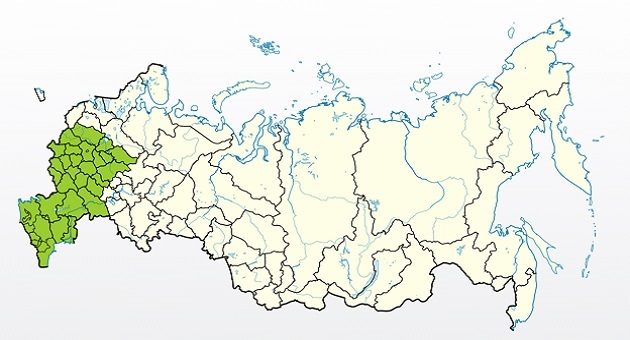
Growing regions
- Some northern regions.
- North Caucasus.
- Crimea.
- European part of Russia.
Origin
Many columnar apple trees in our country were developed under the guidance of Mikhail Vitalyevich Kachalkin, a renowned modern breeder and practitioner, PhD in agricultural sciences, and the long-time director of the Experimental and Selection Nursery. At the beginning of the new century, through open pollination of a seedling of the famous Vozhak variety, a completely new hybrid was created, later named "Amber Necklace."
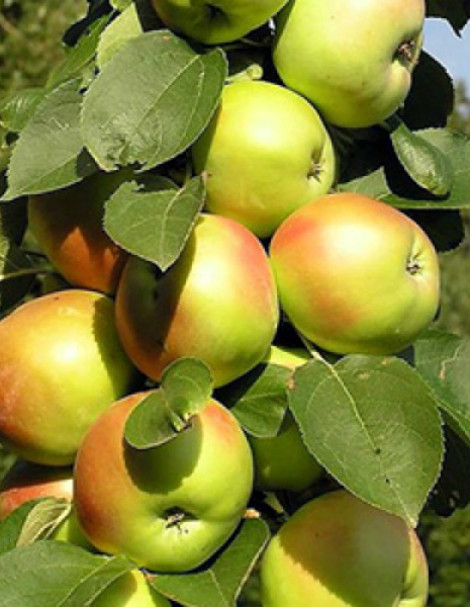
The apple tree gets its name from the appearance of its fruits, which sit tightly on the main conductor, like beads on a string. The apples themselves have an orange-carmine blush on their surface, making them resemble chunks of amber.
The variety was accepted for official field trials in 2007. These were conducted in the Kaluga Region, where all the necessary conditions are available. In 2008, the variety was added to the State Register of Breeding Achievements and zoned for the Central and Central Black Earth regions.
Content
Description of the Amber Necklace apple tree variety
 Every professional and amateur gardener desires early-bearing, fast-growing, and prolific clonal apple trees. The Amber Necklace fully meets all these characteristics. Moreover, these trees are relatively low-maintenance, undemanding of soil, and have good tolerance to low temperatures.
The fruits are unusual, attractive in appearance, very aromatic, and delicious. They are quite large, easy to transport, and store for long periods. The trees are resistant to disease, tolerate dry periods, and are recommended for growing in intensive commercial orchards and small private plots, and can be grown in pots.
Apples: What they look like
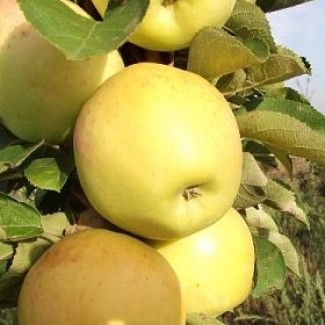
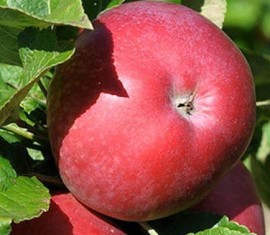
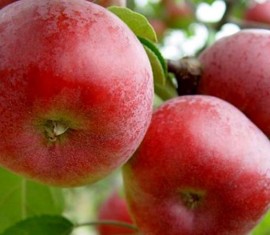
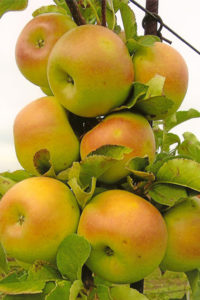 The apples are round, often slightly flattened along the central axis, uniform in size, and medium in size. Most fruits grow to 120-145 grams, but in some cases they can be slightly smaller or larger. By thinning the blossoms (to regulate flowering), experienced gardeners have achieved fruit sizes up to 250-280 grams in favorable years, although their yield has significantly decreased.
The skin is dense, strong, and elastic, but not hard; it's quite brittle, glossy, and smooth. It has a green or greenish-yellow hue during ripening. The blush is translucent, diffuse, reddish, carmine, or pink, and can be orange or crimson, occupying approximately 35-45% of the surface. Subcutaneous punctures are infrequent, fairly small, grayish, and barely noticeable against the light skin. The chemical composition is most easily assessed by analyzing the following parameters:
- P-active substances (catechins) – 325-341 milligrams.
- Pectins (fiber) – 11.9%.
- Sugars (fructose) – 13.6-14.2%.
- Titratable acids – 0.62%.
- Ascorbic acid (vitamin C) – 13.7-14.1 milligrams.
The flesh is dense and snow-white, but in some cases it can have a light green tint. It's crisp, prickly, easy to peel, not hard, and has a pleasant texture. The flavor is sweet and sour, officially considered a table fruit, although many say it's more of a dessert fruit. Professional tasters give the Ozherelye a maximum of 4.3 points for taste and appearance.
Apple tree Amber Necklace: characteristics
Crown and root system
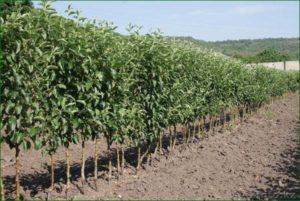 The maximum height of a tree directly depends on the rootstock it is grown on. Therefore, it can be said that The variety can be from 1.5 to 3-3.5 meters in heightIt grows from a single, thick trunk that does not produce lateral skeletal branches if properly maintained. The crown width typically does not exceed 25-40 centimeters in diameter, significantly reducing the space it occupies. The bark is smooth, without pubescence, and grayish-brown or gray-green.
The leaves grow in a dense mat; they are medium-sized, leathery, elongated, green, smooth, and glossy. The blades are short-pointed, with a strongly serrated, serrate-crenate edge. Fruiting occurs on one- and two-year-old fruiting canes. The root system is extensive, fibrous, but shallow and superficial.
Productivity and pollination
This is a consistently productive variety that produces almost the same amount of fruit throughout its active life.
During the season, a single young Yantarnoye Orelya (Amber Necklace) tree can yield at least 5-8 kilograms of beautiful and delicious fruit. With age, the yield will increase until it reaches 12-20 kilograms, making this variety a record-breaker among columnar varieties.
This variety is considered sterile for itself, so it should be interplanted with other varieties to ensure cross-pollination. Pollinators should be kept no further than 50-90 meters away, otherwise, it won't be very effective. To attract insects, trees are sprayed with honey or sugar diluted with water during flowering.
Winter hardiness and disease resistance
The Ozherelye tree's cold tolerance is quite good, especially considering it's a columnar tree. It tolerates harsh winters with temperatures down to -27-30°C, but requires shelter and proper winter preparation. Excessively hot summer weather can reduce the plant's winter hardiness, so after such a period, more careful consideration should be given to covering it for the cold season.
The variety is quite resistant to all infectious fungal diseases, due not so much to genetic immunity as to its ease of care and crown structure. It is exposed to all winds, as it has no side branches, allowing for ventilation. The trees require regular treatment with fungicides and insecticides to prevent disease and insect attacks.
Rootstocks and subspecies
Columnar apple trees generally don't have any subspecies, especially not the new variety Amber Necklace. They can be grown on a wide variety of rootstocks, with some surprising results. On seed rootstock, trees grow over three meters tall, while on dwarf rootstocks, they barely reach a meter or a meter and a half. Fruit characteristics, however, remain largely unchanged.
Features of growing Amber Necklace
 Landing
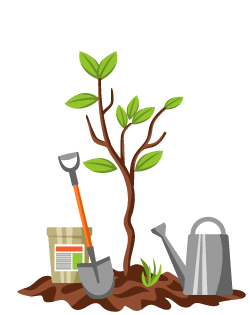 Landing
Basic conditions
- All fruit trees need good light for comfortable growth and good fruit production. Even in the shade, the Ozherelye can produce a good harvest, although the fruit may be small and fewer in number.
- Choose well-ventilated locations, such as open spaces. Stagnant air in the crowns usually leads to disease, which is completely unacceptable.
- Any soil is suitable, as modern agricultural techniques make it possible to create absolutely comfortable growing conditions for any crop, even on rocky slopes, in sand or loam.
- Proximity to groundwater isn't a problem for the Ozherelye; in fact, if the water depth is 1.7-2 meters, it's a perfect spot. However, planting the tree directly near a lake, river, or swamp is not recommended, as the roots may rot.
- Holes are dug either the previous season or 2-4 weeks before planting. The holes are 50 x 60 centimeters and 70 centimeters in diameter. A small amount of fertilizer mixed with soil is added to the bottom, followed by drainage if necessary, and then filled with water.
- You can leave very little space between the trunks, up to 35-50 centimeters, and between rows 50-60 will be enough, but it is better to make 1.1-1.3 meters, this will significantly facilitate care and harvesting.
- Stake stakes are immediately driven into the holes to secure the young seedlings, otherwise even a moderate wind can knock them over. It's best to position them on the north side, as they will provide additional protection from frost.
- Root collar The rootstock must remain at least 6-8 centimeters above the soil surface, otherwise the tree will root higher. Then the original qualities of the rootstock will be lost.
- Place the seedling on a mound of soil or drainage material, spread the roots, and cover with soil, compacting it with your hands, but not too hard. Water the trees with 15-20 liters of water, and mulch the surface.
Landing dates
Apple trees with a closed root system can be transplanted into open ground at any time during the growing season. For open-rooted trees, autumn is a better time to plant them, as this allows for better rooting. However, much depends on the climate. If winters in the region are harsh and frosty, then Ozherelye should be planted in the spring before bud break; in moderate and warm conditions, in September-October.
Tree care
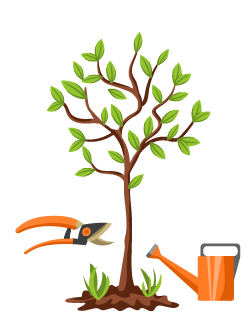 Tree care
Protection from frost and pests
For the winter, the root zone is covered with spruce branches, straw bundles, dry leaves, or grass. This will protect the shallow roots from freezing. The trunks are wrapped in burlap or other fabric. Compact trunks can be covered with a ball-shaped covering using special film or tarpaulin.
To prevent insect attacks, tree trunks are whitewashed with lime in the spring and fall, to a depth of approximately 60-80 centimeters. The easiest way to repel rodents is to coat the trees with rendered animal lard, grease, or drying oil. The key is to ensure the substance has a strong and unpleasant odor, but does not harm the future harvest.
Loosening the soil, watering: proper agricultural technology
The root zone is dug very carefully and gently twice a year. It's important not to disturb the roots that run close to the surface, as this will stress the tree, which can negatively impact fruiting. Hoeing the soil is a good idea 6-8 times per season, after rain or watering the following day, to prevent the soil from compacting into a tight ball.
Trees should be watered as needed, when the soil becomes dry, but it's best not to overwater. Ideally, water once every ten days, unless it rains. If precipitation does occur, count the ten days from that date.
Pruning: simple crown shaping
The plant is trained into a single trunk, so if lateral shoots appear, they will need to be pruned immediately, preventing them from developing and becoming woody. They don't appear often, so they shouldn't cause any problems. If the top bud freezes in winter, the runner will need to be cut back to the second bud, and then allowed to develop a new top. Dead, dry fruiting shoots should be pruned regularly.
Pollinator varieties
- Barguzin.
- Vazhak.
- Sweet Vikich.
- Ostankino.
- Melba.
- Constellation.
- Senator.
Reproduction
- Rooting.
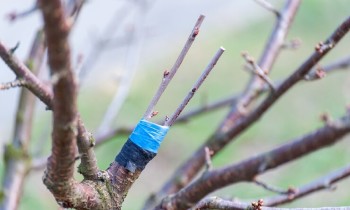
- Kidney grafting.
- Growing from seeds.
- Cuttings.
Diseases and pests
- Black crayfish.
- Scab.
- Bacterial burn.
- Powdery mildew.
- Green aphid.
- Codling moth.
- Scale insect.
- Hawthorn.
Ripening and fruiting of the Amber Necklace
The beginning of fruiting
 The beginning of fruiting
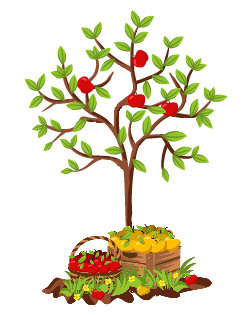
This apple tree is known for producing its first blossoms already in the nursery, but these should be picked immediately, preventing them from developing into apples. The same approach should be taken in the second year. The first harvest can be reaped in the third or fourth year, when it has already reached a size of 4-6 kilograms. It is advisable to perform annual flowering control, removing 35-50% of the blossoms; this will significantly increase the size of the resulting fruit, even in the first years of fruiting.
Flowering time
The tree's flowering period depends directly on the weather and the climate of the area where it's grown. In warmer regions, it can bloom as early as late April, while in colder regions, it can begin blooming in early or even mid-May. The necklace produces a profusion of large, cup-shaped buds with large, slightly pinkish petals, very beautiful and fragrant. They densely cover the entire trunk, making the tree very attractive and decorative during this period.
Fruiting and growth
This fast-growing apple tree can reach 45-65 centimeters in a single year, quickly reaching its full potential. By the fifth or sixth year, it's a full-grown tree with a fully formed crown, capable of producing a substantial harvest. At this point, with proper care, you can harvest 15-18 kilograms, and sometimes much more, of fragrant fruit.
Apples begin to ripen around mid-September, but cold, rainy weather can delay them slightly. The fruits cling to their twigs quite firmly and don't tend to fall to the ground, so there's no need to rush picking. After picking, they're placed in wooden boxes filled with sand or sawdust, where they can be stored in a cellar or refrigerator until spring.
Top dressing
- Humus.
- Superphosphate.
- Compost.
- Manure.
- Mineral complexes.
- Peat.
- Ammonium nitrate.
What to do if it doesn't bloom or bear fruit
- Check for pests or diseases.
- Transplant into the sun.
- Water.
- Fertilize.
Why do apples fall?
- Wind, hail, hurricane, rain.
- Pest damage.
- Diseases.
Please leave your feedback on the Amber Necklace variety, as many gardeners would like to grow similar ones in their gardens.



Comments
Everything is very open with a very clear description of the issues. It was definitely informative. Your website is very useful. Thank you!