Apple tree Yubilyar: characteristics of the variety and care
| Color | Greens |
|---|---|
| Ripening season | Summer |
| Size of apples | Average |
| Taste | Sweet and sour |
| Crown type | Average tree height |
| Shelf life | Low shelf life |
| Application | Fresh , For recycling |
| Winter hardiness | Average winter hardiness |
| Fruiting age | From 5 years old |
 History of origin and regions of growth
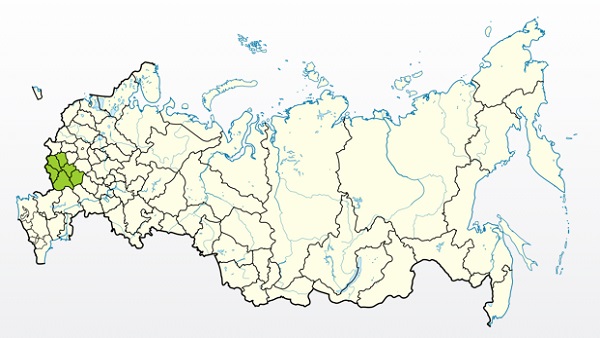
Growing regions
- Belgorod region.
- Tambov region.
- Voronezh region.
- Oryol region.
- Kursk region.
- Lipetsk region.
Origin
A new late-summer triploid variety began to be developed at the All-Russian Research Institute of Fruit Crop Breeding in the early 1980s. A team of breeders, led by E. N. Sedov and including G. A. Sedyshcheva, Z. M. Serova, and V. V. Zhdanov, obtained a seedling from open pollination of the complex hybrid form 814 in 1982. The parent varieties are Delicious Golden, M. floribunda 821, and F2. The first fruits were harvested from the tree eight years after planting.
In 1990, the seedling was designated an elite variety, and just five years later, it was sent for field trials on nearby farms. It took nearly two decades for the crop to be included in the State Register and zoned for the Central Black Earth Region, which only happened in 2009.
Content
Description of the apple tree variety Jubilee
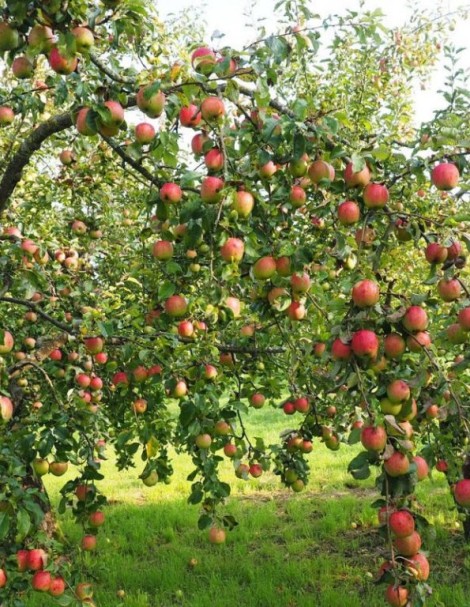
 Apple trees quickly gain foliage and grow tall, are not prone to self-crowding, and are compact, making harvesting much easier. They regularly produce abundant crops without a resting period for many years in a row. They are undemanding, undemanding of growing conditions, and genetically immune to scab. The fruit itself is attractive, tasty, and easy to transport, but has a relatively poor shelf life. However, despite this, they are recommended for both small home gardens and commercial, intensive cultivation.
Apples: What they look like
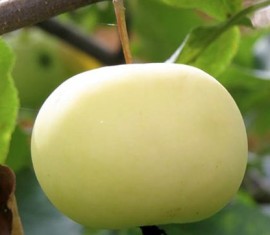
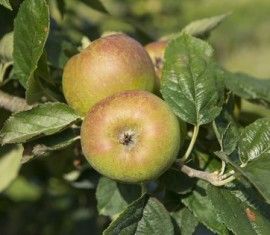
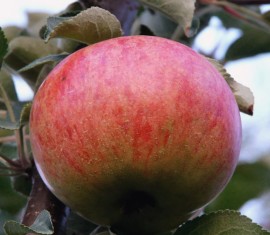
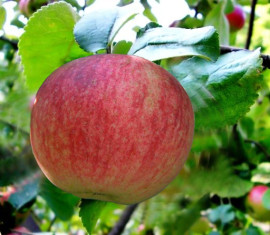
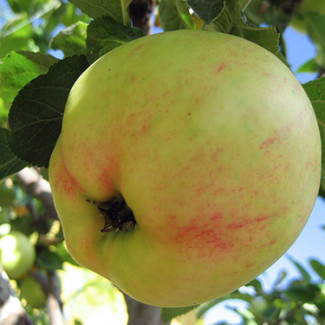
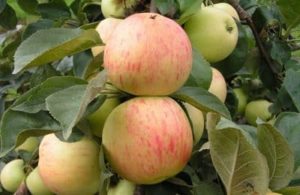 Yubilyar fruits are medium-sized or slightly larger than average, weighing a maximum of 130-150 grams. They are generally round, but can also be round-turnip-shaped or conical. They are smooth, with noticeable, but not overly so, ribbing.
The fruit's skin is smooth, glossy, and dense, free of any oily or waxy coating. It is a rich green when unripe, becoming greenish-yellow or lemon-colored as it ripens. The blush occupies a small portion of the surface, no more than 10-15%; it is crimson or pinkish-red, faintly streaked, pale, and translucent. Subcutaneous punctures are numerous, green, and clearly visible. The chemical composition is best expressed by the following values per 100 grams:
- P-active substances (catechins) – 452 milligrams.
- Ascorbic acid (vitamin C) – 17.5 milligrams.
- Total sugars (fructose) – 10.6%.
- Pectins (fiber) – 12.5%.
- Titratable acids – 0.98%.
The flesh is dense, fairly fine-grained, and juicy, crisp yet tender, not prickly. It has a beautiful creamy hue, is sweet and sour, and has a distinct aroma. Experts rate it 4.4 for taste and 4.5 for appearance on a 5-point scale.
Apple tree Yubilyar: characteristics
Crown and root system
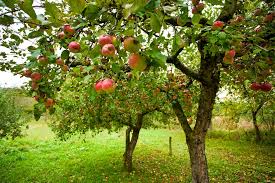 The trees are classified as fast-growing varieties of medium height, as they stretch out to a maximum of about 3.5-4.5 meters, and even then rarelyGardeners typically prune them to a height of 3-3.5 meters to simplify maintenance and harvesting. The crown is rounded or oval, but over the years it can become broadly oval, spreading, and weeping. The shoots are thick and crooked, extending from the trunk at right angles, and covered with smooth, glossy, pubescent bark of a steel-gray hue.
The leaves are fairly large, rounded, and slightly elongated. They are green or dark green, leathery, glossy, and pubescent on the underside. The tips are short and pointed, the edges are serrated and finely serrated, and the veining is rough. The root system is well-developed, branched, and adapted for moisture-seeking.
Productivity and pollination
The variety is considered high-yielding, although it doesn't bear fruit early, which is a concern for many gardeners. However, given the tree's active lifespan of at least 50-75 years, or even longer, the wait for a harvest won't be that long.
A full harvest from one tree per season can reach approximately 80-110 kilograms of fragrant, juicy fruit. Yubilyar is often compared to Melba, which yielded an average of 49-50 centners per hectare over four test years. This variety, in turn, yielded 180-185 centners, which is quite impressive..
The variety is completely self-sterile, so it requires additional pollinators to produce a harvest. For this purpose, it is best planted interspersed with other apple varieties that best match their flowering times. Advanced gardeners set up an apiary near the orchard or use mobile apiaries, and to more effectively attract insects, they also spray the trees with sugar or honey syrup.
Winter hardiness and disease resistance
In the Central Black Earth Region, trees can be considered frost-resistant. They tolerate the relatively harsh winters of the central zone and even more northern regions, when temperatures drop to -18-22°C. At lower temperatures, it is essential to cover the trees during the cold period; for example, young seedlings can be covered with a tent, while older trunks can be wrapped in burlap.
Trees have the Vf gene in their DNA, which completely excludes infection from any of the five races. scabiesThe birthday boy very rarely suffers from other fungal infections, and black crayfish Powdery mildew is most often the result of carelessness and negligence on the part of the gardener. Therefore, regular treatments with fungicides and insecticides cannot be ruled out; they should be carried out regularly and promptly.
Rootstocks and subspecies
While no extensive breeding work has been conducted on subspecies of this variety, it can be grown on various rootstocks. For example, a dwarf variety is very popular. This variety produces much more compact trees, barely reaching 2-2.5 meters, and begins bearing fruit within 2-4 years after planting. However, the winter hardiness of the standard trees decreases significantly. The other characteristics of the parent variety are retained. There is no columnar version of the Yubilyar.
Features of growing Jubilee
 Landing
 Landing
Basic conditions
- Open, sunny sites are the best choice for this variety. They prefer full sun exposure throughout the day; otherwise, fruit production decreases, and the fruit itself becomes small and sour.
- The tree doesn't tolerate drafts, although it does require good crown ventilation. This should be especially monitored to prevent young seedlings from dying.
- Close proximity to groundwater is another consideration for planting Jubilyar. If the groundwater level is higher than 2.5-3 meters, it's better to be on the safe side. To avoid this, you can bury a sheet of slate or a layer of roofing felt or tar paper at a depth of 3 meters. For the same reason, it's not advisable to plant this variety directly near rivers or springs, shallow wells, ponds, lakes, or in lowlands where cold air, rain, or meltwater stagnates.
- The holes don't need to be prepared a season in advance; just 3-5 weeks in advance is sufficient. Dig holes 70-80 centimeters in diameter and the same depth, add fertilizer to the bottom, add drainage on top, and fill with water (15-35 liters). They don't need to be covered; they should be placed outdoors.
- When planting regular trees, leave 4-4.5 meters between trees, but when planting dwarf trees, 3-3.5 meters will be enough.
- The root system is inspected beforehand, removing any dry shoots, broken, or diseased roots. The seedling's rhizome is soaked in water for 7-9 hours to ensure it is well-nourished before being placed in the soil.
- The root collar of any apple tree should remain at least 6-9 centimeters above the ground during planting to prevent the tree from taking root higher. Otherwise, all the qualities of the rootstock will be lost.
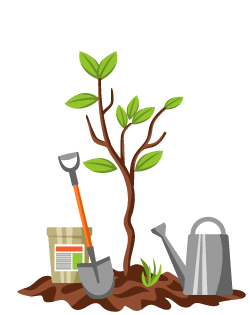
- The seedling is placed on a mound of drainage material, the roots are spread out so they lie freely, and then covered with soil in layers. Compact the soil by hand, gently shaking the trunk to remove air pockets. A 10-15 cm high earthen bank is built around the hole, 20-45 liters of water are poured inside, and the surface is mulched to retain moisture.
Landing dates
The variety thrives when planted in both spring and fall, so there's little difference between the two. It's best to choose a dry, sunny day in late March or early April, or late September or early October, to plant the trees. The only thing to consider is weather and climate conditions. In temperate regions, there's no difference, but in harsher climates, early spring is best.
Protection from frost and rodents
The Yubilyar is a rather delicate variety and can suffer severely from frost. Even at -23-26°C, not only the young bark freezes, but also the wood, causing damage from which the tree will not recover. Therefore, before the cold weather sets in, it is essential to cover it according to all standards. To do this, you can pile soil onto the roots, or lay mats of grass or straw. The tent method is only suitable for young, short trees, but later, simply wrapping the trunks with burlap or other materials is acceptable.
Hungry rodents are repelled in winter by coating the trunks with grease or melted animal fat. To prevent insects from nesting in cracks and chipped bark, which they love to spend the winter in, the trunks are whitewashed with lime up to a height of 1-1.2 meters.
Tree care
 Tree care
Loosening the soil, watering: proper agricultural technology
Like all fruit trees, the Jubilee tree benefits from timely tilling, which is best done twice a year – in spring and fall. You can hoe the soil around the trunk more frequently, also remembering to remove weeds and other plants that can rob the tree of nutrients and microelements.
Apple trees respond well to watering, but only in moderation. No more than 4-6 applications per season are sufficient. These should be timed to coincide with fruit set, flowering, and ripening. It's also a good idea to apply water when there has been no natural precipitation for more than 12-16 days.
Pruning: simple crown shaping
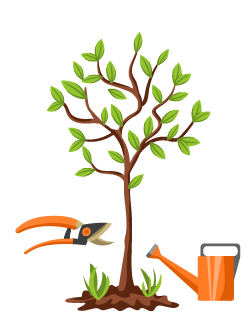
Crown shaping for the Jubilee begins in the first year after planting, as it tends to become naturally dense. The central core is cut back by about a third, and only two or three skeletal branches are left widely spaced. Subsequently, all shoots protruding inward or upward will need to be ruthlessly pruned.
Sanitary pruning of trees is usually done in late autumn, when the sap has stopped flowing in the trunks, and in early spring, before bud break. Rejuvenation can begin when the tree is approximately 16 to 20 years old. Then, two to three mature branches are removed per year to allow the new growth to develop.
Pollinator varieties
Reproduction
- Rooting cuttings.
- Grafting by buds and cuttings.
- Clones (layering).
Diseases and pests
- Powdery mildew.
- Black crayfish.
- Pit bitterness.
- Cytosporosis.
- Green aphid.
- Codling moth.
Ripening and fruiting of the Jubilee
The beginning of fruiting
 The beginning of fruiting
The tree can't be called early-bearing, as the first fruits won't be seen until 7-8 years after planting in open ground. At that point, the tree can yield approximately 5-15 kilograms of delicious, juicy, and aromatic apples. This delay in fruiting is considered the variety's main drawback, not to mention its lack of winter hardiness.
Flowering time
The tree begins to bloom in the second half of May, like most late-summer or early-fall apple trees. Around the 15th or 20th, you can expect the blossoms to begin, lasting approximately 10-14 days. This largely depends not only on the climate but also on the weather of the particular year. In a damp, chilly, rainy, or cold spring, the trees will bloom later, and the buds will remain open longer. The apple blossoms themselves are large, clustered in clusters of 6-8, with white or slightly pinkish petals, a very delicate color, and possess a pleasant, strong fragrance.
Fruiting and growth
Trees are considered fast-growing because they can easily reach 45-65 centimeters in height in a single season. This is especially noticeable before the fruiting season begins, after which the rate slows slightly, but not significantly. Yields grow exponentially, so by the 10th to 12th year, the tree's productivity will reach its peak. At that point, it's possible to harvest up to 150 kilograms of aromatic apples.
The harvest begins to ripen in mid- to late August and should usually be picked by early September. Apples ripen evenly, and if they're not ripened, they'll fall to the ground, requiring immediate processing. They simply can't be stored for long, even in a cellar with ideal temperature and humidity. After 30-45 days, the fruit will become loose, sour, mealy, not juicy, and cottony, and will begin to taste bitter and rot.
Top dressing
- Mineral complexes.
- Wood ash.
- Humus.
- Compost.
- Ammonium nitrate.
- Manure.
What to do if it doesn't bloom or bear fruit
- Provide moisture.
- Check for pests and diseases.
- Transplant.
- Limit watering.
Why do apples fall?
- Overripe.
- Natural factors.
- Pests.
- Diseases.
Leave your feedback on the late-summer variety Yubilyar to share your experience with other gardeners.