Auxis apple tree: characteristics of the variety and care
| Color | Reds |
|---|---|
| Ripening season | Autumn |
| Size of apples | Average |
| Taste | Sweet and sour |
| Crown type | Average tree height |
| Shelf life | Average shelf life |
| Application | Fresh , For recycling |
| Winter hardiness | Average winter hardiness |
| Fruiting age | Up to 5 years |
 History of origin and regions of growth
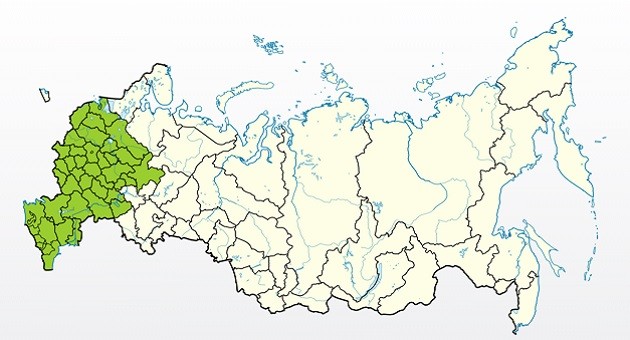
Growing regions
- Middle zone.
- Crimea.
- North Caucasus.
- Some northern regions.
Origin
Another unusual variety, not yet included in the State Register of Breeding Achievements of Russia, was developed by breeders at the Lithuanian Research Institute of Fruit and Vegetable Growing at the beginning of the new millennium. It was obtained by hybridizing the McIntosh variety, well-known to all gardeners, and the Grafenstein Red.
It thrives in temperate and temperate continental climates. Therefore, it has been zoned not only in its native land but also in many countries of the European Community. In our country, it is currently grown exclusively in private gardens.
Content
Description of the Auxis apple variety
 Frost-hardy apple trees capable of producing impressive yields always attract the attention of gardeners in our country. One such variety is Auxis, which is also easy to grow and care for, quickly begins fruiting, and has good resistance to fungal infections. The fruit is delicious, has high marketability, is easy to transport, and stores well in suitable conditions. These apple trees are recommended for growing not only in small plots near the home but also in commercial intensive orchards.
Apples: What they look like
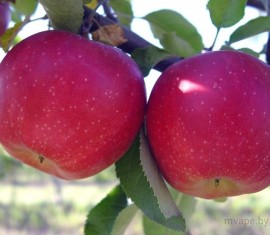
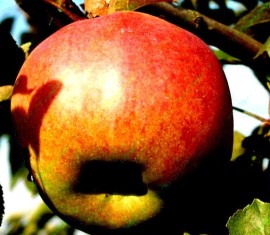
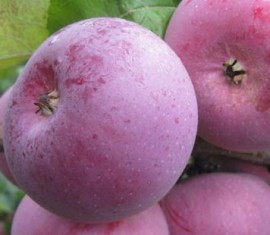
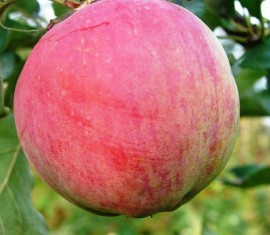
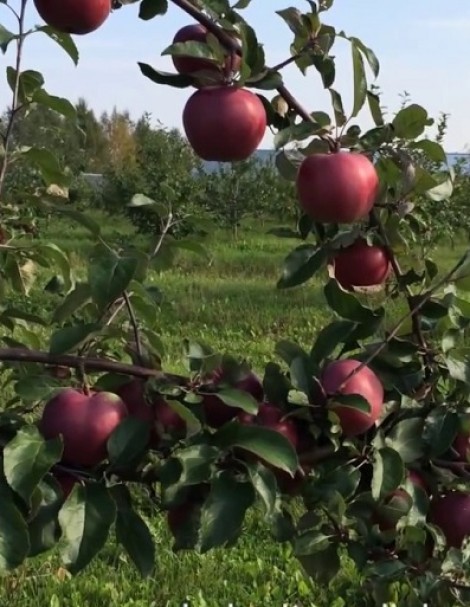
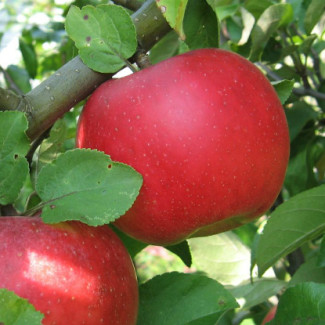
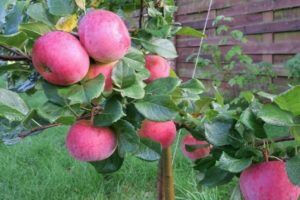 The fruits of this apple tree are not particularly large. They are generally medium or slightly larger than average, weighing approximately 140-190 grams. They are round, flattened, and can be turnip-shaped, with slight ribbing. They are generally uniform and symmetrical.
The skin is dense, glossy, and shiny, with a light oily coating that can become slightly bluish during ripening. It is green or lemon-green, sometimes yellow. The blush covers approximately 55-75% of the surface; it is crimson-red, striped, and diffusely spotted. Subcutaneous punctures are large, clearly visible, gray-green, and numerous. The chemical composition can be best characterized by the following values per 100 grams:
- P-active substances (catechins) – 234 milligrams.
- Ascorbic acid (vitamin C) – 5 milligrams.
- Total sugars (fructose) – 10.6%.
- Pectins (fiber) – 11.4%.
- Titratable acids – 0.43%.
The flesh is firm yet tender, crisp, juicy, and delicately creamy or slightly greenish. The fruit exudes a very strong, distinctive aroma and has a sweet and sour, harmonious, and balanced flavor, considered a dessert. Professionals give these apples 4.4 points for flavor and color on a 5-point tasting scale.
Apple tree Auxis: characteristics
 Crown and root system
 Crown and root system
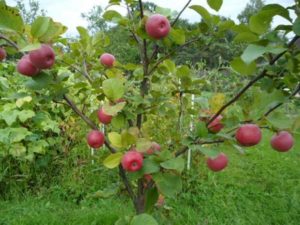
Officially, trees of this variety are classified as medium-sized, although without pruning they can easily reach 5-6 meters or even more.However, gardeners prefer to prevent this type of growth, instead managing it with formative pruning. The crown is rounded and fairly compact, but over the years it can become broadly oval and sometimes even spreading. The shoots are straight and long, covered with brown or greenish-brown bark with slight pubescence. Fruiting is mixed: on rings, spears, and fruiting twigs.
The leaves are medium-sized, more rounded than elongated, and short-pointed. They are a rich green, matte finish, with a lightly pubescent underside and delicate nervation, as well as a finely serrated, slightly serrated edge. The root system is medium-deep and highly branched. Some roots are located near the surface, making maintenance somewhat challenging.
Productivity and pollination
The variety begins bearing fruit quite early and is also considered a high-yielding variety.
One mature tree can produce approximately 70-80 kilograms of aromatic and delicious apples per season..
A disadvantage of Auxis is its self-sterility. This means that to produce fruit, it needs other varieties nearby that bloom at a similar time. Experienced gardeners also recommend keeping these trees no further than 40-70 meters away, and bringing mobile apiaries to the planting sites. You can also spray the flowering trees with a sugar syrup solution to further attract bees.
Winter hardiness and disease resistance
The variety's tolerance to low temperatures is average. They tolerate the mild, frost-free winters of Crimea or the Caucasus fairly well, but in harsher regions, they require adequate shelter. Frosts down to -15-20°C are tolerated fairly well if the trunks are wrapped in burlap or old tights. You can pile soil (15-25 centimeters) onto the root zone, which must be removed in the spring, or lay down straw bales.
Auxis is quite resistant to various fungal infections. However, immunity will only be established if the owner maintains the trees regularly and in a timely manner. Remove dry leaves from under the apple trees, especially rotting fruit, avoid overwatering, and spray them with fungicides and insecticides to control insect pests.
Rootstocks and subspecies
No subtypes of this variety are known yet, although it is grown on various rootstocks. The results are roughly the same, although the trees grow more compact on semi-dwarf and dwarf rootstocks. There are no columnar subtypes of this variety, so if you're offered something similar, it's best to avoid purchasing it.
Features of growing Auxis
Landing
 Landing
Basic conditions
- Choosing sites where the groundwater level doesn't rise above 2.5-3 meters is the main requirement when choosing a site for apple trees. If this isn't taken into account, the rhizomes will reach the water and begin to rot. For the same reason, avoid planting this variety directly near springs, rivers, ponds, or lakes, shallow wells, or in floodplain lowlands where meltwater accumulates in the spring.
- A sunny, open, well-ventilated spot for an apple tree is ideal. However, care must be taken to ensure there are no drafts. Trees can be planted on a slope, but only on a southern, southeastern, or southwestern-facing one.
- Soil Clay, sandy loam, and black soil are suitable for seedlings, but the main thing is that it's not excessively acidic or salty. This will likely kill all your seedlings. Acidity is easily neutralized with lime.
- There's no need to prepare the holes in advance; you can do so just 2-3 weeks before planting. To do this, dig holes 60-70 centimeters deep and 70-90 centimeters in diameter. Add a small amount of soil mixed with fertilizer to the bottom, then add drainage, and pour 40-55 liters of water over it. Leave everything like this, uncovered.
- It is advisable to leave at least 4.5-5 meters of distance between trees to avoid conflict between roots and crowns in the future.
- Stake staking is immediately driven into the holes to tie the seedling to. Ideally, it should be on the north side.
- The root collar is left approximately 5-8 centimeters above the surface to prevent the tree from rooting higher. Otherwise, all the original properties of the chosen rootstock will be completely lost.
- The trees should be prepared by inspecting the rhizome, cutting off dried or broken shoots, and placing them in a mixture of soil and water for 4-7 hours.
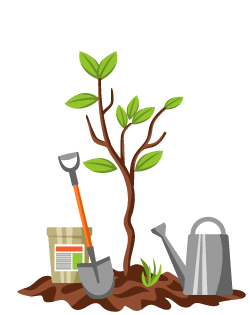
- Place the seedling vertically in the hole, cover with soil, and compact it fairly firmly. Water the top with 35-40 liters of water, and mulch the surface with compost, sawdust, manure, or whatever else is on hand.
Landing dates
This variety responds well to planting in both spring and fall. It's crucial to choose a time when spring frosts are past their initial stage, and at least 4-5 weeks before they occur in fall. In the first case, this is approximately March-April, and in the second, September-October. The survival rate of seedlings planted in spring and fall is approximately the same.
Protection from frost and rodents
Proper winter protection is the key to good growth and abundant future harvests of Auxis. Therefore, it's a good idea to mound soil over the roots (15-25 centimeters), lay mats of dry grass or straw bales, wrap the trunks with burlap or agrofibre, and use the tent method with young trees.
Insects can be driven away by promptly whitewashing the trunks in the fall and spring with ordinary lime. To repel rodents that chew the bark during the winter, coat the trunks with rendered lard or any other animal fat.
Tree care
 Tree care
Loosening the soil, watering: proper agricultural technology
The area around the tree trunk should be dug no more than twice a year, and even then, extreme caution is required to avoid damaging the rhizome. Hoeing can be done a little more frequently, but care should be taken. At the same time, remove root suckers, weeds, and other plants.
Don't forget about watering to ensure your apples grow large and beautiful. Balance is crucial, as overwatering will create a favorable environment for fungal growth. Expect one mature tree to need no more than 10-15 liters of water per week, and even then, only if the weather is dry and very hot.
Pruning: simple crown shaping
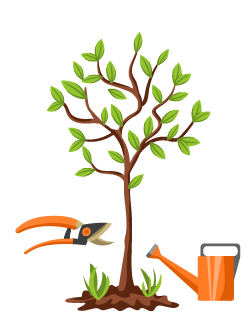
Crown formation begins approximately 2-3 years after Auxis is planted outdoors. The standard, sparsely layered form is quite sufficient for this variety; it's just right for proper development and abundant fruiting. Pruning is done in spring or fall, while the sap in the trunks is still present.
Sanitary measures should also be taken, including removing all diseased, broken, or dead shoots. This is also done in the spring and fall. All cut areas should be treated with garden varnish, water-based paint, or simply covered with soil to reduce stress on the tree.
Pollinator varieties
- Granny Smith.
- Everest.
- Delicious golden.
- Idared.
- Borovinka.
- Antonovka.
- Glory to the winner.
Reproduction
- Rooting cuttings.
- Grafting by buds and cuttings.
- Growing from seeds.
- Clones (layering).
Diseases and pests
- Powdery mildew.
- Cytosporosis.
- Fruit rot.
- Scab.
- Cytosporosis.
- Tinder fungus.
- Green aphid.
- Codling moth.
Ripening and fruiting of Auxis
The beginning of fruiting
 The beginning of fruiting
How quickly an apple tree begins to bear fruit depends largely on the rootstock. On dwarf and semi-dwarf trees, it begins to bloom for the first time in the second or third year, which is when the first apples appear. On vegetative rootstocks, fruiting is delayed slightly, until about four or five years. In the first few years, yields are quite meager, only 5-7 kilograms, but it's definitely worth trying.
Flowering time
This variety typically blooms a little later than other apple trees, from around the end of May until mid-June, delighting with its decorative and highly fragrant flowers. They are large, pinkish-white, and densely covered with blossoms. In some cases, depending on weather conditions, the variety may bloom a little earlier or later; this is normal.
Fruiting and growth
The tree grows green mass quite rapidly. In just one year, it can grow at least 25-40 centimeters, so it reaches its final size very quickly. Growth is more vigorous before fruiting begins, and then slows down a bit. Fruitfulness increases rapidly, and by the 8th to 10th year, a full harvest can be achieved. Experienced gardeners note that Auxis may exhibit some regularity and periodicity after approximately 18-22 years of active fruiting. However, this is not critical, and the tree rarely takes a rest.
It's customary to pick apples from the branches around mid-September, all at once. If you don't pick them early, they'll fall to the ground, so it's best to hurry. They have a medium shelf life, until about February or March. After that, they become soft, sour, and lose their flavor. Therefore, by that time, they should be completely processed.
Top dressing
- Compost.
- Nitrogen fertilizers.
- Humus.
- Ammonium nitrate.
- Manure.
What to do if it doesn't bloom or bear fruit
- Check for pests and diseases.
- Transplant.
- Limit watering.
Why do apples fall?
- Overripe.
- Natural factors.
- Pests.
- Diseases.
Leave your feedback on the unusual French variety Auxis to share your experience with other gardeners.