Apple tree "Children": characteristics of the variety and care
| Color | Greens |
|---|---|
| Ripening season | Autumn |
| Size of apples | Average |
| Taste | Sweet |
| Crown type | Average tree height |
| Shelf life | Low shelf life |
| Application | Fresh , For recycling |
| Winter hardiness | High winter hardiness |
| Fruiting age | Up to 5 years |
 History of origin and regions of growth
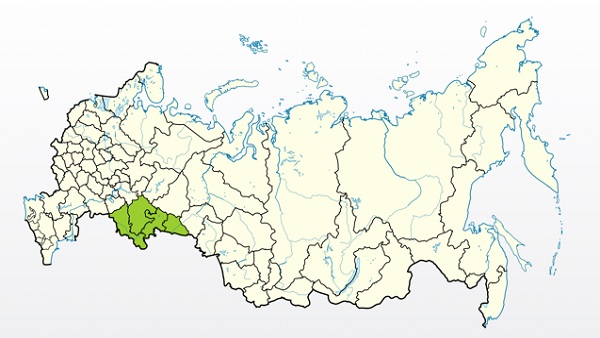
Growing regions
- Chelyabinsk region.
- Bashkortostan.
- Kurgan region.
- Orenburg region.
Origin
Breeders at the South Ural Research Institute of Fruit, Vegetable, and Potato Growing, led by M.A. Mazunin, developed many frost-resistant apple varieties suitable for growing in the region's harsh conditions. One of these was the variety named "Detskoe." Its "parents" were the notorious "Welsi" variety, crossed with the "Uralskoe Nalivnoe" apple.
By the end of the twentieth century, seedlings were considered elite and sent to nearby gardens for field testing. In 2003, the Detskoe variety was added to the State Register and zoned for the Ural region.
Content
Description of the apple tree variety "Children's"
 These relatively new apple trees are considered very promising, which is why interest in them is particularly high. They are the very ones that are capable of displacing the trusty old varieties and taking their place.
These are undemanding trees, resistant to severe frosts and sudden changes in temperature, able to withstand long, harsh winters and short, hot periods. They are also highly productive, producing large fruits with an unusually sweet flavor. They are recommended for growing both in private courtyards and in intensive commercial spaces.
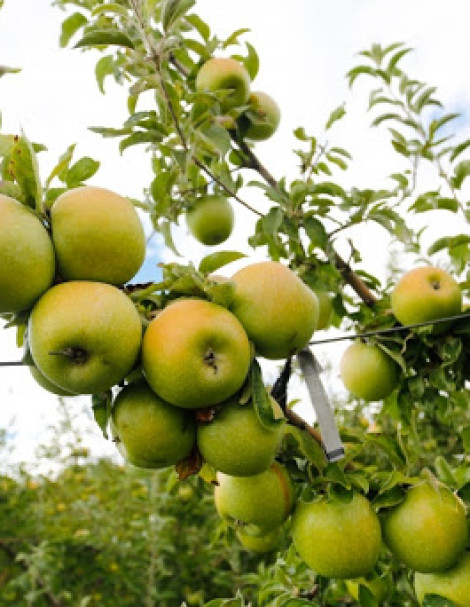
Apples: What they look like
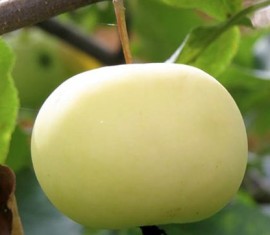
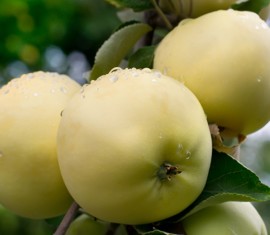
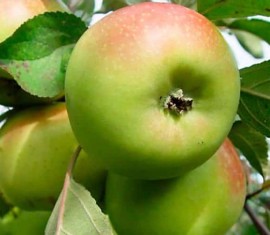
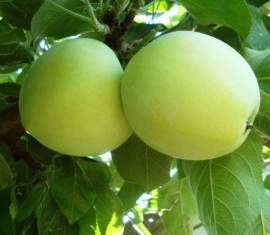
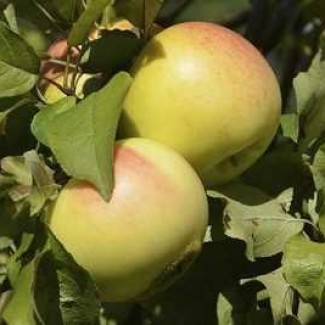
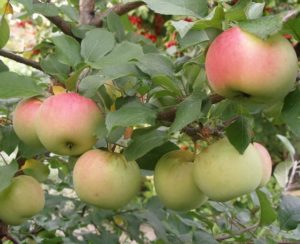 The fruits typically grow to medium or slightly larger than average size, which is quite an achievement for Siberian apple trees. They weigh approximately 95-150 grams, are uniform and symmetrical, round or slightly flattened, and have subtle ribbing.
The skin is dense, shiny, smooth, and glossy, with a substantial oily coating. When young, it is a rich green, but as it ripens, it acquires a yellowish-green tint. The blush is pale, occupying no more than 40-65% of the surface, soft pink or slightly reddish, blurred, streaked, and mottled, giving the apples a subtle variegation. Subcutaneous punctures are numerous, medium-sized, grayish-green, and not very visible on the surface. The chemical composition is as follows:
- P-active substances (catechins) – 326 milligrams.
- Ascorbic acid (vitamin C) – 8 milligrams.
- Total sugars (fructose) – 11.9%.
- Pectins (fiber) – 13.5%.
- Titratable acids – 0.15%.
The flesh is medium-dense, slightly crunchy, tender, with a distinct creamy-green hue and intense juiciness. The flavor is considered dessert-like; it's sweet but has a slightly tart aftertaste. Professionals don't call it balanced or harmonious, although they do consider it pleasant. The tasting score is 4.4 out of 5.
Apple tree "Children's": characteristics
Crown and root system
 It is customary to classify the variety as tall, but a more accurate definition is a medium-sized tree. The maximum height of the apple tree is approximately 4-4.5 metersIt doesn't grow anymore, so this is a rather controversial issue. The tree's crown is oval or pyramidal when young, becoming broadly oval, spreading, and even drooping with age. It can occupy quite a large area, up to 5 meters in diameter, which should be kept in mind when planting. The branches are long, medium-thick, and covered with reddish-brown bark without pubescence.
The leaves are medium-sized, elongated, oval, and long-pointed, rich green or just green. They are leathery, dense, coarsely ribbed, finely toothed, serrated, and can form a boat-shaped leaflet, with a wavy edge. The root system is highly branched, moderately deep, and more often than not has a central taproot.
Productivity and pollination
Compared to other Siberian and Ural apple trees, Detskoe can be called a high-yielding variety, although it certainly cannot catch up with Antonovka.
In a single season, a mature tree can easily yield approximately 60-110 kilograms of fragrant, sweet fruit. Fruit yield is directly influenced by weather and climate, as well as fertilizing and timely application.
The tree cannot pollinate itself, so it requires other apple varieties that bloom at the same time nearby. It is recommended to interplant this variety with other autumn-blooming apple trees so they can cross-pollinate. You can also spray the entire crown with diluted sugar during flowering and use mobile apiaries.
Winter hardiness and disease resistance
This variety tolerates temperatures down to -38-40°C very well, making it suitable for growing in fairly northern regions. If the climate is milder and low temperatures don't typically last longer than 1-2 weeks, simply wrapping the trunk with burlap will not harm the tree. In other cases, more careful protection is recommended.
Average resistance to scab, various rots, powdery mildew, and other fungal infections means there's little need to worry about this. However, with timely and effective fungal and insect prevention, the trees will virtually never become diseased. During years of severe epiphytotics, the tree's foliage may be affected, but the fruit remains edible.
Rootstocks and subspecies
No subspecies of the Detsky variety have yet been developed, although it can be grown on a wide variety of rootstocks, which slightly alters the variety's characteristics. For example, on dwarf and semi-dwarf rootstocks, the trees become very compact, not growing taller than 2-2.5 meters. Although their frost resistance decreases, the fruit size reaches 120-160 grams. On wildings and seed rootstocks, the tree becomes virtually frost-resistant, allowing it to be grown even in Siberia and in the Far East.
Peculiarities of Growing Children's
 Landing
 Landing
Basic conditions
- Like any other fruit crop, this apple tree loves full sun, especially considering that it grows primarily in northern regions. Therefore, it's best to choose open spaces, unshaded by buildings or other trees, to ensure good growth and abundant fruiting.
- Don't forget about groundwater, which should be no higher than 3-3.5 meters. To prevent the tree's roots from reaching it, you can lay a sheet of slate or roofing felt at a depth of 2.5-3 meters. This will help if there is no other place for the tree.
- Any soil is suitable for children's beds, as long as it's not too acidic. This can be corrected with regular lime, which effectively "saturates" the soil.
- You need to prepare the holes in advance, and if you didn't have time to do it in the spring or fall, then you need to do it at least 2-4 weeks in advance. Dig a hole 70-90 centimeters deep and the same in diameter, fill the bottom with soil mixed with compost, add a drainage layer of stones, gravel, or broken brick on top, and fill with water.
- The distance between holes in a row should be approximately 3-4 meters, and between rows, 4-5 meters. It's important to consider the spreading crown and branching of the rhizome, which can conflict with each other and interfere with each other's growth.
- Always leave the root collar 6-9 centimeters above the soil surface to prevent the tree from taking root higher. Otherwise, all the properties and qualities of the rootstock will be negated.
- Don't forget about staking stakes. It's best to place them on the north side and remove them no earlier than 4-5 years into the plant's growth.
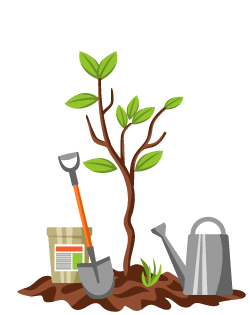
- Place the seedling directly on a pile of stones, spread the roots, and cover with layers of soil, compacting them by hand. Shake the tree to remove any air pockets. Water with 30-55 liters of water, and mulch the surface with straw, chopped grass, or compost.
Landing dates
It's acceptable to plant baby plants either in the spring, around late March or early April, when frosts have already passed, or in the fall, around mid- to late October, when the leaves have finished falling. Make sure there are approximately 4-6 weeks before the first frost.
Protection from frost and rodents
Young trees benefit from frost protection, especially in the first few years. They can be covered with a tent, or simply wrapped in burlap or agrofibre, and the root zone can be lined with straw bales or dry grass mats. Some people also pile up 10-15 centimeters of soil if winters are particularly harsh.
To protect trees from insects, you can whitewash their trunks with regular lime in the spring and fall; that will be sufficient. However, hungry hamsters, mice, and hares This won't stop them. To prevent them from gnawing at the tender young bark and branches, it's best to coat the trunk with grease or even rendered animal lard.
Tree care
 Tree care
Loosening the soil, watering: proper agricultural technology
It never hurts to loosen the soil around the tree. Twice a year, you can dig around the tree, being careful not to damage the roots, and lightly hoe the soil as needed. At the same time, you can remove any weeds or other plants that interfere with the apple tree's normal growth.
The variety has a moderate drought tolerance, meaning it certainly doesn't suffer from watering. It's crucial not to overdo it, as this can lead to overwatering, which can lead to disease and even death. A good rule to follow is the 10-day rule, where water is applied once every ten days if there's no rain. If precipitation does occur, count back ten days before the next watering.
Pruning: simple crown shaping
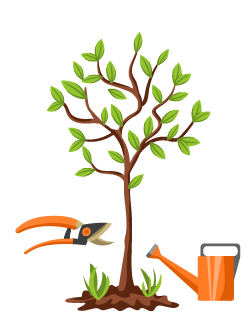
Standard crown shaping methods are sufficient for the Children's tree, as long as they are carried out regularly. Starting in the first year, the central conductor is removed by one-third, and all branches are pruned except for two or three skeletal branches spaced far apart. These are also shortened to be 5-8 centimeters shorter than the trunk. Subsequently, it will be necessary to simply maintain the desired shape by trimming off suckers and shoots growing inward.
Don't forget about tree pruning. This is done as needed, as well as in spring and fall. Dry, damaged, or diseased shoots are removed. Rejuvenation can also be done, but not before the tree reaches 18-20 years of age, by removing 2-3 older branches. This will allow the young shoots, which will produce better fruit, to develop.
Pollinator varieties
- Memory of Zhavoronkov.
- In Memory of Ulyanishchev.
- Uralsk resident.
- Hope.
- Gorno-Altaisk.
- Miass.
Reproduction
- Rooting cuttings.
- Grafting by buds and cuttings.
- Growing from seeds.
- Clones (layering).
Diseases and pests
- Powdery mildew.
- Black crayfish.
- Pit bitterness.
- Cytosporosis.
- Fruit rot.
- Scab.
- Green aphid.
- Codling moth.
Ripening and fruiting of Children's
The beginning of fruiting
 The beginning of fruiting
The tree is considered an early-bearing tree because it begins producing apples as early as 4-5 years after planting in open ground. The yields then reach only a few kilograms, and full fruiting will take a while, but there's definitely enough to try. Even 5-7 kilograms will be a real find for lovers of sweet apples.
Flowering time
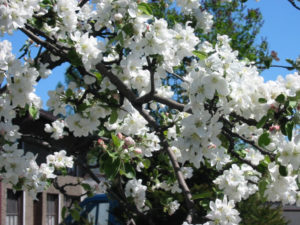
Much depends on the growing region, climate, and weather. On average, flowering can begin around mid-May, but can also occur at the end of the month. It lasts for about two or even three weeks, so the bees usually have time to do their work. The flowers themselves are large, beautiful, fragrant, and saucer-shaped. They are snow-white or slightly pinkish in color, gathered in small inflorescences of 6-10.
Fruiting and growth
The Detsky variety has an average growth rate, although many gardeners consider it slow-growing. The tree can grow approximately 15-30 centimeters in a single season, so it will take a long time to reach its full size. Similarly, its yield increases gradually and leisurely, reaching its peak only around 12-15 years. No periodicity in fruiting has been observed; it produces well every year.
The fruits begin to ripen around the second half of September, sometimes delaying until the end of the month or even early October. Apples don't need to be stored; they're delicious immediately after picking. They make delicious jam, juice, and preserves, but they don't keep for long—no more than 30-45 days at most.
Top dressing
- Mineral complexes.
- Humus.
- Superphosphate.
- Ammonium nitrate.
- Compost.
- Manure.
What to do if it doesn't bloom or bear fruit
- Check for pests and diseases.
- Transplant.
- Limit watering.
Why do apples fall?
- Very overripe.
- Natural factors.
- Pests.
- Diseases.
Leave your feedback on the sweet Detskoe variety to share your experiences with professional and amateur gardeners.