Apple tree Narodnoe: characteristics of the variety and care
| Color | Greens |
|---|---|
| Ripening season | Summer |
| Size of apples | Average |
| Taste | Sweet and sour |
| Crown type | Average tree height |
| Shelf life | Average shelf life |
| Application | Fresh , For recycling |
| Winter hardiness | High winter hardiness |
| Fruiting age | Up to 5 years |
 History of origin and regions of growth
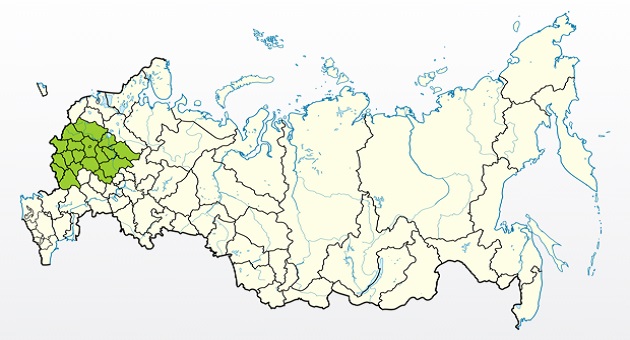
Growing regions
- Middle zone.
- Voronezh region.
- Lipetsk region.
- Mordovia.
Origin
This late-season variety began to be developed in 1936 at the experimental station of the I.V. Michurin Scientific Research Institute of Fruit Growing. The work was led by renowned pomologist and breeder Sergei Ivanovich Isaev, along with Z.I. Ivanova, V.K. Zayets, and M.P. Maksimova. By crossing the older Bellefleur apple tree with the familiar Papirovka, a completely new variety was created, which it was decided to name Narodnoye.
In the 1940s, seedlings were selected for testing and sent to various farms in the central part of the country and other regions. It wasn't until 1964 that the variety was recognized as elite, entered into the State Register, and zoned for the aforementioned regions.
Content
Description of the Narodnoe apple variety
 This variety is ideal for intensive commercial orchards. With its particularly compact crown, it produces impressive annual harvests, and its fruits have a delicate, unusual dessert flavor. However, these trees are also a useful addition to small garden plots. Considering the enviable winter hardiness of its standard trees, Narodnoe can be grown practically anywhere in the temperate zone.
Apples: What they look like
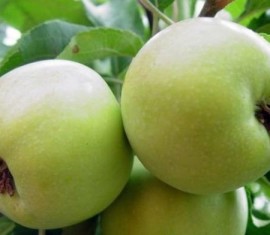
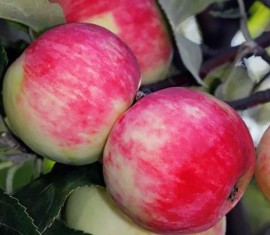
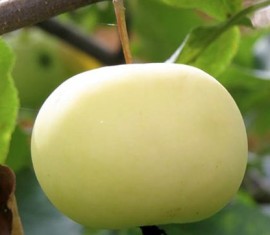
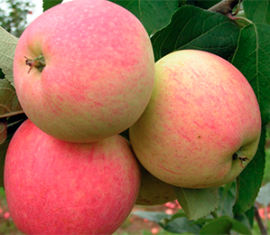
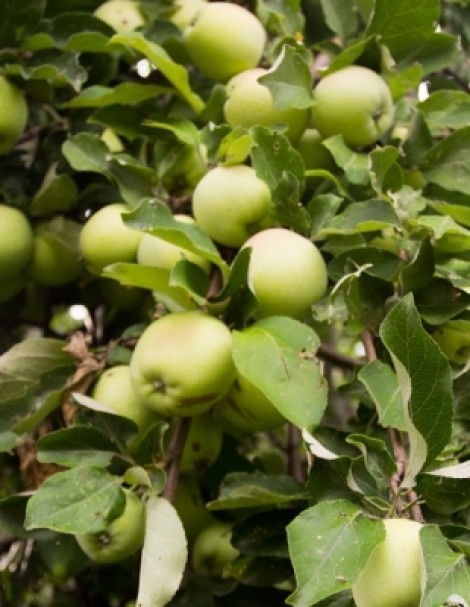
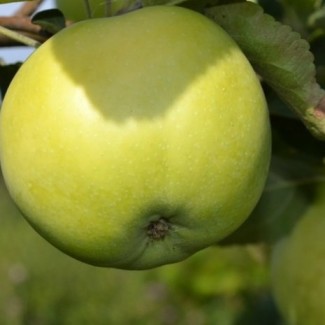
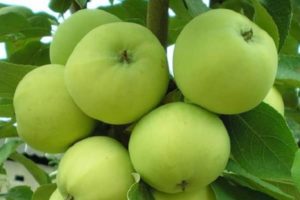 The fruits are generally medium-sized, weighing approximately 110-140 grams. They are round or slightly round-conical, with subtle ribbing. Some may have a transverse "seam," more characteristic of Papirovka.
The skin is smooth, glossy, dense, yet thin. It's initially bright green, fading to a slightly yellowish or even white color as it ripens. The blush is completely absent, not appearing even in particularly sunny years. Subcutaneous grayish spots are numerous and clearly visible. They turn golden when ripe, which can serve as a good indicator for harvesting. The chemical composition can be characterized by the following indicators per 100 grams:
- P-active substances (catechins) – 243 milligrams.
- Ascorbic acid (vitamin C) – 7.7 milligrams.
- Total sugars (fructose) – 11.4%.
- Pectins (fiber) – 13%.
- Titratable acids – 0.4%.
The flesh is fine-grained, medium-dense, juicy, and very tender, with a sweet-tart tang, greenish-yellow color, and can be slightly creamy. Its flavor is considered harmonious, balanced, and dessert-like, with a powerful apple aroma. The tasting score for appearance and flavor is 4.7-4.8 out of 5, respectively.
Apple tree Narodnoe: characteristics
Crown and root system
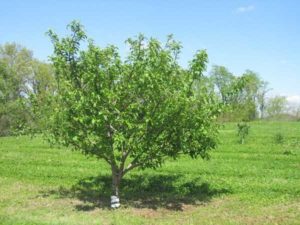 The tree is considered a medium-sized or semi-dwarf variety. Without pruning, it can easily reach a height of 4 meters or more. However, most thrifty growers avoid this, limiting growth to 3-3.5 meters for ease of maintenance and harvesting. The crown may be somewhat oval when young, but with age it becomes rounded or spreading. The branches are sparse, extending from the trunk at or near a right angle. They are thick, long, and raised, with brown and russet bark.
The leaves are a rich light green, dense, and leathery, with a matte and wrinkled surface and may be slightly pubescent on the back. They are medium-sized, oval-elongated, with a slightly serrated edge and a sharp tip that often curls inward. The root system is branched and superficial, lacking a central taproot.
Productivity and pollination
The Narodnoye apple tree is considered a high-yielding, early-bearing apple. A single mature tree can yield at least 140-170 kilograms of aromatic and delicious fruit.
Moreover, it begins to bear fruit in full quite early, only 6-8 years after planting in open ground, for which it is highly valued by gardeners.
This variety also exhibits remarkable self-fertility. It doesn't require other apple trees for cross-pollination, and it's also resistant to natural disasters, prolonged spring rains, and the absence of pollinating insects. It will still produce a good harvest. However, it works well as a pollinator, so it's recommended to plant it interspersed with other varieties that bloom at the same time.
Winter hardiness and disease resistance
Although frost resistance wasn't specifically targeted during breeding, the hybrid turned out to be quite winter-hardy. It easily tolerates freezing temperatures down to -28-30°C, requiring no shelter at all. Experienced gardeners still recommend covering young or damaged trees to be on the safe side. In harsher conditions, seedlings may freeze, but they quickly recover during the growing season.
Folklore is susceptible to fungal infections, but quite rarely, under extremely unfavorable growing conditions or in particularly wet years. Powdery mildew and scab They are dangerous, but if all preventative measures (fungicide treatment) are taken promptly, there is nothing to worry about. To prevent pests, regularly spray the plantings with insecticides.
Rootstocks and subspecies
There are no subspecies of Narodny, but it can be grown on various rootstocks. For particularly compact plantings, dwarf rootstocks can be used, resulting in trees no taller than 2-2.5 meters. They retain all the other qualities of the parent variety.
Features of growing Narodny
 Landing
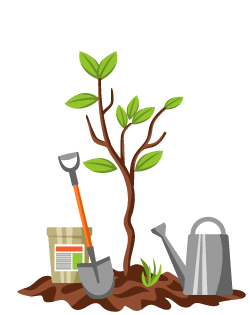 Landing
Basic conditions
- Only well-lit areas are suitable for this variety; in the shade, the tree may not bloom or bear fruit.
- Soil The apple tree's soil should be as airy and breathable as possible. It grows well in sandy loam, clay loam, or black soil, but the latter should be diluted with river sand. It's a good idea to ensure the soil is slightly acidic, with a pH of no more than 7.
- The holes can be prepared in advance, in the fall, or dug 2-3 weeks before planting. To do this, dig a hole 80 centimeters deep and the same diameter, mix the top layer with fertilizer (organic and some minerals), add 20-30 liters of water, and leave uncovered. The distance between the holes should be no more than 3-3.5 meters, which is just right for the roots and crown.
- Before planting, the seedlings are immersed in water with their root system for 5-6 hours; if they are very dry, they can be soaked overnight.
- A layer of broken brick, nut shells or vermiculite, 10-15 centimeters thick, must be placed at the bottom of the hole for drainage.
- Place the seedling vertically on top, ensuring the grafting site (root collar) protrudes at least 7-9 centimeters above the ground. Otherwise, the tree may root higher, and all the properties of the rootstock will be lost.
- Stakes for tying are driven into the hole immediately, and for this unstable tree it is better to arrange them in a triangle for each tree.
- The seedling is carefully planted, compacting the soil lightly, but only by hand. Water with 30-40 liters of water, and the surface is mulched with chopped grass, compost, or peat.
Landing dates
Options with closed root system You can plant it at any time during the growing season. Exposed roots are preferred in the fall, as this gives the tree more time to adapt before it needs to expend energy on growing green mass. However, this can also be done in the spring, around early April, before the buds begin to open, but regular watering will be necessary during the first year.
Protection from frost and rodents
In the temperate climate of central Russia, trees don't require winter protection, except for seedlings in the first three years after planting. Their trunks can be wrapped with agrofibre, burlap, roofing felt, or roofing felt. The root zone is covered with mats of straw, hay, or spruce branches.
To protect the tender young bark from hungry mice and hares during the cold season, trees are coated with melted lard or grease in the fall. To repel insect pests, the trunks are whitewashed with lime to a height of 1-1.5 meters. If you prefer commercial products from a gardening store, you can use them.
Tree care
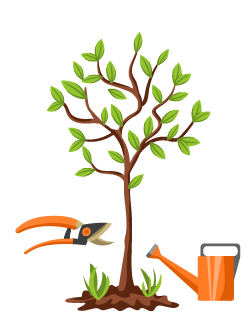 Tree care
Loosening the soil, watering: proper agricultural technology
The rhododendron thrives on highly oxygenated soil, so you'll need to hoe the soil quite frequently, at least once or twice a month. This will also remove root suckers, weeds, grass, and shrubs that rob the plant of nutrients. Twice a year, in spring and fall, you should also carefully dig around the trunk, being careful not to damage the roots located close to the surface.
Water the variety as needed, but no more than once a week. 40-50 liters of water, applied in two doses, is sufficient. During particularly dry weather, watering can be increased to once every five days. Pay particular attention to watering during fruit set and ripening. Fertilizers and other fertilizers are also added along with the water.
Pruning: simple crown shaping
The main formative pruning is done immediately upon planting. The central core is cut back by one-third, and all other branches are trimmed in tiers, 5-7 centimeters shorter than each other. The tree will do the rest for you; it's not prone to becoming dense, so it usually develops a broadly oval or spherical, sparse shape on its own.
But sanitary pruning is worth paying attention to. Every fall, all damaged, dead, and diseased branches need to be trimmed. Rejuvenation can begin in the 10th year, by removing 2-3 mature shoots per year, allowing the young shoots to develop.
Pollinator varieties
- Antonovka.
- Anise.
- Champion.
- Honey Crisp.
- Florina.
- Snowy Calville.
Reproduction
- Clones (layering).
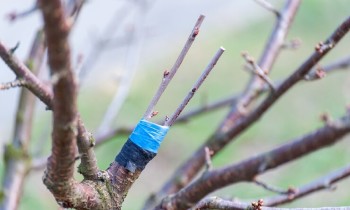
- Grafting by cuttings or buds.
- Rooting cuttings.
- Growing from seeds.
Diseases and pests
- Scab.
- Powdery mildew.
- Black crayfish.
- Fruit rot.
- Cytosporosis.
- Green aphid.
- Leaf roller.
- Scale insect.
Ripening and fruiting of the Narodnoe apple tree
The beginning of fruiting
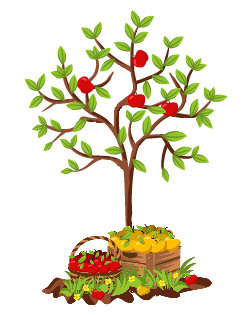 The beginning of fruiting
This apple tree is considered particularly early-bearing, as it begins blooming profusely in its second or third year and can yield as many as 3-5 kilograms of beautiful, plump apples. Experienced gardeners recommend pinching off the buds during this period, which will significantly increase the yield in subsequent years. By the third or fourth year, you can harvest 10-15 kilograms of fragrant fruit.
Flowering time
Like all apple trees, the Narodnoe blooms in May. A more precise time can only be determined experimentally, depending on the growing region. This can be mid- or late May, and weather conditions in a given year also influence this factor. The apple tree's flowers are very beautiful and fragrant, gathered in clusters that fall profusely from the branches.
Fruiting and growth
As mentioned earlier, this apple tree grows very quickly, literally before your eyes, producing shoots up to 40-60 centimeters in a year. Therefore, it begins to produce a full harvest early. Even before reaching ten years of age, you can harvest over 100 kilograms of apples several times in a row. Trees don't have a specific cyclical pattern, but sometimes, for reasons beyond your control, it can reduce yield.
It's best to start picking the fruit at the end of August, although they won't be fully ripe for consumption by then. They are at their tastiest a little later than the Papirovka apples (7-10 days). However, if you miss the right moment, they may fall to the ground, and then you'll only be able to make jam or compotes from them. This is one of the few early fall or late summer apples that can be successfully stored in the cellar until the New Year or even a little later.
Top dressing
- Peat.
- Compost.
- Mineral complexes.
- Bird droppings.
- Ammonium sulfate.
- Urea.
- Humus.
- Manure
- Superphosphate.
What to do if it doesn't bloom or bear fruit
- Check for pests and diseases.
- Feed.
- Transplant to a sunnier area.
- Provide regular watering.
Why do apples fall?
- Natural factors.
- Excessive humidity.
- Pests.
- Diseases.
Leave your own reviews of the Narodnoe variety to share your experience with other gardeners.