
Snowy Calville Apple Tree: Variety Features and Care
| Color | Whites |
|---|---|
| Ripening season | Autumn |
| Size of apples | Large |
| Taste | Sweet and sour |
| Crown type | Tall tree |
| Shelf life | Low shelf life |
| Application | Fresh , For recycling |
| Winter hardiness | Low winter hardiness |
| Fruiting age | Up to 5 years |
 History of origin and regions of growth
Growing regions
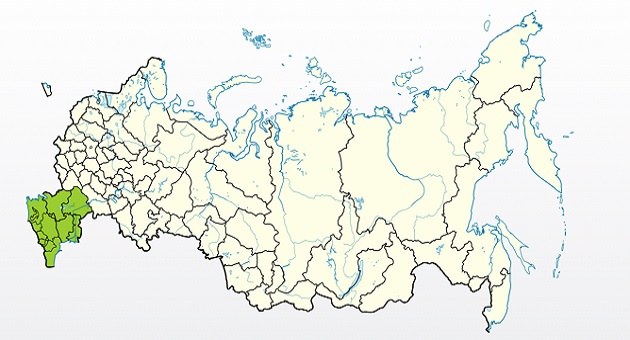
The variety is considered to be of Transnistrian Ukrainian origin and is zoned only in the southern regions of Russia due to its low winter hardiness.
Origin
There are several theories about the origin of this apple variety, all of them completely different, and it's unclear which one is true. The most likely theory is that the Calville Snow apple is a hybrid of an ancient French variety known since the time of Louis XIII (17th century).
This apple tree has many different names, including popular ones: Calville White or White Coast, Snow White, Bishop's Cap, Taponne, Calville Blanc, White Zurich, White Winter, Magnificent.
According to the renowned Soviet horticulturist and breeder Vasily Nikolaevich Yaropud, the ancestor of this apple tree was first discovered in our country in the village of Studenoye (Vinnytsia Oblast, Kryzhopol district, Ukraine) at the end of the nineteenth century. The renowned breeder Simirenko began experimenting with the variety in the 1920s and 1930s, crossing it with the German apple tree Boken and the Simirenko Ranet.
In the middle of the century, the variety was added to the State Register for the Ukrainian SSR, the North Caucasus, and some southern regions of Russia. Until the late 1990s, the apple tree accounted for approximately 12-14% of all winter fruit varieties planted commercially. With the development of many new hybrids, the Calville variety's popularity gradually declined.
Content
Description of the Snowy Calville apple tree variety
 Almost everyone knows the unique, rich, and excellent flavor of this variety's fruit. However, this isn't its only advantage. Early maturity and abundant annual fruiting, the large size of the apples, and the trees' excellent resistance to fungal infections and pests—all of this makes the Snow Calville a desirable variety for both home gardens and large, intensive commercial orchards.
Apples: What they look like
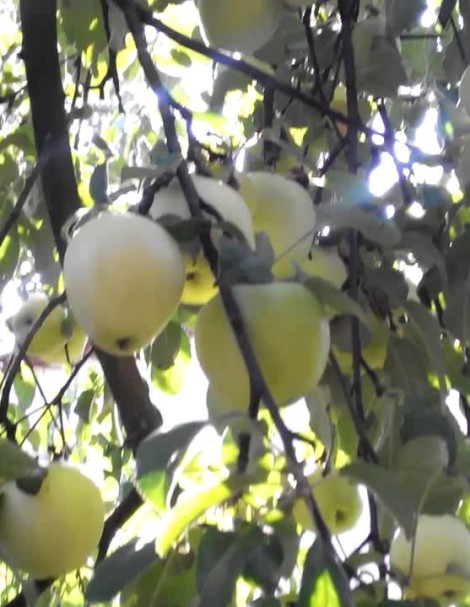
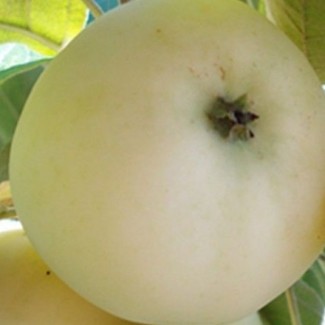
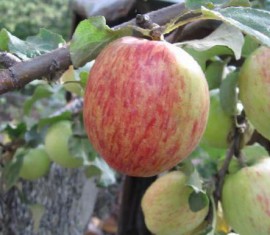
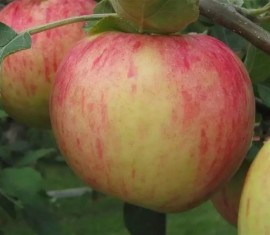
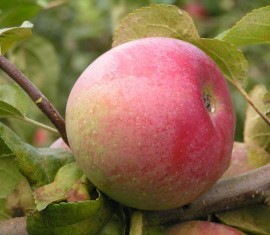
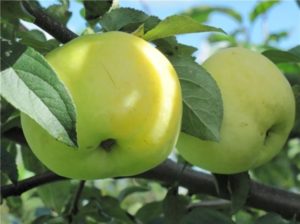 The size of the fruit your apple tree will bear depends directly on many factors, such as climate and weather conditions, and proper care. On average, they are usually large, weighing between 140 and 250 grams. They are round or round-conical in shape, and can be slightly flattened, with strong or weak ribbing.
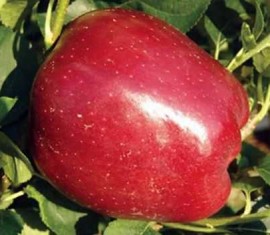
When young, the skin is a rich, bright green, becoming lighter, almost white, or yellow as it ripens. A pale pink, translucent blush appears on the surface of the fruit only on the sunny side, and even then very rarely. Subcutaneous spots are numerous, light, small, and clearly visible. The chemical composition can be characterized by the following indicators per 100 grams:
- P-active substances (catechins) – 150 milligrams.
- Ascorbic acid (vitamin C) – 9.2 milligrams.
- Total sugars (fructose) – 13%.
- Pectins (fiber) – 14%.
- Titratable acids – 0.5%.
The fruit's flesh is very tender, fine-grained, prickly, and crisp, with a snow-white color, which likely explains the variety's name. The apples have a distinctive sweet and sour flavor, considered a dessert-like, harmonious, and balanced. The apples received a tasting score of 4.6 out of 5.
Snowy Calville apple tree: characteristics
Crown and root system
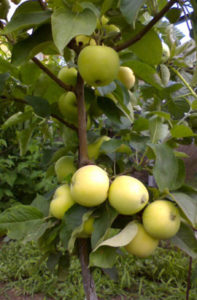 The trees are considered vigorous and can easily reach a height of 5-7 meters without special formative pruning. Crown In young seedlings, the crown is usually oval, but with age it becomes spherical and even drooping, weeping, and spreading. It can cover an area up to 5 meters in diameter. The crown is prone to spontaneous thickening; the shoots are quite thick, geniculate, and brownish-green in color, turning brown with age, with tips drooping.
The leaves of the Snow Calvillea are quite small, elongated, oval, dense, and arranged at right angles to the branches. They are dark green, but so heavily pubescent that they appear glaucous. The margins are slightly serrated, and the tip can be quite pointed. The root system is highly branched, deep, and adapted to searching for water over long distances.
Productivity and pollination
The variety truly has a very enviable fruitfulness: from one mature tree you can harvest at least 180-220 kilograms of aromatic, delicious apples per season.
It's a long way from Antonovka, but it's already much better than most other winter varieties. Calville doesn't exhibit any cyclical fruiting; it produces a consistently abundant harvest throughout its entire active life.
Snow Calville is considered a completely self-sterile apple tree. This means that if there are no apple trees of other varieties within 150-200 meters, no harvest can be expected. Therefore, it is best to plant it alternately with other varieties to ensure cross-pollination. It's also a good idea to have an apiary nearby or set up a portable one in the garden in the spring.
Winter hardiness and disease resistance
This variety is considered to have average winter hardiness, but in reality, it struggles to withstand prolonged frosts, barely reaching -20-25°C. However, if you properly prepare the trees for cold weather, stop watering promptly, and wrap and cover them, you can plant this variety even in temperate climates.
The variety is particularly resistant to scab, although it lacks genetic immunity. It can also be susceptible to other fungal infections, especially in humid conditions with frequent rainfall. This should be monitored especially closely when grown in humid maritime climates, such as Crimea. Pests rarely attack trees, but it's better to periodically carry out preventative treatments than to treat the trunks later.
Rootstocks and subspecies
Trees are typically grown on vegetative rootstock, but a dwarf variety, MM106, is also available. This variety produces much shorter trees, barely reaching 4-4.5 meters, making care and harvesting significantly easier. In addition to an earlier fruiting period (3-4 years), this subvariety retains all the characteristics of the parent plant. The Snowy Calville variety itself has become the source for many new hybrids, successfully grown in our country and far beyond.
Growing Snow Calville
 Landing
 Landing
Basic conditions
- Apple trees should be planted in a sunny location where they will receive light for most of the day. In the shade, the fruit will gradually become smaller, and the tree may eventually stop blooming altogether.
- The apple tree does not like drafts, although good ventilation does not bother it.
- Ideal soil for Calville is sandy loam, loam, or chernozem, but not too saturated, with an acidity of no more than 6.5-7 pH. Acidic soil can instantly kill seedlings, preventing them from even establishing.
- It's recommended to consider the water table, as the tree's roots can penetrate very deep. If the water table is less than 3 meters deep, the rhizome may begin to rot. Avoid planting this variety near open water.
- Planting holes should be prepared at least 3-4 weeks in advance, but it's best to do this in the fall. To do this, dig holes 60-70 centimeters deep and 1 meter in diameter. Then, mix the topsoil with fertilizer and return it to the original location. Add 30 liters of water and leave uncovered.
- The tree is tall, so it's best to leave 5-6 meters between holes, with 4-5 meters between rows. This will prevent the trees from clashing with each other, either through their roots or crowns.
- All seedlings of this variety should be soaked in warm water 4-5 hours before planting, after inspecting the roots. Any dry, damaged, or wilted roots should be immediately removed with garden shears. Immediately before planting, create a "swamp" of soil, clay, and water and immerse the rhizome in it.
- A drainage layer of approximately 10-15 centimeters is immediately placed at the bottom of the hole. This can be made from gravel, broken brick, vermiculite, or even nutshells.
- Special stakes are immediately dug into the holes to support the trees. They are placed on the north side and cannot be removed until 4-5 years have passed.
- Trees are planted vertically on drainage, ensuring that the root collar (the grafting site) is at least 6-8 centimeters above the surface. Otherwise, the tree will root above it, which will completely negate the rootstock's properties and significantly slow the growth and development of the apple tree. It's customary to plant the grafting material fairly firmly, shaking the sapling to eliminate air bubbles. Then, tamp it down with your feet, water it with 40 liters of water, and mulch with chopped grass, compost, peat, and humus.
Landing dates
This variety is considered to be not very frost-resistant, so it is best to plant it in the spring, when the risk of frost has completely disappeared. It does not flower in the first few years, but only grows green mass.
It is important to know that proper Snow Calville seedlings should not have leaves or budding buds, otherwise they will most likely die.
However, many say that the specimens planted in October also took root well and bore fruit as expected. Trees purchased in bags or pots (closed root system), can be planted throughout the growing season.
Protection from frost and rodents
The harsher the climate and weather in your region, the more extensive care your apple tree will require. Place straw or hay mats on the root zone and cover with spruce branches. Wrap the trunks with burlap, agrofibre, or roofing felt. In severe frosts, you can use a ball-type covering, at least while the trees are young and haven't grown too tall.
To prevent hungry rodents from eating the tender bark of Calville apple trees during the winter, it's common to coat the trunks with lard or grease. This is a very effective, effective, and completely safe method for apple trees. Whitewashing the trunks with lime to a height of 1-1.5 meters in the fall will also help repel insects.
Tree care
 Tree care
Loosening the soil, watering: proper agricultural technology
You'll need to regularly remove weeds from the tree's trunk area, as well as any root suckers and shoots from other trees and shrubs. This will also loosen the soil to provide more oxygen to the roots. Fertilizer can be added along with the water.
Watering this apple tree is recommended only as a last resort, during extremely dry and hot weather, and then no more than three times per season. Ideally, the first watering should be timed to coincide with bud formation, the second with fruit set, and the third with fruit ripening. For young trees, 20-30 liters per watering is sufficient, while mature trees will require up to 50.
Pruning: simple crown shaping
If trees of this variety are neglected, the crown will gradually become denser, and the apples will gradually become smaller. Ultimately, they may become completely extinct within just a few years. Therefore, formative and thinning pruning should be carried out regularly, in early spring, before the sap begins to flow.
In the first year, prune the main stem by a third, leaving just a few side branches, the largest and strongest, spaced widely apart. These should be even shorter than the trunk, a rule that should be followed throughout the year. Regular sanitary pruning is also necessary in the fall, after the leaves have fallen. Remove all diseased, dead, or damaged branches. All cut areas must be sealed with water-based paint or garden varnish.
Reproduction
- Clones (layering).
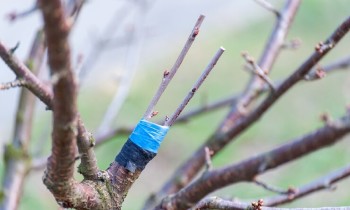
- Grafting by cuttings or buds.
- Rooting cuttings.
- Growing from seeds.
Diseases and pests
- Powdery mildew.
- Cytosporosis.
- Fruit rot.
- Scab.
- Leaf roller.
- Green aphid.
- Flower beetle.
Ripening and fruiting of the Snowy Calville apple tree
The beginning of fruiting
 The beginning of fruiting
In the first few years after planting, only Calvillea grafted onto dwarf rootstock typically blooms. It is recommended to deadhead this flowering completely. This subspecies begins to bear fruit fully in the 3rd or 4th year after planting. On vegetative rootstock, the tree begins to bear fruit normally only in the 4th or 5th year. In the first few years, you can harvest no more than 5-15 kilograms of aromatic fruit.
Flowering time
Like most winter apple trees, this variety blooms in mid-May in warmer regions. If the climate and weather are cooler, flowering may linger until early or even mid-June. It lasts only 5-10 days.
Fruiting and growth
Apple trees of this variety grow very quickly, adding 15-25 centimeters annually. At the same time, their fruiting rate increases just as rapidly. A full harvest can be harvested from a single tree in 8-10 years, and with proper care, up to 200 kilograms of juicy apples can be harvested from 11-13 years.
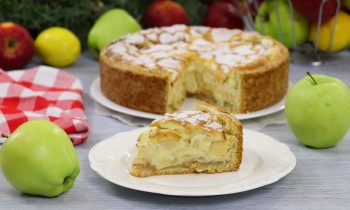
Apples ripen in the second half of September, almost all at the same time. Gardeners recommend scheduling the harvest for the fifteenth. There's a good reason for this: if you miss the harvest, the fruit will simply fall to the ground and need to be processed immediately. Apples are most often eaten fresh, but they are also suitable for making juices, jams, and preserves. It's believed they can be stored until early February, but this isn't recommended, as even in a humid and well-ventilated cellar, apples lose their unique flavor and aroma within 1-3 weeks. They become soft and tasteless.
Top dressing
- Bird droppings.
- Manure.
- Humus.
- Ammonium nitrate.
- Urea.
- Superphosphate.
What to do if it doesn't bloom or bear fruit
- Apply fertilizer.
- Transplant.
- Check for pests or diseases.
- Stop watering.
Why do apples fall?
- Overripe.
- Excess water.
- Natural phenomena (wind, rain, hail).
- Diseases.
- Pests.
Don't forget to leave your feedback on the Snow Calville variety in the comments to share your experience with other gardeners.

Comments
My absolute favorite apple variety! Delicious, juicy, and crispy! Especially when it's cold outside. Mid-October is their perfect time. Oh, how plump they are!