Papiroyantarnoye apple tree: characteristics of the variety and care
| Color | Greens , Whites , Yellow |
|---|---|
| Ripening season | Summer |
| Size of apples | Large |
| Taste | Sweet and sour |
| Crown type | Average tree height |
| Shelf life | Low shelf life |
| Application | Fresh , For recycling |
| Winter hardiness | High winter hardiness |
| Fruiting age | From 5 years old |
 History of origin and regions of growth
Growing regions
- Ural.
- Western Siberia.
Origin
The renowned Russian scientist Leonid Andrianovich Kotov was involved in breeding winter-hardy apple trees at the Sverdlovsk Horticulture and Vegetable Breeding Station. Back in the late 1990s, he developed an entirely new hybrid, the parent varieties of which were Yantar and Papirovka. It was from these two varieties that the new apple tree received its name.
Almost immediately, the apple tree was classified as an elite variety and shipped to farms in the Urals, Western Siberia, and other regions of our country. It performed so well that in 2002 it was decided to include it in the State Register and zone it for the aforementioned regions.
Content
Description of the Papiroyantarnoye apple variety
 A late summer variety, almost completely devoid of blush, is just gaining popularity Urals and in some other regions. It is considered promising due to its high yield, early maturity, tolerance to harsh growing conditions, ease of cultivation, excellent fruit quality, and resistance to various apple fungal infections. Despite the poor shelf life of its fruit, this variety is recommended for both large commercial intensive orchards and small home gardens.
Apples: What they look like
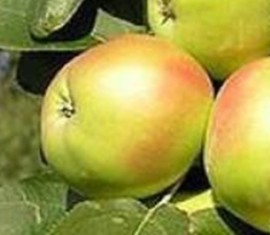
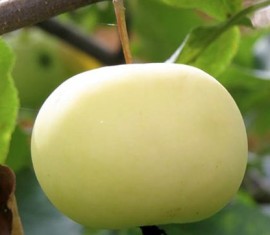
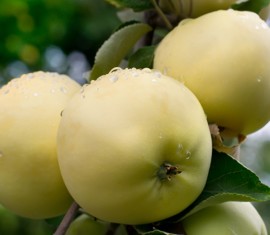
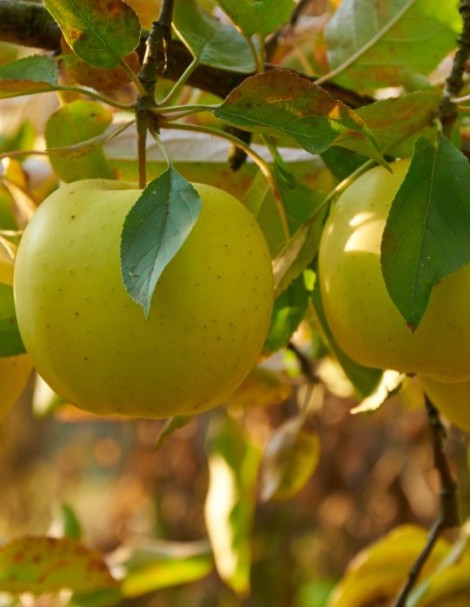
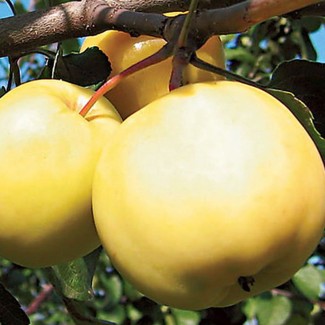
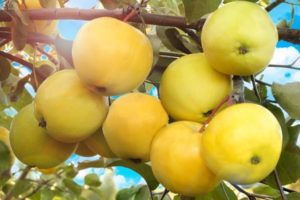 The fruits of this variety are predominantly medium to large in size, a figure directly influenced by climate, weather conditions, and care. They easily reach 130-180 grams in weight, with some specimens exceeding 200 grams. The fruits are uniform, round, smooth, with slight ribbing, and can be slightly flattened or elongated.
The skin is smooth, dense, elastic, quite firm and strong, green or even dark green when unripe. As it ripens, it turns yellowish-green, and sometimes even white or translucent. These apples lack a blush, but they can appear yellow when exposed to sunlight. Subcutaneous spots are light gray or slightly greenish, barely visible, and the chemical composition is characterized by the following indicators per 100 grams:
- P-active substances (catechins) – 258 milligrams.
- Ascorbic acid (vitamin C) – 7 milligrams.
- Total sugars (fructose) – 19%.
- Pectins (fiber) – 13.2%.
- Titratable acids – 0.8%.
The flesh is fine-grained, crisp, juicy, medium-dense, non-prickly, tender, and has a very pleasant texture. It is snow-white or whitish-cream in color and has a strong, distinctive aroma. The flavor is considered dessert-like, balanced, and harmonious; experts say it's better than Papirovka or Yantar. The official professional tasting score is 4.4 points for appearance and 4.5 points for flavor on a 5-point scale.
Papiroyantarnoye apple tree: characteristics
Crown and root system
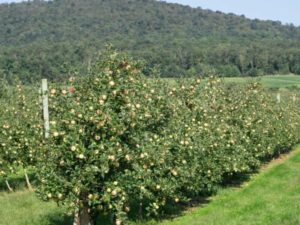 Trees of this variety are classified as medium-sized, but not as semi-dwarfs, which make up more than half of this subgroup. Without additional pruning, the trunks easily reach 5-7 meters in height.However, most gardeners, through crown shaping, aim for a height of no more than 4-4.5 meters to facilitate harvesting and care. Branches extend from the main stem, typically at a nearly right angle. The crown is oval or pyramidal when young, becoming increasingly spherical, broadly oval, or spreading with age.
The trunk bark is grayish-brown, and the branches are gray-brown or slightly brownish-green, smooth, and covered with light pubescence. The leaves are dark green, leathery, glossy, and shiny, with a pubescent surface. They are short-pointed and have a slightly wavy, finely serrated edge. The root system is robust, highly branched, and deep, holding firmly in the soil, and is well adapted to seeking water.
Productivity and pollination
The variety is considered high-yielding and also relatively early-bearing.
During the growing season, one mature tree of the Papiroyantarnoye variety, with proper care and timely fertilizing, can yield approximately 65-80 kilograms of delicious, aromatic fruits..
Experts consider this variety completely self-fertile, meaning it doesn't require other apple trees to form fruit. Pollinating insects and wind are sufficient for the process to occur. However, the yield under these conditions will not exceed 65-75% of the maximum possible. Therefore, it's still advisable to have other apple trees with suitable flowering times growing within 50-100 meters.
Winter hardiness and disease resistance
This variety has excellent low-temperature tolerance. It easily tolerates temperatures down to -29-32°C, especially if winter preparation is carried out correctly and promptly. For example, it's crucial not to water the plants later than mid-September, otherwise they simply won't have time to prepare for winter. The trees dislike drafts and strong winds, but otherwise, even sudden temperature changes don't harm them.
Papiroyantarny, like its "parents," has a natural immunity to scab and other fungal infections of apple trees. It's not genetically determined, but the variety is rarely affected. If it does become infected, it almost always affects only the leaves, while the fruit is perfectly edible. In rare cases, it's best to discard the entire crop, but avoid burying it within the plot.
Rootstocks and subspecies
Despite the fact that the variety is considered new, it already has several main subspecies, which are becoming increasingly popular among amateur and professional gardeners.
| Subspecies | Description |
| Summer | This subspecies is grown on a standard clonal rootstock, resulting in earlier fruiting and ripening. Apples weighing 120-150 grams can be harvested as early as mid- to late August. Trees on this rootstock resemble columnar trees, but are not. |
| Dwarfs and semi-dwarfs | Gardeners appreciate this subvariety due to its more compact size. It grows no more than 2-2.5 meters, making it much easier to care for and harvest. Dwarf varieties begin to bear fruit approximately 3-4 years after planting, without losing their commercial and consumer qualities or yield. Moreover, standard varieties have a shallow root system, making them suitable for planting even in areas with low groundwater levels. |
Features of growing Papyroyantram
 Landing
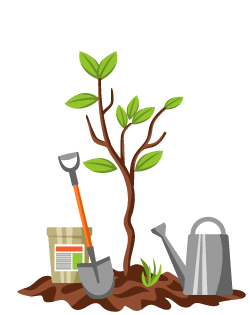 Landing
Basic conditions
- The planting location should be chosen so that the apple trees will be well lit throughout the day.
- It's best to keep the seedlings away from drafts, as this can damage the tree. It's best to plant them in open areas, but protected from strong winds by the walls of buildings, taller trees, or hedges.
- Proximity to groundwater is not ideal for apple trees of this variety. Their roots tend to penetrate deep and easily reach moisture. Constant moisture inevitably leads to rot and death of the tree.
- Planting holes for any apple tree are typically prepared in advance, in the fall. However, with the Papiroyantarne variety, this is not necessary; it can be done in just 2-3 weeks. To do this, dig holes 65-80 centimeters deep and 90-100 centimeters in diameter, and add a small amount of topsoil mixed with fertilizer to the bottom. Then, add about 5-10 centimeters of drainage, fill the entire hole with 25-35 liters of water, and leave it outdoors.
- It is advisable to leave at least 4.5-5 meters between trees so that in the future they do not conflict with either their crowns or root systems.
- Metal or wooden stakes are driven into the holes immediately, preferably on the north side of the tree trunk. They can be removed no earlier than 2-3 years after the apple trees begin to bear fruit.
- The root collar should be left at least 8-12 centimeters above the soil surface, otherwise the tree may take root higher, and then all the original qualities and properties of the rootstock will be leveled out.
- The seedlings are placed vertically on a drainage mat, the rhizomes are spread out, covered with soil, and compacted by hand, being gentle. They are watered with approximately 35-40 liters of water, and the surface is mulched with sawdust, chopped grass, and compost.
Landing dates
Officially, Papiroyantarnoye can be planted in either fall or spring. However, experienced gardeners note that the former option is highly likely to result in the seedlings dying. They don't have time to adapt to the new conditions before the frost sets in, so they freeze and die in winter. It's best to choose a sunny, warm day in late March or early April, before the sap begins to flow in the trunks, and begin planting.
Protection from frost and rodents
Trees are quite resistant to low temperatures, but winter preparations will still be necessary. In the harshest regions, it's best to pile a 12-15 centimeter layer of soil over the rhizome or cover the root zone with straw or grass mats. Trunks are wrapped in burlap, old tights, or roofing felt. Only trees on dwarf rootstocks or young seedlings should be covered with a tent-like covering.
To protect against insects, all trees are whitewashed with lime, to a height of approximately 1.2-1.5 meters. This is best done in early spring and late fall. To prevent rodents from gnawing the bark during the cold season, you can coat it with grease or even aromatic lard; this will definitely repel mice, hamsters, and other insects. hares.
Tree care
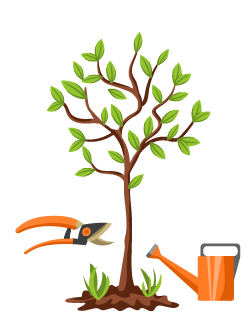 Tree care
Loosening the soil, watering: proper agricultural technology
It's recommended to dig up the area around the trunk once or twice a year to allow the roots to have access to oxygen. Dwarf varieties require caution, as their roots are located close to the surface and are easily damaged.
During the first year after planting, standard trees require ample moisture, which should be applied at least 2-4 times per month (maximum once per week). However, in the future, this is not necessary at all; watering should be limited to 4-6 times per season, and only when there has been no natural precipitation for at least 2-3 weeks.
Pruning: simple crown shaping
The Papiroyantarny's crown is quite dense, so it will need to be pruned regularly to avoid excessive thickening. For a standard tree, it's sufficient to begin shaping it in the 2nd or 3rd year, leaving just 2-4 skeletal branches and a central conductor, and removing all others. However, this variety can be used to create a good creeping variety, but shaping the crown by completely removing the trunk and bending the branches toward the ground will require starting in the first year.
Regularly perform sanitary pruning, removing all dry, broken, or damaged branches. Don't forget to seal the cut areas with garden varnish, water-based paint, or even just a mixture of soil and water. Rejuvenation pruning, removing 2-4 mature branches, should begin no earlier than 15-18 years of age.
Pollinator varieties
- Borovinka.
- In Memory of Ulyanishchev.
- Uralsk resident.
- Sparan.
- Antonovka.
- Bellefleur the Chinese.
- Simirenko.
Reproduction
- Rooting cuttings.
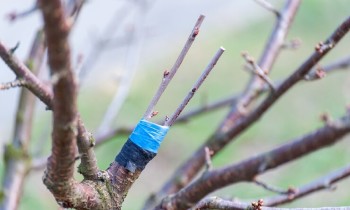
- Grafting by buds and cuttings.
- Clones (layering).
Diseases and pests
- Moniliosis.
- Scab.
- Powdery mildew.
- Fruit rot.
- Cytosporosis.
- Tinder fungus.
- Green aphid.
- Codling moth.
Ripening and fruiting of Papiroyantarny
The beginning of fruiting
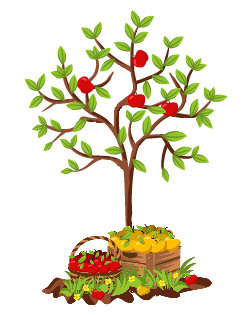 The beginning of fruiting
This variety isn't exactly precocious. It produces its first apples approximately 6-7 years after planting in open ground. At this point, you'll be able to harvest no more than five kilograms of aromatic fruit, but it's enough to sample. Dwarf varieties begin bearing fruit in 3-5 years, but their overall lifespan on this rootstock is significantly reduced.
Flowering time
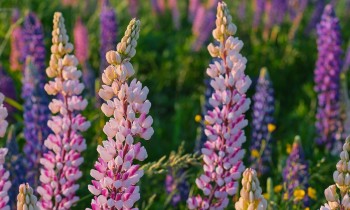
Papiroyantarnoye begins blooming in the second ten days of May. However, this will depend not only on the climate of the growing region but also on the prevailing weather conditions of the particular year. In cold and rainy weather, bud opening may be delayed until the end of the month. This process lasts approximately 10-14 days. The flowers themselves are beautiful, fragrant, large, gathered in clusters, pure white or with a light green tint.
Fruiting and growth
The tree grows rather slowly, initially faster before fruiting begins, but then slows down. It can grow no more than 10-15 centimeters per year, so fruiting doesn't increase very quickly. A full harvest can only be collected 9-12 years after fruiting begins.
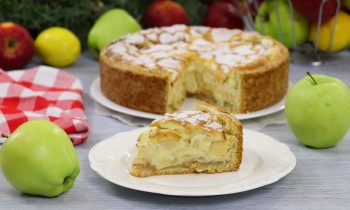
Apples usually begin to ripen in late August or early September. They ripen evenly, and almost all of them need to be picked at once. But there's no need to rush; the fruit holds well on the branches and doesn't fall to the ground until mid- to late September. Papiroyantarnoye (Papirot) can't be stored for long; it retains its flavor for no more than 3-4 weeks. Therefore, it's best to process it immediately into juices, jams, or compotes.
Top dressing
- Superphosphate.
- Compost.
- Nitrogen fertilizers.
- Humus.
- Potassium complexes.
- Ammonium nitrate.
- Manure.
What to do if it doesn't bloom or bear fruit
- Check for pests and diseases.
- Transplant.
- Limit or increase watering.
Why do apples fall?
- They are very overripe.
- Natural factors.
- Pests.
- Diseases.
Leave your feedback on the winter-hardy Papiroyantarnoye variety to share your experience with others.