Starkrimson apple tree: characteristics of the variety and care
| Color | Reds |
|---|---|
| Ripening season | Summer |
| Size of apples | Large |
| Taste | Sweet and sour |
| Crown type | Average tree height |
| Shelf life | Low shelf life |
| Application | Fresh , For recycling |
| Winter hardiness | Low winter hardiness |
| Fruiting age | Up to 5 years |
 History of origin and regions of growth
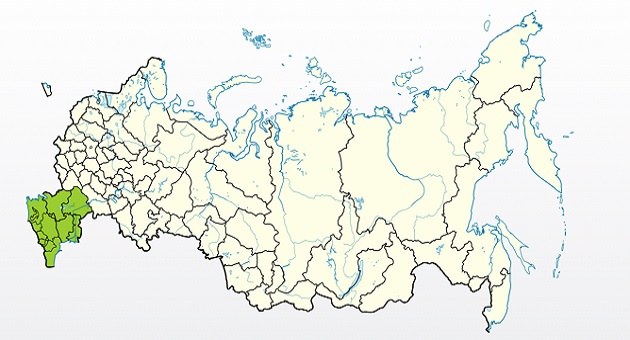
Growing regions
- Crimea.
- North Caucasus.
Origin
Experts say this apple variety originated in Ohio or Iowa in the United States as early as 1921. It was the result of a random (spontaneous) somatic mutation. The parent variety is considered to be the famous Delicious Starking, which itself is a clonal subvariety of Delicious Red. The entirely new hybrid was discovered by breeder Roy A. Bisbee, who sold the new variety to Brothers Stark in 1956.
The apple tree got its name for its beautiful, unusually bright appearance. Starkrimson means Crimson Star in English.
This ancient variety quickly spread throughout America, and was then brought to Europe by gardeners intrigued by its impressive fruit. Around the 1970s, the apple trees reached the Soviet Union, where they also became widespread and popular.
As early as 1974, the decision was made to add the variety to the State Register, which was done, and it was also zoned for the North Caucasus region. Today, the market is flooded with new, more productive, winter-hardy varieties that hold much greater promise, but Strakrimson remains elusive, and so it is still found in many gardens across the country.
Content
Description of the Starkrimson apple variety
 The trees are characterized by their small stature and relatively compact crown, making them suitable for cultivation not only in private gardens but also in large, intensive commercial orchards. Furthermore, they begin bearing fruit quite early, producing substantial yields. The fruits themselves are beautiful, possess excellent commercial and consumer qualities, and can be stored almost until the next harvest. All this, despite their low winter hardiness, makes the apple tree popular, even almost a century after its creation.
Apples: What they look like
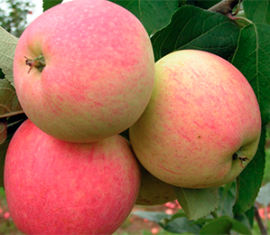
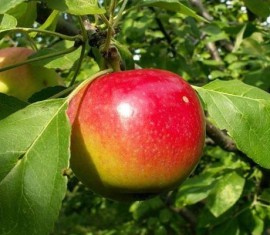
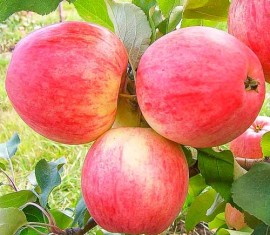
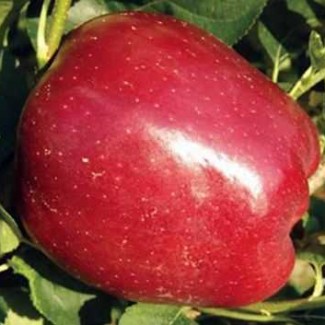
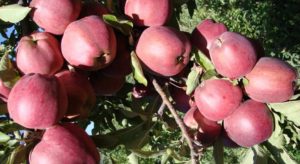 The fruits are generally larger than average and large. They can easily grow to 180-250 grams in favorable conditions. However, they are not uniform; smaller specimens are also found, as are larger ones, weighing 110-130 grams and 280-300 grams. They are round, slightly elongated-conical, with medium ribbing, which is quite visible at the top of the fruit; the larger the apples, the more noticeable the ribbing.
The skin is smooth, dense, thick, yet delicate. It is dry and glossy, with a characteristic waxy coating that gives it a bluish tint. The underlying color is green or greenish-yellow at consumer maturity. The blush is continuous, covering more than 95-97% of the fruit. It is dark carmine or beetroot red, possibly burgundy, but can appear dark purple beneath the coating. Subcutaneous punctures are numerous, light green or grayish, small, and clearly visible against the dark blush.
- P-active substances (catechins) – 145 milligrams.
- Ascorbic acid (vitamin C) – 1 milligram.
- Total sugars (fructose) – 11.1%.
- Pectins (fiber) – 14.7%.
- Titratable acids – 0.28%.
The flesh is dense, fine-grained, and very juicy. It's prickly, sweet and sour, easy to peel, and crisp. When unripe, it has a distinct green hue, but as it ripens, it takes on a lemony-green hue. The apple's aroma is characteristic of apples, powerful and pleasant. Experts have given the fruit a 4.7 out of 5 stars for appearance and a 4.6 out of 5 stars for flavor.
Starcrimson apple tree: characteristics
Crown and root system
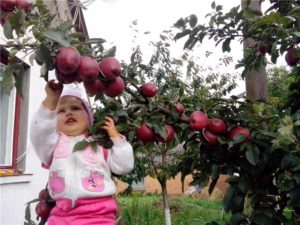 The tree is considered to be of medium height, but in fact it can easily be classified as a natural semi-dwarf or even a dwarf. Without shaping, apple trees grow to a maximum height of 2.5-3 meters., but this is rare. In most cases, owners limit its growth by pruning it to just 2 meters to facilitate harvesting and maintenance of the trunks. The crown is not prone to thickening; it has a broadly pyramidal or broadly oval shape, can be broom-shaped, and in old age, even spreading. Shoots often branch off from the trunk at an acute angle, which can lead to them breaking off when the harvest ripens. They are covered with smooth, pubescent bark of a gray-brown or steel-gray color.
The leaves are medium-sized, elongated, and dark green, with a short, pointed tip that curls downward. The leaf margins are serrated, wavy, and serrate. The surface is leathery and smooth, but not shiny, rather matte. The tree's root system is superficial and branched, and may or may not have a central taproot, depending on the rootstock.
Productivity and pollination
The fertility of the variety has never been questioned, as just a few apple trees can provide all a person's needs for an entire year.
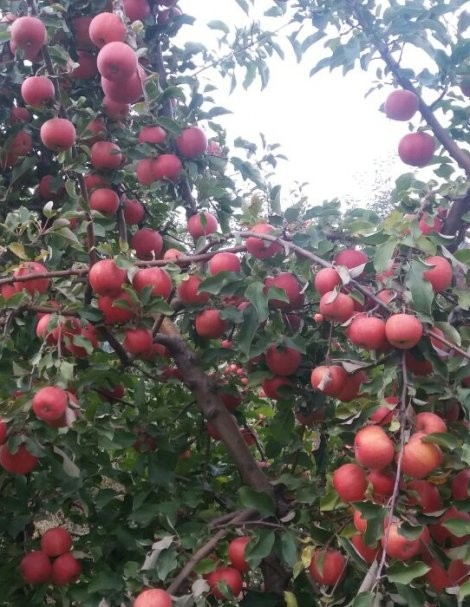
Under favorable conditions, a single mature apple tree can yield up to 120-160 kilograms of fragrant, beautiful, and delicious fruit. However, there have been cases where even more was harvested, up to 200 kilograms, under good weather and meticulous care..
The variety is considered conditionally sterile, meaning it requires other apple trees with suitable flowering times for cross-pollination. Therefore, it's best to interplant different varieties, bring mobile apiaries to orchards, and spray the trees with sugar syrup to attract bees.
Winter hardiness and disease resistance
A look at the growing regions reveals that this tree's frost resistance is quite poor. In the mild Crimean or Caucasian climates, they grow quite well, but require winter protection. In temperate climates, for example, they often die within the first year after planting. Frosts as low as -15-17°C can kill the Strakrimson in even a short time, so it's best not to waste money and effort trying to plant it in unsuitable regions.
This old variety has low resistance not only to scab but also to other fungal infections. If it becomes infected, it attacks immediately and heavily, like an avalanche. Both leaves and fruit are affected, so eating diseased apples is not recommended. Prevention is as simple as promptly clearing the area around the trunk of leaves, rotting fruit, and other debris, preventing excess moisture, and regularly and promptly treating the trees with fungicides and insecticides.
Rootstocks and subspecies
There are no true subspecies of apple trees, but they can be grown on various rootstocks, with the end result varying slightly. The most popular is the MM-106 rootstock. On this rootstock, apple trees do not grow taller than 2-2.5 meters. The tallest trees are grown on seedling rootstocks. Columnar Stracrismon trees are not yet known, and no research has been conducted on this topic.
Features of growing Stracrismon
 Landing
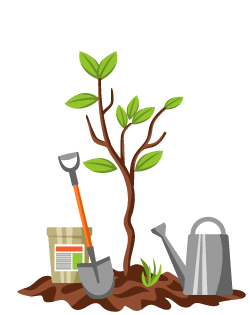 Landing
Basic conditions
- To ensure a decent yield, choose a location where the crown receives good sunlight for most of the day. Planting it in the shade is unacceptable, as it may not produce any fruit at all.
- Apple trees should not be planted where the groundwater level rises more than 1.5-2 meters above the surface, as this can cause them to rot. Therefore, it is also undesirable to plant them in low-lying areas, near rivers or ponds, shallow wells, or where meltwater accumulates in the spring. All of these conditions will lead to root rot.
- Starcrimson doesn't like drafts, although it does need good crown ventilation to prevent air stagnation and subsequent fungal infections. It's best planted on southern and southeastern slopes.
- Ideally, the holes should be prepared a year before planting, but if you miss the opportunity, you can dig them 4-6 weeks in advance. To do this, dig holes 60-70 centimeters deep and the same in diameter, add fertilizer, cover with stones or broken brick, and then fill with 25-40 liters of water.
- Soil Apple trees can be grown in any soil, from black soil to sandy loam. However, in the former case, it will need to be diluted with imported washed river sand, while in the latter case, more attention will be paid to fertilization. The only thing the seedling won't tolerate is excessive acidity; this needs to be neutralized with lime, as the trees will likely die.
- Leave approximately 2-2.5 meters between planting holes, and 1.5-2 meters between rows is fine. This will give the apple trees plenty of room to spread out.
- The rootstock's crown is traditionally left 5-8 centimeters above the soil surface to prevent the tree from rooting higher. Otherwise, you'll simply lose the rootstock's qualities.
- Holding the tree by the trunk, cover it with soil, compacting it, and then water it with 35-45 liters of water. Mulch the surface well with chopped grass, sawdust, humus, or compost.
Landing dates
This variety grows exclusively in mild and warm climates, so there's little difference between planting it in spring or fall. You can choose a sunny, warm day in late March or early April, before the buds begin to open, or in late September or early October, after the leaves have finished falling. Potted and bagged trees (closed root system) can be moved to open ground at any time from April to October.
Protection from frost and rodents
Before wintering, trees must be properly prepared; otherwise, damage can occur not only to the bark and branches, but even to the wood itself. Therefore, it's best to wrap the trunks with roofing felt, burlap, or tarpaulin, and rake soil or lay straw mats over the root zone. This will protect delicate seedlings from frost, but in harsher conditions, it's recommended to cover the trees with a tent-like covering, which is convenient due to their low height.
To repel insects that prefer to spend the winter in bark crevices and around the rhizomes, trees are whitewashed with lime every fall and spring. And to repel rodents that eat young branches and the tender bark of trunks, the trunks are coated with grease or rendered lard.
Tree care
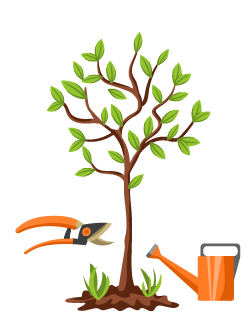 Tree care
Loosening the soil, watering: proper agricultural technology
The soil around trees of this variety requires regular loosening. Twice a year, the area around the trunk is dug up, but this must be done very carefully to avoid damaging the shallow roots. You can also hoe the soil several times a season, immediately removing all weeds, shoots, and root suckers.
Frequent watering is recommended for Starkrimson; some even recommend 10-15 liters 2-3 times a week. However, this is only recommended during dry, hot summers, to avoid overwatering the trees. Drip irrigation is also an option; it's even better for apple trees and eliminates the need for excessive moisture.
Pruning: simple crown shaping
Properly performed formative pruning will not only ensure a good yield but also prevent the risk of many diseases. Crown ventilation is crucial for this variety, so it's best to space the branches far apart. You can create a broom-shaped, open-tiered, bowl-shaped, or inverted-pyramidal crown; the key is to prune out suckers (those protruding upward) and inward-growing shoots promptly.
It's also important to promptly remove dead, broken, or diseased branches from trees, as these can impede their proper development. This is best done in early spring or late fall, sealing all cuts with water-based paint, garden varnish, or another suitable product. After 12-15 years, rejuvenation can be performed every few years. This involves removing two or three mature shoots to allow more room for the young shoots.
Reproduction
- Rooting cuttings.
- Grafting by buds and cuttings.
- Growing from seeds.
- Clones (layering).
Diseases and pests
- Moniliosis.
- Scab.
- Powdery mildew.
- Fruit rot.
- Cytosporosis.
- Tinder fungus.
- Green aphid.
- Codling moth.
Ripening and fruiting of Starkrimson
The beginning of fruiting
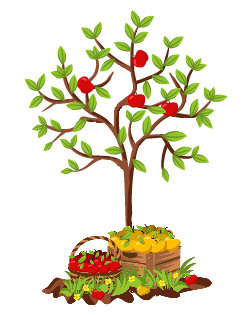 The beginning of fruiting
This variety is extremely early-bearing. Buds begin to open on apple trees in nurseries as early as the first year, but it's recommended to remove them to allow the trees to strengthen. Fruiting begins in the second or third year, when approximately 10-15 kilograms of fragrant and beautiful fruit can be harvested. On dwarf rootstocks, the first fruiting period is similar, but on seed rootstocks, it may take until the fourth or fifth year, but still quite soon.
Flowering time
This variety blooms in mid-May, but if the weather is cold or rainy, this may shift to the end of the month. It usually never opens its buds earlier. The process lasts 10-14 days, and it occurs en masse, like an avalanche, making the trees look particularly beautiful during this period. Stracrismon flowers are large, gathered in clusters of several, saucer-shaped, fragrant, and tinged with a slight pink hue.
Fruiting and growth
Apple trees grow quite quickly, so they stop growing completely by the 8th to 10th year. Approximately 25-50 centimeters per year for the first fruiting and half that later is normal. Yields also increase rapidly, and by the 6th to 8th year, harvests are practically full.
Apples are harvested from approximately mid-September until October. They ripen gradually, rather than all at once. Therefore, there's no need to worry about them falling to the ground. However, during harvesting, they are only technically ripe; consumer maturity doesn't occur until 30-45 days after they're placed in the cellar. The fruit keeps very well, maintaining its marketability and flavor until late April or even May.
Top dressing
- Superphosphate.
- Compost.
- Nitrogen fertilizers.
- Humus.
- Potassium complexes.
- Ammonium nitrate.
- Manure.
What to do if it doesn't bloom or bear fruit
- Check for pests and diseases.
- Transplant to a sunnier location.
- Limit or increase watering.
Why do apples fall?
- Natural factors.
- Pests.
- Diseases.
Leave your feedback on the winter-hardy Starkrimson variety to share your experience with others.