Apple tree Souvenir Altai: characteristics of the variety and care
| Color | Reds |
|---|---|
| Ripening season | Autumn |
| Size of apples | Average |
| Taste | Sweet and sour |
| Crown type | Average tree height |
| Shelf life | Average shelf life |
| Application | For recycling , Fresh |
| Winter hardiness | High winter hardiness |
| Fruiting age | Up to 5 years |
 History of origin and regions of growth
Growing regions
- Siberian Federal District.
Origin
This autumn apple variety was developed at the Siberian Research Institute of Horticulture by the renowned Russian breeder Mikhail Afanasyevich Lisavenko, after whom the research institute was later named. He created over four dozen frost-resistant varieties suitable for growing in the harsh Siberian conditions. The Altay Souvenir apple was developed in collaboration with N.V. Ermakova and I.P. Kalinina. It was developed by crossing the Gorno-Altaisk variety with a mixture of pollen from the Chinese Bellefleur and the saffron pepin.
The first specimens of this variety were obtained in 1954, after which they were sent to nearby farms for detailed research and testing. In the mid-1970s, Suvenir was classified as an elite variety and entered into the State Register. In 1985 and 1999, it was zoned for the Altai Krai and Western Siberia, respectively.
Content
Description of the Souvenir Altai apple tree variety
 This apple tree attracts most gardeners with its beautiful, tasty, and fragrant fruits, and most importantly, its fairly large size for a Siberian variety. The tree also bears fruit early, produces good harvests annually, and is quite resistant to low temperatures and, most importantly, to the main problem of all apple trees: scab. However, among its drawbacks, gardeners cite its low resistance to moniliosis, but with proper care and preventative measures, this can be avoided. It is recommended not only for small private farms but also for commercial intensive orchards.
Apples: What they look like
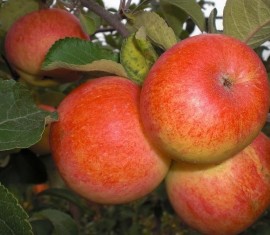
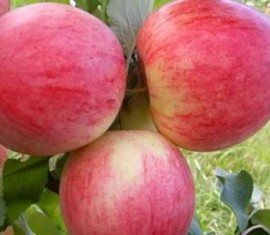
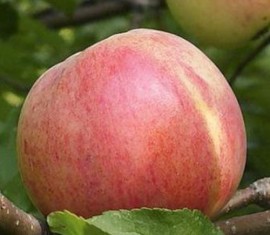
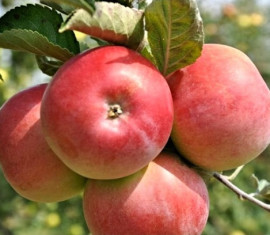
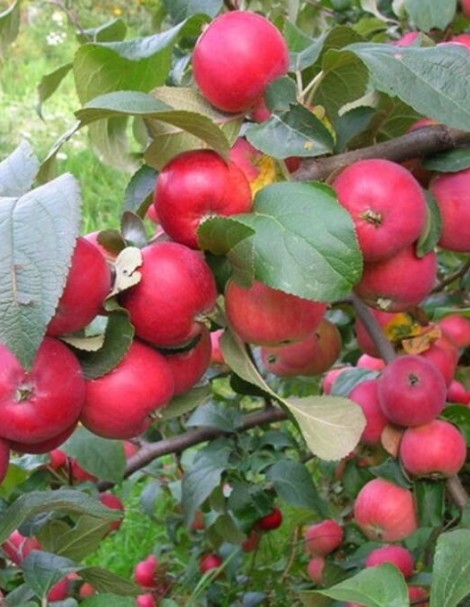
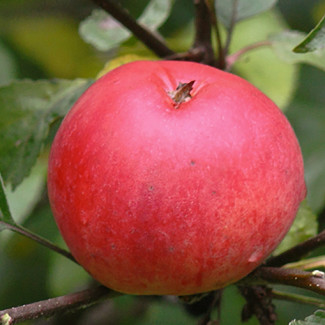
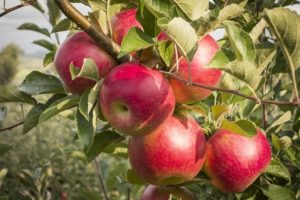 For Siberia Apples of this variety can safely be called large, but in reality they are medium or slightly smaller than average. The ruddy fruits reach a maximum weight of 85-130 grams, have a round or round-conical shape, and can be slightly flattened. Ribs are often clearly visible on the surface. The fruit's surface is smooth, glossy, and covered with a bluish waxy coating that is easily wiped off.
The skin is dense and smooth, greenish-green when unripe, becoming light yellow or even golden as it ripens. The blush is pink or reddish-pink, blurred and streaky, and covers approximately 85-90% of the apple's surface. The apples are attached to a long, pubescent stalk. The chemical composition is as follows (per 100 grams):
- P-active substances (catechins) – 101 milligrams.
- Ascorbic acid (vitamin C) – 11.9 milligrams.
- Total sugars (fructose) – 11.4%.
- Pectins (fiber) – 5.6%.
- Titratable acids – 0.99%.
The flesh of these apples has a slightly creamy hue when ripe. It is juicy, dense, fine-grained, prickly, and crisp. It has a sweet and sour, balanced, and harmonious dessert flavor with a strong aroma. According to professional tasters, the fruits receive a 4.8 for appearance and a 4.4 on a 5-point scale.
Apple tree Souvenir Altai: characteristics
Crown and root system
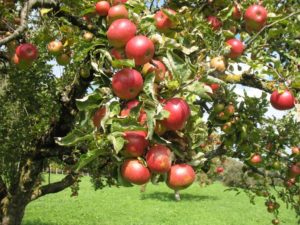 Souvenir is considered to be a medium-sized tree, although compared to Alyonushka, it is much larger. On average, Without formative pruning, the variety can grow 4-5 metersHowever, experienced gardeners prefer to limit it to a maximum of three meters. The medium-density crown won't require frequent thinning. It has a rounded shape, allowing it to eventually become spherical or oval. The branches grow mostly at right angles to the trunk. They are straight, covered with brown or greenish-brown bark; young ones may be pubescent.
The tree's leaves are medium-sized, elliptical or ovate, and elongated. They are bright green or light green, short-pointed, leathery, glossy, and shiny, with a light pubescence on the back. The leaf curves downward, has a serrated edge, and a short petiole. The root system is highly branched but rather superficial. It may or may not have a central taproot, depending on the rootstock used.
Productivity and pollination
It is considered that Souvenir Altaya is a medium-yielding variety.
One adult tree produces an average of 25-40 kilograms of delicious fruit per year.
It begins bearing fruit slightly later than other varieties developed by the same research institute, only 5-6 years after planting in open ground. This is fully compensated by the apples' size, aroma, and pleasant taste. Gardeners have been able to harvest up to 50-60 kilograms from a single mature tree, provided the tree's growing conditions are comfortable.
The variety is self-fertile, meaning even if there's no other apple tree nearby that blooms at the appropriate time, you'll still get a harvest. However, experienced gardeners recommend planting trees within 150-200 meters of other varieties to increase yields to 100%. It's also a good idea to establish orchards near apiaries or use portable versions.
Winter hardiness and disease resistance
Considering the harsh Siberian climate, the apple tree's resistance to low temperatures can be considered average. It copes with normal winters fairly easily, but in particularly cold years, or when thaws frequently alternate with prolonged, bitter frosts, it can suffer severe damage. Moreover, not only young shoots but even the wood can be damaged. Fortunately, the apple tree has excellent resilience and fully recovers from damage in just a year or two.
The variety is resistant to scab, and when infected, only the leaves are affected, leaving the fruit unharmed. This is another advantage of Souvenir Altaya, as even a diseased tree can produce apples that can be picked and eaten. One drawback is its lack of resistance to moniliosis, but this is easily addressed with preventative measures.
Rootstocks and subspecies
There are several subspecies of this variety, which are worth talking about in a little more detail.
| Subspecies | Description |
| Autumn (late) | This subvariety is grown on vegetative rootstock. The apples begin to ripen slightly later, around the end of September. Otherwise, they retain all the characteristics of the parent variety. |
| Semi-cultured | To mitigate the effects of low temperatures and increase resistance to fungal infections, Souvenir apples are often grafted onto wild apples. Apples of this subspecies grow somewhat smaller, weighing only 70-100 grams, but their flavor remains unchanged. |
Features of growing Souvenir Altai
 Landing
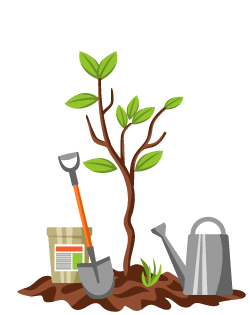 Landing
Basic conditions
- For a good harvest, the apple tree's crown must be well-lit for most of the day. Therefore, it's best to choose a site away from shade, where they will bear fruit poorly.
- Plants do not like drafts, so it is better to arrange planting under the protection of taller trees, building walls, fences and hedges.
- Soil A souvenir requires fertile soil, but if that's not available, it can be artificially fertilized. It should be slightly acidic; sandy loam or loamy soil are good options, and black soil is far from the worst.
- Avoid planting this variety in damp hollows or marshy lowlands, as the apple tree does not thrive in excessively wet conditions and will die. Locations near natural bodies of water, wells, or where groundwater levels rise excessively are unsuitable.
- Holes for the seedlings are dug in advance, preferably in the fall. In most cases, holes 70-80 centimeters deep and 1 meter in diameter are sufficient. A topsoil layer mixed with fertilizer is placed at the bottom, followed by a thin (10-15 centimeter) layer of drainage material. The entire mixture is watered with 30-40 liters of water and left outdoors throughout the winter.
- Before planting, carefully inspect the rhizome, removing any dry or damaged shoots if necessary. Make a special slurry of soil and water, the consistency of heavy cream, and soak the rhizome in it before planting the tree.
- After spreading all the roots, place the seedling directly on the drainage trench and cover it with soil, compacting it lightly with your hands. Don't pack the root ball too tightly, as apple trees prefer oxygen-rich soil. Create a border around the perimeter, pour 30-40 liters of water inside, and mulch the surface with compost, chopped grass, or humus.
It's important to maintain this tree's "sovereign space" to prevent future conflict between the crown and roots. Leave 3.5-4.5 meters between seedlings, and at least 4-5 meters between rows..
Landing dates
Both fall and spring plantings are acceptable. However, gardeners say the latter option is preferable, as apple trees have a higher survival rate and begin bearing fruit earlier. Therefore, it's best to plant them in April, before the buds begin to open. Over the summer, a one-year-old seedling will develop a root system, new branches, and become sufficiently strong before the cold season. Trees purchased from nurseries closed root system can be moved to open ground at any time during the growing season.
Protection from frost and rodents
The Altai souvenir tree's frost resistance is indeed good, but in particularly harsh winters, it can still freeze, especially when young. Therefore, it's a good idea to properly prepare the trees for winter. To do this, rake a 10-15 centimeter layer of soil onto the root zone and cover it with mats of dry grass or straw. The trunks are wrapped in agrofibre, burlap, roofing felt, or roofing felt. If the weather forecast is unfavorable, young trees can be covered with a tent.
Tree care
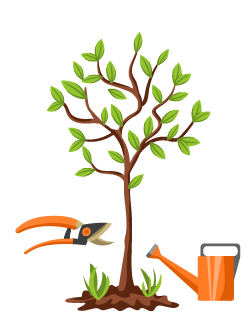 Tree care
Loosening the soil, watering: proper agricultural technology
It's recommended to dig up the area around the tree's trunk once or twice a year. At the same time, you should immediately remove weeds, other plant shoots, and root suckers from around the tree. All of these things rob the fruit tree of nutrients. However, this must be done carefully, as it's easy to damage the shallow root system.
Watering is an important factor when growing Souvenir Altai. Trees need to be watered at least three times and no more than seven times per season. Watering can be timed to coincide with the most important stages of the apple tree's life: flowering, fruit set, foliage growth, and fruit ripening. Fertilizers can be added along with water, preferably complex fertilizers that contain all the nutrients necessary for growth.
Pruning: simple crown shaping
It's often recommended to shape this tree into a sparse, tiered crown, allowing the branches maximum exposure to sunlight. This should be started in the first year, but there's little need to worry, as trees come from the nursery with a central trunk and several skeletal branches already established. All you need to do is maintain the shape. Remember to trim about one-third of the crown annually so the tree can devote all its energy to producing fruit.
It's important to carry out sanitary pruning on time. After autumn, remove all damaged branches, dead shoots, and those affected by disease. The same process will need to be repeated in the spring. It's important to do this when sap flow is slow, either before bud break or after the leaves have fallen.
Pollinator varieties
- Alyonushka.
- Pepinka.
- Welsey.
- Gorno-Altaisk.
- Ranetka.
- Bellefleur the Chinese.
- Saffron pepin.
Reproduction
- Clones (layering).
- Rooting cuttings.
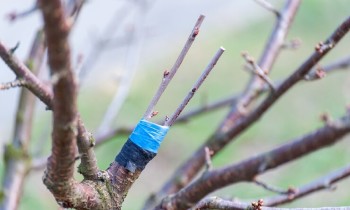
- Grafting by buds and cuttings.
Diseases and pests
- Scab.
- Moniliosis.
- Hawthorn.
- Leaf roller.
- Flower beetle.
- Codling moth.
Ripening and fruiting of the Altai Souvenir
The beginning of fruiting
 The beginning of fruiting
The variety is considered early-bearing, and under favorable conditions, the first harvest can be collected as early as four years after planting outdoors. However, in most cases, the tree only begins to bear fruit properly in its sixth or seventh year, even if it blooms earlier. A large harvest is not expected at this stage, but a few dozen fruits are quite possible.
Flowering time
Compared to other Siberian apple trees, the Souvenir of Altai blooms relatively late. Blooming begins no earlier than the second half of May, but can sometimes extend to early June. In unfavorable weather conditions, it can be delayed until mid-June. The tree blooms for approximately 10-14 days. The flowers are large, gathered in small inflorescences, with fairly fleshy petals, mostly white but sometimes with a slight pink tint.
Fruiting and growth
Apple trees grow very quickly, at least 30-45 centimeters per year, and sometimes even more. Therefore, it's important to devote a lot of time to pruning them to make harvesting and maintenance easier in the future. They also produce fruit quite rapidly. By the 8th or 9th year, the tree will be able to produce almost full yields of up to 30-40 kilograms of fresh, aromatic fruit.
Apples ripen as early as the first half of September, but if flowering is delayed, the fruit will ripen about the same amount later. They keep quite well in a well-ventilated cellar for at least 3-4 months, making them a good shelf-life. They also transport well; their thick skin helps them withstand shipping and remain in good condition.
Top dressing
- Mineral complexes.
- Superphosphate.
- Compost.
- Manure.
- Ammonium nitrate.
- Humus.
What to do if it doesn't bloom or bear fruit
- Check for pests and diseases.
- Provide or stop watering.
- Transplant to a sunnier area.
Why do apples fall?
- Natural factors.
- Pests.
- Diseases.
Leave your feedback on the winter-hardy Souvenir Altaya variety to share your experience and knowledge with other amateur and professional gardeners.