Apple tree Uslada: characteristics of the variety and care
| Color | Reds |
|---|---|
| Ripening season | Summer |
| Size of apples | Large |
| Taste | Sweet and sour |
| Crown type | Average tree height |
| Shelf life | Average shelf life |
| Application | Fresh , For recycling |
| Winter hardiness | High winter hardiness |
| Fruiting age | Up to 5 years |
 History of origin and regions of growth
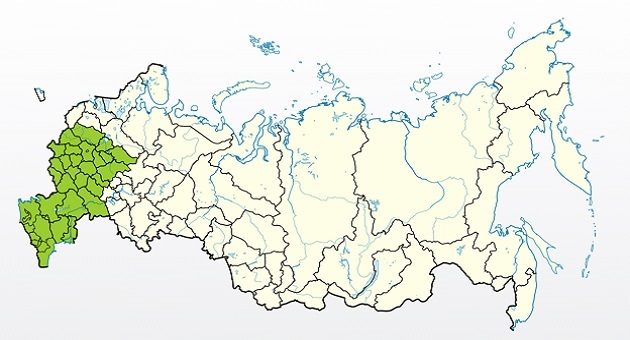
Growing regions
- Middle zone.
- North Caucasus.
- Crimea.
- Some northern regions.
Origin
This variety is one of those developed in the mid-twentieth century by the renowned biologist and breeder S. I. Isaev at the experimental station of Moscow State University named after M. V. Lomonosov. In 1961, he performed a complex cross between a hybrid of the Kitayka Bellefleur and the Papirovka variety with a senjatsa hybrid of the Tayezhny variety and the popular Borovinka variety. As a result, by the mid-1970s, the new variety, given the beautiful and poetic name of Uslada, was sent for field trials to farms in the Moscow region.
In the 1980s, the variety was designated an elite variety due to its exceptional performance. In 1996, it was added to the State Register of Breeding Achievements and zoned for the Central and Northwestern regions.
Content
Description of the apple tree variety Uslada
 An autumn variety with excellent flavor, high winter hardiness, early fruiting, and a fairly productive yield despite its compact size—all of these qualities characterize Uslada. However, many gardeners choose it for more than just this reason: the fruit from these trees has excellent flavor, is beautiful, can be transported long distances, and keeps well until mid-winter, or even longer, without losing its appeal. Uslada is recommended for growing in both small garden plots and large, intensive commercial plantings.
Apples: What they look like
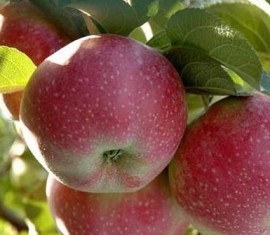
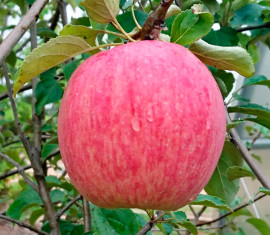
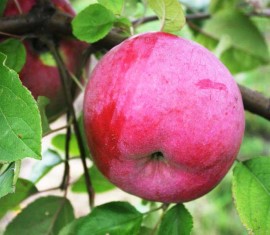
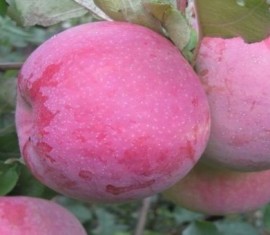
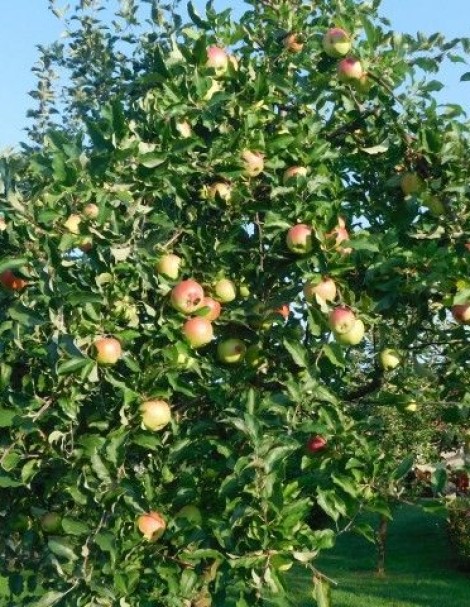
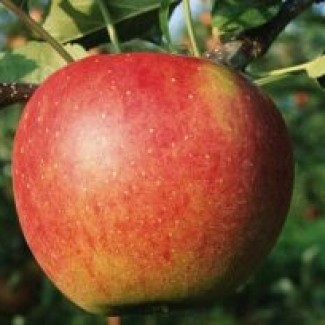
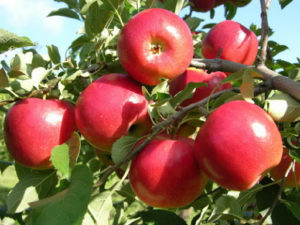 The variety's fruits can be medium to large in size, depending on environmental factors, care, shade, and canopy density. They grow to 120-160 grams in weight or 180-220 grams. The fruits are predominantly round, symmetrical, and irregular in size, sometimes slightly conical. The ribbing is very subtle and almost imperceptible.
The skin is firm but not thick, glossy, smooth, and green when young, turning greenish-yellow or yellow as it matures. The blush is bright red, crimson, or carmine, with a blurred, streaky, mottled pattern, and covers 75-95% of the surface. Subcutaneous dots are light green, numerous, small, and clearly visible. The chemical composition can be assessed by several indicators:
- P-active substances (catechins) – 150 milligrams.
- Ascorbic acid (vitamin C) – 20.9 milligrams.
- Total sugars (fructose) – 12.7%.
- Pectins (fiber) – 7.6%.
- Titratable acids – 0.58%.
The flesh is dense, very juicy, crisp, tender, and fine-grained. It's mostly pure white, but beneath the skin it can be covered with a network of reddish veins, giving it a pinkish tint. The texture is considered pleasant, and the flavor is harmonious, sweet and sour, with a dessert-like quality. Experts give these apples 4.6-4.8 points out of 5 for taste and appearance, respectively.
Apple tree Uslada: characteristics
Crown and root system
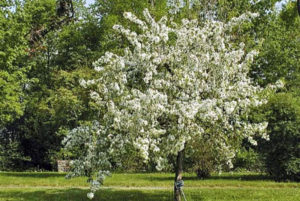 The variety is considered a medium-sized tree, as it grows to approximately 4-4.5 meters.With timely formative pruning, a height of 2.5-3 meters can be achieved, making maintenance and harvesting extremely easy. The crown tends to become denser, requiring regular pruning. When young, it has a pyramidal or oval shape, but with age, it becomes broadly oval and even spreading. Branches grow upward, adjoining the trunk at an acute angle, covered with steel-gray or gray bark, medium in thickness, and long.
The tree's leaves densely cover the branches, shading the sun. They are large, oval, slightly elongated, short-pointed, leathery, and dense, with coarse ribbing. They are rich or bright green, glossy, with a finely serrated, slightly wavy margin, and have a noticeable pubescence on the underside. The root system is robust, branched, and superficial, well adapted to seeking moisture in the soil.
Productivity and pollination
The variety is considered high-yielding, although it can't compare to, for example, Antonovka. However, given the small crown size, the yields seem quite substantial.
In one season, a mature apple tree of the Uslada variety can produce approximately 75-90 kilograms of beautiful, tasty and juicy fruits..
The variety is self-sterile, so don't expect apples unless there's another apple tree nearby that blooms at the right time for cross-pollination. Experienced gardeners recommend interplanting different varieties; this usually prevents any problems. It's helpful to have an apiary nearby, and to further attract bees, you can spray the blooming trees with sugar or honey syrup.
Winter hardiness and disease resistance
Uslada is frost-hardy, easily enduring all the hardships and privations of the temperate climate. It will withstand temperatures down to -25-32°C, even sudden temperature fluctuations, but it dislikes excess moisture. Harsher conditions can freeze young wood, not just shoots and buds, which will delay the tree's recovery. It is essential to protect this variety from frost according to all regulations to avoid its loss.
High resistance to scab, powdery mildew, and other fungal infections makes this variety a favorite in areas with frequent wet and rainy summers. However, preventative treatments are still recommended, as the variety lacks genetic immunity. Spraying apple trees with insecticides is also necessary to prevent insect attacks.
Rootstocks and subspecies
No subspecies of the Uslada apple tree exist in nature, nor are there any columnar varieties. Therefore, if you are offered something similar, it's best to refuse the purchase; it's likely a scam. However, it is possible to grow this variety on different rootstocks, achieving additional qualities inherent to them.
Features of growing Uslada
 Landing
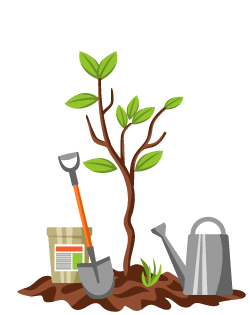 Landing
Basic conditions
- It's best to choose a sunny location with natural ventilation but no drafts. If possible, plant Uslada at a higher elevation, where it won't be shaded by other, taller trees. It will still bloom and bear fruit, but the apples will be much smaller.
- It's not recommended to plant this variety in low-lying areas, near natural bodies of water (streams, rivers, lakes), in floodplain meadows, or where the groundwater level rises above 2-2.5 meters. The trees will begin to root toward the moisture and then rot.
- It's best to select slightly acidic soil for Uslada. This could be sandy loam, clay loam, black soil, or even rocky slopes with only a little soil. If the acidity is too high, it's best to "quench" the soil with lime first.
- You need to prepare the planting holes in advance, ideally a season beforehand, but if you're late, you can dig holes 70-80 centimeters deep and the same in diameter 2-4 weeks in advance.
- Place some of the fertile soil from the top layer, additionally mixed with fertilizer, on the bottom, then add rocks or nut shells for drainage, and fill the entire thing with 35-55 liters of water. There is no need to cover the holes.
- The tree's root collar should always be left at least 5-7 centimeters above the surface to prevent rooting above this point. If this happens, all the properties and qualities of the rootstock will be completely lost.
- It's a good idea to immediately dig support beams or stakes into the holes for tying. These will help the tree maintain an upright position under any circumstances. Ideally, they should be positioned on the north side of the sapling.
- Place the seedling in a hole on the drainage surface, spreading the roots out so they can lie freely. If space is limited, the holes will need to be slightly widened. Before planting, inspect the rhizomes and prune out any damaged, dry, or obviously diseased or non-viable roots.
- The tree is placed upright, covered with soil, and compacted by hand, being careful to prevent air pockets from forming. An earthen embankment is built around the tree's circumference, approximately 45-60 liters of water are poured into it, and the surface is mulched.
Landing dates
This variety roots well, so it can be planted either in early spring, after the threat of frost has passed, or in the fall. In this case, it's essential to wait until the leaves have completely fallen, but leave a window of 2-3 weeks before the first frost. With a closed root system, seedlings in pots, containers, or special bags that don't require disposal can be transplanted to their permanent location at almost any time, even in the midst of the summer heat.
Protection from frost and rodents
Trees of this variety are quite resilient to low temperatures and sudden, sudden fluctuations. However, it's still a good idea to properly prepare them for winter. First, stop watering as early as the second half of September; this will help stop the sap from flowing in the trunk. Trunks are wrapped with burlap, tarpaulin, roofing felt, agrofibre, or old tights, while dwarf varieties are covered with a spherical covering.
Whitewashing tree trunks with lime will help repel insects. This will prevent them from settling in cracks and crevices in the bark, near the roots, in crevices, and crevices, where they can damage not only the foliage and fruit but also the wood itself in the spring. Coating the lower part of the trunk with grease, melted animal fat, or other pungent aromatic substances also works well to repel rodents.
Tree care
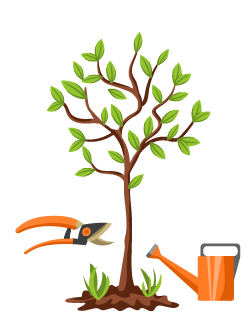 Tree care
Loosening the soil, watering: proper agricultural technology
You should dig around the trunk once or twice a year, and only in the first few years. Although the tree prefers aerated soil, the area around the trunk can be covered with sod; this won't harm the apple tree at all. In the early stages, you can hoe the soil and weed several times a season.
Watering should also be done regularly when young, about once every 2-3 weeks. If the weather is very hot and dry, even mature trees can benefit from a 15-20 liter evening irrigation at the base, or even better, a drip irrigation, if available. Fertilizer can be added to the soil along with the water to promote growth and fruiting.
Pruning: simple crown shaping
You can begin shaping strong seedlings from the first year, but if the tree is slightly weakened, it's best to postpone the process until the second or third year. The Delight tree tends to become dense, but you can shape it into almost any desired form. The key is to keep the skeletal branches spaced well apart at different heights. You'll need to strictly adhere to the same pattern in the future, so it's worth memorizing your steps.
In the fall, just before wrapping up for the winter, a sanitary inspection and pruning are carried out. This involves cutting off all dry, broken shoots, which will only hinder the tree next season, robbing it of its vital energy without providing any benefit. The cut wounds are sealed with garden pitch, paint, drying oil, or even just plain swamp water.
Reproduction
- Rooting cuttings.
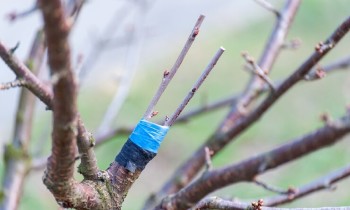
- Grafting by buds or cuttings.
- Growing from seeds.
- Clones (layering).
Diseases and pests
- Powdery mildew.
- Scab.
- Cytosporosis.
- Green aphid.
- Hawthorn.
- Codling moth.
Ripening and fruiting of Delight
The beginning of fruiting
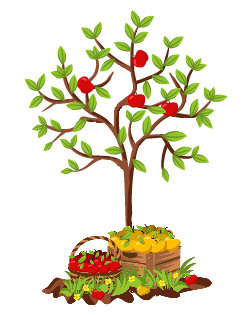 The beginning of fruiting
This variety is considered early-bearing, meaning the first apples can be harvested approximately 4-5 years after planting. However, flowers may appear as early as 2-3 years after planting, but they should not be allowed to develop. It's best to pluck all buds, allowing the tree to develop the necessary skeletal shoots, green mass, and rhizome.
Flowering period
Despite the early ripening of the apples, the tree doesn't bloom very early. Around the end of May, the buds are just beginning to open. They fully bloom in early June, a process that lasts for about 10-16 days, quite a long time. The flowers are snow-white, but sometimes slightly pinkish. They are very delicate, with thin, almost weightless petals, fragrant, and densely cover the branches.
Fruiting and growth
Uslada grows quite quickly. In just 8-10 years, it can reach its full size, especially with regular crown shaping. It can grow approximately 35-55 centimeters per year. Fruiting also increases rapidly. From an initial harvest of 5-10 kilograms, by the 7th to 10th year, it will yield a full harvest of 60-75 kilograms of fragrant and juicy fruit.
Those who appreciate a tart flavor begin picking apples from the vine as early as mid- to late August. At this point, they're perfect for compotes or sour juices. However, storing them requires waiting until early September, when the sugars in the fruit carmelize. The apples don't have a long shelf life, only 2-3 months, but that's plenty of time to enjoy their fresh flavor.
Top dressing
- Mineral complexes.
- Chicken manure.
- Wood ash.
- Ammonium nitrate.
- Manure.
- Compost.
- Humus.
What to do if it doesn't bloom or bear fruit
- Provide watering.
- Check for pests and diseases.
- Transplant to a sunnier location.
- Fertilize.
Why do apples fall?
- Natural factors.
- Overripe.
- Pests.
- Diseases.
Please leave your feedback on the Uslada variety so that other gardeners can learn about your experiences growing these trees.